

作者:adsturbo.ai|发布日期:2026-09-20|更新日期:2026-09-20
A pre-owned luxury condition video ads maker helps resale sellers turn static inventory photos into close-up, evidence-led product videos. The strongest videos do not hide wear: they show scratches, corner rub, hardware finish, interior details, movement, and relevant authenticity cues in a controlled sequence that buyers can evaluate.
For secondhand handbags, watches, jewelry, shoes, and accessories, the goal is not to make every item look new. The goal is to make its actual condition easier to understand before purchase.
What is a pre-owned luxury condition video ads maker?
A pre-owned luxury condition video ads maker is a workflow or tool for producing resale videos that combine product presentation with transparent condition disclosure. It typically uses product photos, inspection notes, reference footage, voiceover, captions, and close-up motion to explain what the buyer is receiving.
The practical distinction is important:
- A promotional product video emphasizes beauty, status, and desirability.
- A condition video emphasizes evidence, context, and accurate expectations.
- A trust-focused resale ad combines both without making unsupported authenticity claims.
Marketplace requirements increasingly expect sellers to disclose defects and condition accurately. For example, TikTok Shop’s US pre-owned product requirements call for clear condition disclosures and authentication documentation for eligible categories. The policy also warns against unsupported claims such as “guaranteed authentic.” (seller-us.tiktok.com)
A video can support buyer confidence, but it should never be presented as a substitute for professional authentication.
Why video is useful for secondhand luxury condition disclosure
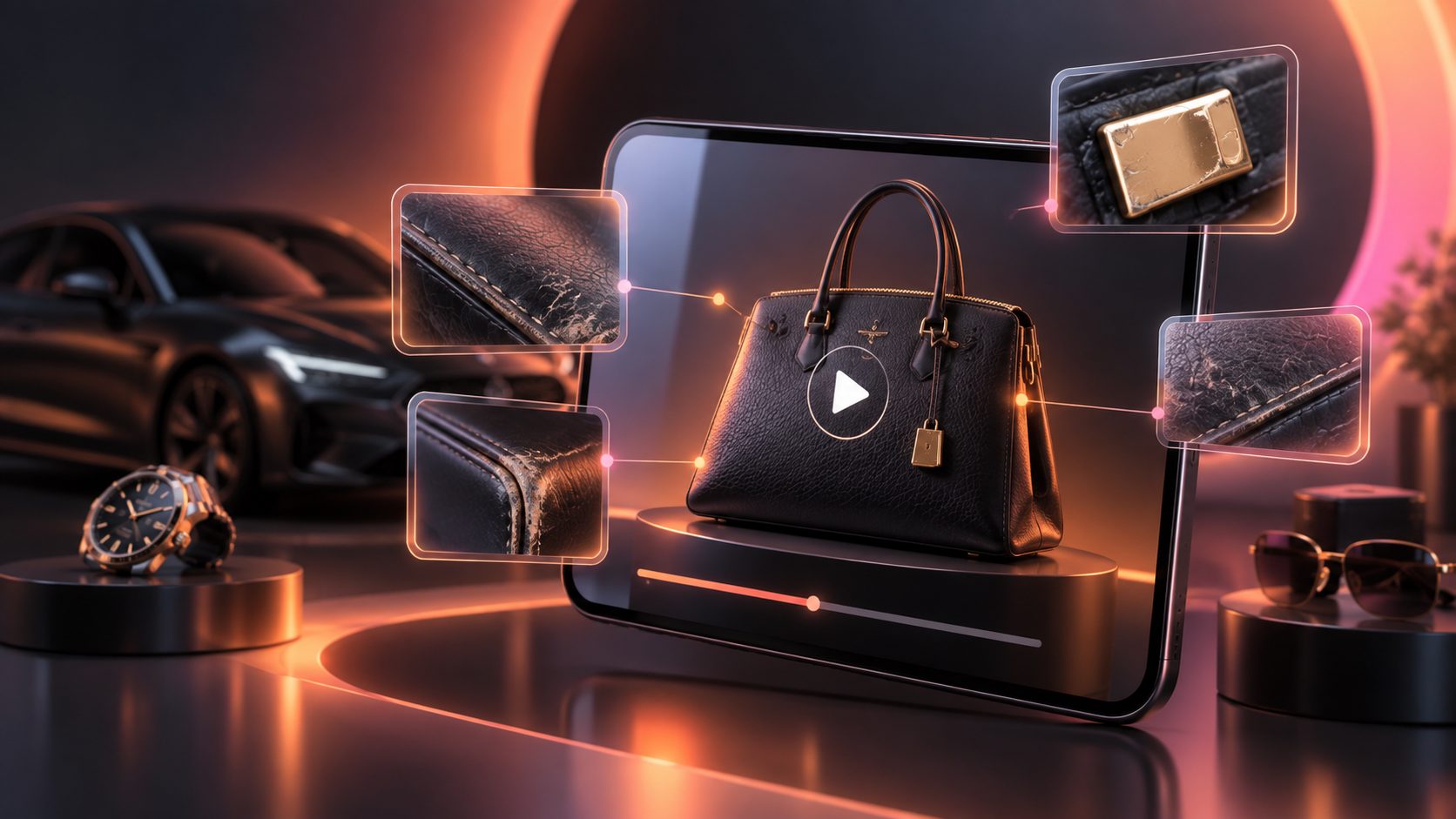
Still images can make metal look uniform, soften fine scratches, or hide how a closure works. Motion adds a second layer of evidence because light changes across the surface while the item moves.
A useful resale condition video can reveal:
| Detail to show | What buyers can evaluate |
|---|---|
| Clasp, turnlock, or zipper movement | Alignment, stiffness, wobble, and function |
| Chain, buckle, or logo plate under moving light | Hairline scratches, tarnishing, and plating wear |
| Corners and edges from several angles | Scuffing, cracking, peeling, or color loss |
| Interior and lining | Stains, odor-related disclosures, pen marks, and shape |
| Serial, date, or brand markings | Supporting details for a broader authentication review |
| Handles, straps, and feet | Darkening, stretching, deformation, and contact wear |
The highest-value shots are not necessarily the most glamorous. A slow macro pass across a worn corner may answer more buyer questions than a wide beauty shot.
A resale hardware video can show condition consistency and mechanical behavior, but it cannot independently prove authenticity. Hardware color, engraving, and construction are supporting clues, not a complete authentication process. (gorgeautiful.com)
The Condition Proof Ladder: an original framework for resale videos
A practical way to structure these videos is the Condition Proof Ladder. Each level answers a different buyer question, moving from identity to risk.
1. Identity: What exactly is the item?
Open with the product category, brand, model name if verified, size, color, and included accessories. Avoid adding details that have not been confirmed by the seller’s inventory records.
2. Overview: What does the item look like as a whole?
Show the front, back, sides, base, and interior. Use even lighting and a stable camera path so the viewer can understand the item’s proportions and overall shape.
3. Wear: Where are the visible imperfections?
Use close-up shots for corners, handles, straps, edges, lining, and hardware. Pair each visual with precise wording such as “light surface scratching on the clasp” or “visible corner rub on the lower front edge.”
4. Function: Does anything operate differently?
Demonstrate the zipper, clasp, lock, snap, strap adjustment, or watch crown only when safe and appropriate. A functional movement clip is more useful than simply claiming that the feature works.
5. Evidence boundary: What does the video not prove?
End with a clear boundary. The video can document visible condition and handling, but it does not replace authentication, valuation, or a marketplace inspection process.
This framework creates an information hierarchy instead of a generic slideshow. It also reduces a common resale problem: leading with polished lifestyle footage and leaving the buyer to discover important defects in the description.
How to create a condition-first luxury resale video
Step 1: Build an inspection shot list
Before producing the video, create a checklist for the specific item category.
For a luxury handbag, include:
- Front, back, sides, base, and interior
- Corners, piping, handles, straps, and edge paint
- Logo, closure, zipper pulls, feet, chain, and other hardware
- Serial, date, or production markings where applicable
- Accessories, packaging, dust bag, receipt, or missing inclusions
- Repairs, alterations, odor concerns, stains, and shape loss
Condition guides used by resale marketplaces commonly emphasize these areas because they affect both buyer expectations and perceived value. (middlewhomarket.com)
Step 2: Film micro-details with controlled movement
Use slow camera movement rather than fast pans. Light should travel across reflective hardware so hairline marks become visible without creating harsh glare.
For difficult details, create two versions:
- Evidence clip: neutral lighting, slow movement, no dramatic music.
- Sales clip: product styling, benefit-led text, and a clearer call to action.
Keeping those purposes separate helps sellers avoid making a condition disclosure feel like an apology or making a promotional video appear misleading.
Step 3: Add captions that describe, not exaggerate
Good captions are specific and observable:
- “Light scratches visible on the front clasp”
- “Minor darkening on the top handles”
- “Interior includes one small ink mark”
- “Strap and closure shown in motion”
- “Authentication documentation available with the listing”
Avoid unsupported wording such as “flawless,” “investment grade,” or “guaranteed authentic” unless the claim is supported by the relevant marketplace or authentication process. TikTok Shop’s US policy specifically restricts unverifiable claims in pre-owned luxury listings. (seller-us.tiktok.com)
Step 4: Produce platform-ready versions
A single source video can be adapted into:
- 9:16 vertical video for TikTok, Instagram Reels, and YouTube Shorts
- 1:1 square video for product feeds and marketplace placements
- 16:9 video for landing pages, YouTube, and desktop viewing
AdsTurbo supports product video creation, video subtitles, background replacement, AI upscaling, character replacement, and video translation. Its Video Subtitle tool can generate synchronized captions and export either a captioned video or a separate subtitle file. For multilingual resale catalogs, the same condition script can be localized into additional languages while preserving the original inspection sequence.
A practical 30-second script structure
A short condition-focused ad can follow this sequence:
- 0–3 seconds: Show the full item and identify the product category.
- 3–8 seconds: Present front, back, base, and overall shape.
- 8–15 seconds: Move through the most important wear points.
- 15–21 seconds: Demonstrate hardware, closure, strap, or functional details.
- 21–26 seconds: Show interior, markings, and included accessories.
- 26–30 seconds: State the condition summary and direct viewers to the full listing.
The opening should not promise perfection. It should promise clarity. For example: “See the actual hardware wear before you buy.”
For sellers managing many SKUs, AdsTurbo can support batch-oriented production from product images and structured selling points. Its Product Image workflow accepts JPG and PNG product images, analyzes product shape, color, and category, and can generate multiple ecommerce image formats. That can provide the visual base for a repeatable resale content workflow.
For more advanced creative testing, the ecommerce video ads ROAS testing framework offers a useful way to separate creative variables such as opening hook, proof sequence, caption style, and call to action.
How to improve buyer trust without overclaiming
Trust is created by consistency between the video, listing copy, photos, and authentication documentation.
Use one shared condition record for every channel. The same item should not be described as “excellent” on one marketplace and “very good” on another without an explanation. A structured record should include:
- Condition grade
- Specific flaws
- Functional checks
- Measurements
- Included and missing accessories
- Authentication status
- Video file or inspection reference
This “single source of truth” approach makes it easier to reuse inspection information across product pages, social ads, and customer service responses. It also reduces the risk of a polished ad contradicting the written listing.
If the item has a meaningful flaw, show it early enough that the buyer does not feel it was deliberately hidden. Transparency can make the video less traditionally glamorous, but it makes the sales message more credible.
For sellers who also need multilingual campaigns, ecommerce video ad translation for localization can help adapt voiceover and subtitles for regional audiences. Keep product names, condition grades, and defect descriptions consistent during translation.
Frequently Asked Questions
Can a condition video prove that a luxury item is authentic?
No. It can show visible markings, construction details, and hardware behavior, but authentication requires a qualified process appropriate to the product and marketplace.
Should sellers show scratches in paid ads?
Yes, when the scratches materially affect the buyer’s understanding of condition. Showing them briefly and explaining them accurately is usually more credible than relying on heavily edited beauty footage.
What is the best lighting for luxury hardware?
Use soft, even lighting combined with a slow change in angle. The objective is to reveal surface wear without creating glare that obscures the finish.
Can one video work for every resale platform?
The source footage can be reused, but the edit should be adapted for vertical, square, and horizontal placements. Captions, opening speed, and text size should match the platform.
How can sellers produce these videos at scale?
Create a repeatable inspection checklist, capture standardized product images, maintain a condition record, and generate variations from the same verified facts. AdsTurbo supports product video, subtitles, translation, upscaling, and related ecommerce creative workflows.
Final takeaway
A strong pre-owned luxury condition video ads maker workflow treats video as evidence, not decoration. Show the item at full scale, move slowly across wear points, demonstrate relevant hardware, describe defects precisely, and keep authenticity claims within the limits of available documentation.
That approach gives buyers a clearer decision path and gives sellers reusable content for listings, social ads, marketplaces, and multilingual campaigns.
For product-focused creative production, the luxury jewelry macro video ads workflow provides another useful example of how close-up movement can preserve detail while keeping the product visually appealing.