PTC Space Heater Thermal Imaging Video Ads: Build a Credible 15-Second Test

Summarize with
Summary
Learn how to turn PTC heater thermal imaging and timed warm-up tests into credible 15-second Amazon and TikTok video ads. Build your proof-led creative.
By adsturbo.ai | Published 2026-10-27 | Updated 2026-10-27
PTC space heater thermal imaging video ads work because they show heat instead of merely claiming it. A short thermal-camera sequence, a controlled warm-up timer, and a clear product demonstration can make an Amazon listing or TikTok Shop creative feel more trustworthy—provided the test is repeatable and the claims stay within the evidence.
What makes thermal imaging useful in a heater ad?
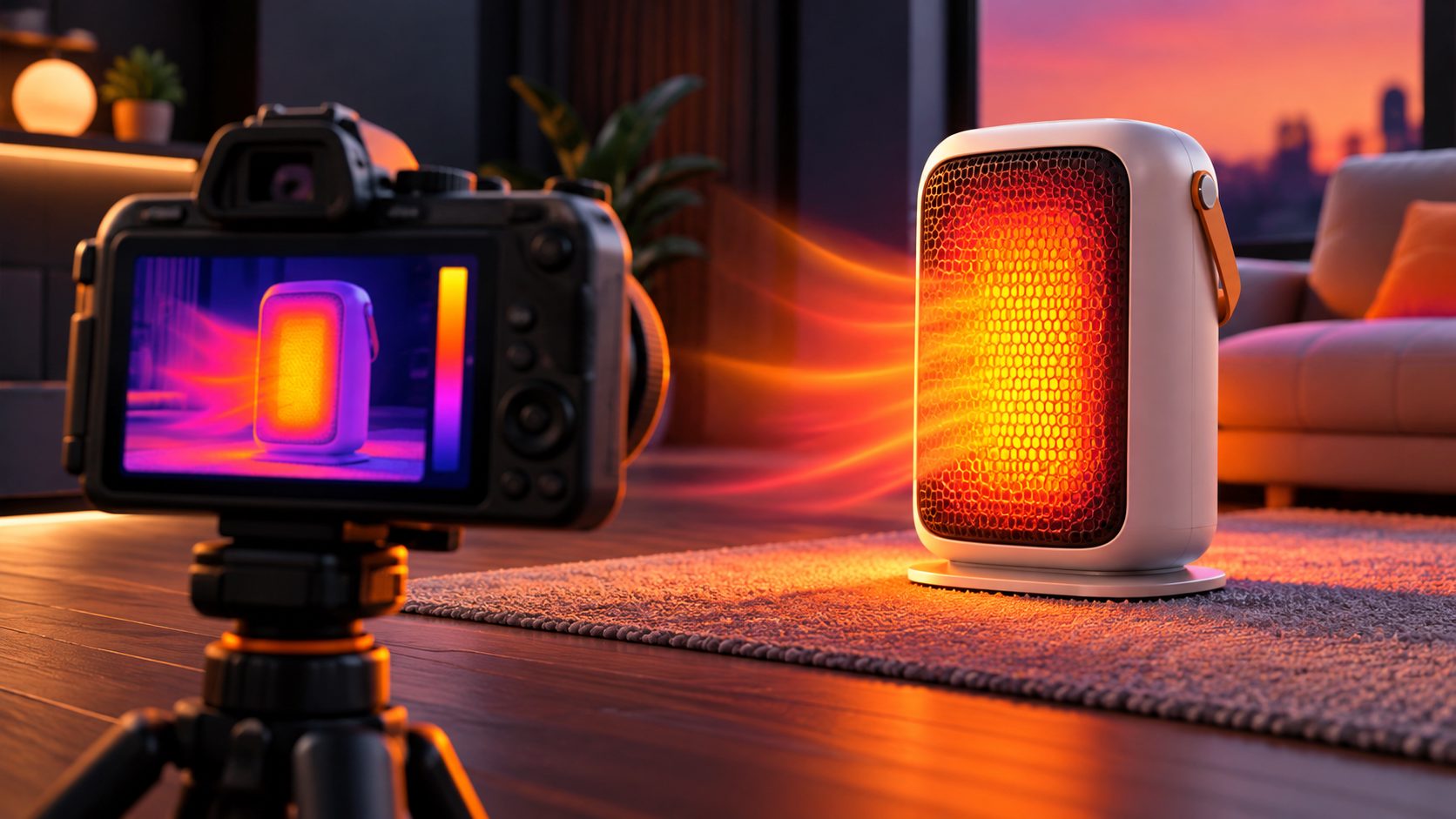
Thermal imaging is a visual method for showing relative heat distribution across a scene. In a space-heater video, it can reveal the warm-air plume, heating-zone spread, grille temperature changes, and cold areas that remain outside the airflow.
The strongest use is not “look how hot this gets.” It is a before-and-after comparison with visible testing conditions:
- Room temperature before startup
- Distance from the heater to the target area
- Heater mode and power setting
- Elapsed time
- Thermal image or temperature overlay
- A simple explanation of what changed
Professional heater testing commonly combines thermal cameras with temperature sensors and fixed time intervals. For example, TechGearLab describes a five-minute direct-heat test using sensors positioned at different points in front of a heater, while its thermal camera records the airflow pattern. (techgearlab.com)
That approach provides a better creative model than showing a random infrared clip with no baseline.
How to design a credible warm-up test
A useful ad test should answer one question: How quickly and evenly does this heater deliver noticeable warmth in a defined setup?
Use this five-step filming method:
- Choose a controlled space. Record the room size, starting temperature, and whether doors or windows are open.
- Mark the camera position. Keep the thermal camera at the same distance and height for every shot.
- Set a fixed measurement period. Use 5, 10, or 15 minutes rather than an undefined “fast heating” claim.
- Capture both thermal and normal video. Thermal footage proves heat distribution; normal footage shows controls, design, and use context.
- Repeat the test. Run at least three trials under similar conditions and report the range instead of selecting only the best result.
A practical original framework for ecommerce sellers is the 3-Point Heat Proof:
| Proof point | What to show | Why it matters |
|---|---|---|
| Startup | Thermal image at 0 seconds | Establishes the baseline |
| Direction | Heat plume at 5 seconds and 15 seconds | Shows airflow behavior |
| Result | Same frame after a defined interval | Supports a measurable comparison |
Do not present a room-temperature increase as a universal promise. Room insulation, ceiling height, airflow, humidity, thermostat cycling, and camera emissivity settings can change results. A test result should describe the setup, not imply that every buyer will experience the same outcome.
A 15-second script for Amazon and TikTok Shop
A short heater ad needs proof before explanation. The first three seconds should create a visual contrast, not introduce a long product description.
Recommended 15-second structure
0–2 seconds — Cold-to-warm hook
Show a normal shot of the heater in a cool room, then cut immediately to the thermal view.
2–5 seconds — Product action
Show the power button, mode selection, and airflow direction. Keep the product visible so the thermal footage does not feel disconnected from the item being sold.
5–9 seconds — Timed result
Add a simple overlay such as: “Thermal view after 5 minutes.” Use the actual test time and avoid unsupported superlatives.
9–12 seconds — Practical use case
Show a desk, bedroom corner, workspace, or other relevant setting. Demonstrate where the heat is directed rather than suggesting that a small heater replaces whole-home heating.
12–15 seconds — CTA and product detail
End with the product, a concise benefit, and the shopping action: “See specifications” or “Shop the tested model.”
A proof-led voiceover could read:
“Cold air at startup. Watch the heat spread in real time. Tested from the same position for five minutes. Check the product details before choosing your heater.”
The wording is deliberately restrained. It communicates a test without claiming a guaranteed temperature, room size, energy saving, or safety outcome that the footage does not establish.
Which claims should the video avoid?
Thermal footage is persuasive, but it does not prove every performance or safety claim. Avoid turning a visual demonstration into an unsupported promise.
Be careful with:
- “Heats the entire house”
- “Warms any room in seconds”
- “Uses less electricity than every other heater”
- “Cannot overheat”
- “Completely safe”
- “Guaranteed to lower your heating bill”
A thermal camera shows surface or apparent temperature patterns. It does not independently validate electrical safety, long-term durability, energy cost, or whole-room comfort. For safety-related messaging, use only documented product specifications and applicable manufacturer instructions. The U.S. Consumer Product Safety Commission has separately examined portable electric heaters and plug heating under electrical-load conditions, which illustrates why thermal visuals should not be treated as a complete safety certification. (cpsc.gov)
For a stronger listing, pair the video with product documentation, operating instructions, and clearly stated limitations.
How to adapt one test for Amazon, TikTok, and Reels
The test can remain the same while the edit changes by platform.
Amazon product video
Prioritize clarity over speed:
- Keep the heater visible in most shots.
- Use readable captions for test conditions.
- Show the product controls and form factor.
- Avoid aggressive claims that may conflict with the listing details.
- End on a clean product frame rather than a fast meme-style CTA.
Amazon category benchmarks show that leading space-heater listings often use substantial visual content: a 2026 snapshot from Cohley reported a median of seven gallery images, brand video on seven of ten top listings, and creator videos on ten. (cohley.com)
TikTok Shop video
Lead with movement and contrast:
- Start with the thermal transition.
- Use larger captions and faster cuts.
- Show a relatable cold-room scenario.
- Keep the product action easy to understand without sound.
- Test multiple hooks using the same verified footage.
Useful variations include “Cold corner test,” “Five-minute thermal check,” and “What the airflow actually reaches.” Each version should preserve the same test conditions so creative performance can be compared fairly.
AdsTurbo supports product video creation from JPG or PNG product images, along with ad copy and creative variations. For a more complete workflow, combine the proof footage with a 15-second product demonstration script framework and use 4K video upscaling for ecommerce ads when the thermal footage needs clearer export quality.
A production workflow for sellers
A repeatable workflow reduces editing time and protects claim accuracy:
- Collect evidence: Record the heater, room setup, test duration, starting conditions, and thermal footage.
- Extract the strongest proof: Select one clear temperature or visual change instead of stacking several confusing metrics.
- Create the base edit: Build a 15-second version with normal footage, thermal footage, captions, and CTA.
- Generate variants: Change only one element at a time—hook, voiceover, background, caption style, or final CTA.
- Localize: Produce translated audio and subtitles for additional markets while preserving the original test numbers.
- Review claims: Confirm every number, time reference, and performance statement against the recorded test.
AdsTurbo provides video subtitles with automatically transcribed, time-synchronized captions and supports subtitle downloads or separate subtitle-file exports. Its video tools also include translation, upscaling, motion control, character replacement, and ad-cloning workflows for adapting a tested creative into multiple versions.
Frequently asked questions
Does thermal imaging prove that a heater warms an entire room?
No. It shows heat distribution in the camera’s field of view. A room-wide claim requires a controlled test that measures multiple locations over a defined period.
How long should a heater video ad be?
For a short-form ecommerce ad, 15 seconds is a practical starting point. The key is to show the baseline, heating action, timed result, and CTA without hiding the test conditions.
Can a thermal camera replace a thermometer?
Not always. Thermal cameras visualize temperature patterns, but readings can vary with surface material, reflections, distance, and emissivity settings. Use a calibrated thermometer or sensor when a precise numeric claim matters.
What is the best hook for TikTok Shop?
A visible contrast usually works better than a generic product introduction. Try a cold-room frame followed by a thermal view, then explain the test duration in plain language.
Can one test produce multiple ad versions?
Yes. A single verified test can support different edits for Amazon, TikTok Shop, Instagram Reels, and paid social. Keep the evidence unchanged while testing the hook, pacing, captions, and CTA.
For sellers turning product demonstrations into scalable creative, AdsTurbo’s ad-cloning workflow can help restructure a reference ad’s pacing, scene logic, and CTA pattern. The most credible result still comes from the same foundation: a clearly defined test, honest measurement, and visual proof that matches the claim.