Dash Cam Night Vision Comparison Video Ad: A Seller’s Creative Framework

Summarize with
Summary
Build a credible dash cam night vision comparison video ad with dual-screen proof, low-light testing, and AI-ready production steps. Create your next variation with AdsTurbo.
By adsturbo.ai | Published 2026-10-27 | Updated 2026-10-27
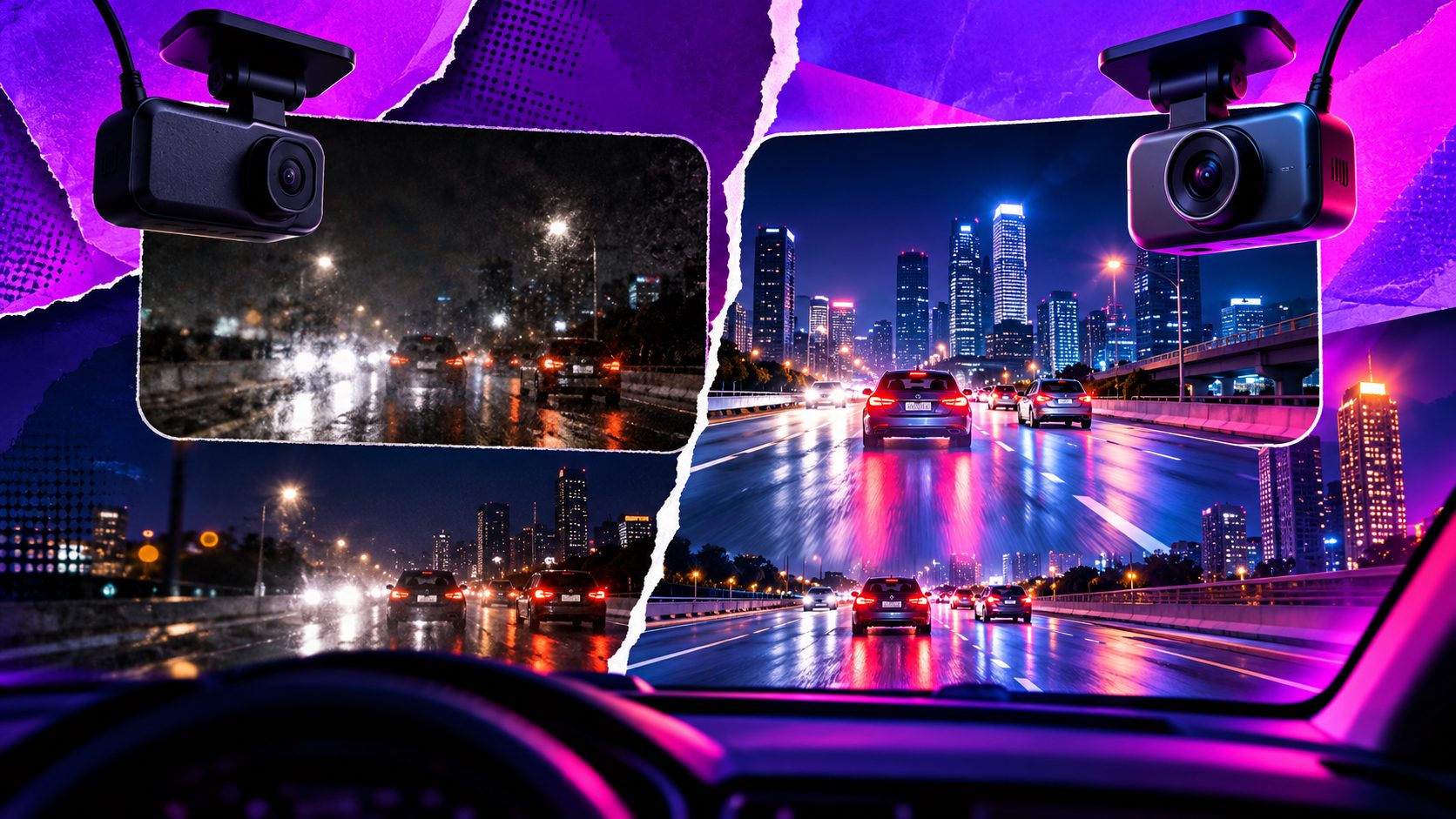
A dash cam night vision comparison video ad should do more than show a brightened road scene. It should help shoppers judge plate visibility, headlight control, rear-camera coverage, and real-world clarity through a fair, side-by-side demonstration.
For Amazon and direct-to-consumer automotive sellers, the strongest format is a short proof-led video: the same route, the same driving conditions, and synchronized front-and-rear footage. That structure turns a technical specification into visual evidence.
What makes a dash cam night vision comparison video persuasive?
A persuasive comparison video answers one question quickly: what can the buyer actually see at night? The first 3–5 seconds should establish the test condition, while the next few seconds should reveal the visual difference without excessive effects or unsupported claims.
Top-ranking dash cam guides commonly focus on sensor quality, lens aperture, HDR or WDR processing, resolution, bitrate, and channel coverage. Their central lesson is consistent: 4K alone does not guarantee better nighttime footage. A high-resolution camera with poor light gathering or aggressive processing may perform worse than a lower-resolution model with cleaner shadow detail. (caranddriver.com)
For a product ad, translate those technical points into three visible tests:
- Dark-road detail: Can the viewer distinguish lane markings, signs, or parked vehicles?
- Headlight recovery: Does glare wash out the scene?
- Dual-screen consistency: Does the rear or interior view remain useful rather than becoming a dark secondary window?
This is the first information gain for sellers: do not structure the video around “night vision on” as a vague feature. Structure it around evidence the customer can inspect.
Which scenes belong in a dual-screen night comparison?
The best sequence uses controlled contrast instead of random driving footage. A practical 20-second storyboard can be built as follows:
| Time | Visual | On-screen message |
|---|---|---|
| 0–2 sec | Split-screen front and rear view | “Night test: same road, same moment” |
| 2–6 sec | Unlit or low-light road | “Shadow detail comparison” |
| 6–10 sec | Oncoming headlights | “Check glare and highlight control” |
| 10–14 sec | Street sign or parked vehicle | “Look for readable detail” |
| 14–17 sec | Rear-camera view | “Front + rear coverage” |
| 17–20 sec | Product close-up and CTA | “See more clearly after dark” |
The split-screen should remain stable. Avoid switching between cameras so quickly that shoppers cannot tell which view they are evaluating.
A useful production rule is to keep one visual variable per scene. If the first scene demonstrates darkness, do not also add rain, heavy motion blur, dramatic transitions, and color grading. Otherwise, the viewer cannot tell whether the camera or the editing created the difference.
How should sellers test low-light footage before editing?
A credible ad does not need a laboratory, but it does need repeatable capture conditions. Use the same windshield position, route, speed range, mounting angle, and export settings for every comparison clip.
A simple seller-side test plan:
- Record one route at dusk, on a lit urban road, and on a darker road.
- Capture front and rear footage at the same time.
- Include one headlight-heavy scene and one low-contrast scene.
- Freeze the footage briefly on a sign, vehicle outline, or lane marking.
- Compare the original files before adding color correction.
- Label footage accurately instead of claiming a result that the frame does not show.
The most important editorial distinction is between visibility and readability. A brighter image may make the road look more comfortable while still failing to preserve license-plate detail. Conversely, sharpening can make edges appear clearer while introducing halos or artificial texture.
For Amazon listings, keep claims tied to visible demonstrations. “Shows more road detail in this test” is safer and more precise than “best night vision,” unless an independently documented test supports the broader claim.
What is the best script structure for an Amazon or Shopify ad?
A high-performing script should connect the visual proof to a buyer problem rather than list specifications.
Hook:
“Night driving is where dash cams reveal their real difference.”
Problem:
“Dark roads and oncoming headlights can hide important details.”
Proof:
“Here is the same moment shown side by side from the front and rear cameras.”
Interpretation:
“Compare shadow detail, glare, and how much of the road remains visible.”
Product context:
“Use the footage to evaluate the camera in the conditions you actually drive.”
CTA:
“See the full comparison and choose the coverage that fits your vehicle.”
This approach is particularly useful for automotive products because shoppers often need confidence before purchase. It avoids relying on a presenter’s opinion and lets the footage carry the argument.
For additional product-page creative, pair the night test with an auto parts fitment compatibility video ad framework. A separate installation or mounting clip can answer a different conversion objection without overcrowding the comparison video.
How can AI scale night comparison ad variations?
AI is most useful after the proof footage is organized. Start with one verified comparison sequence, then produce controlled variations for different audiences and placements.
AdsTurbo supports ad cloning, motion control, lip sync, character replacement, video translation, AI upscaling, background replacement, and subtitle generation. Its Ad Clone workflow can use a reference video to reconstruct the script, pacing, shot logic, and CTA structure for new versions. That makes it suitable for testing different hooks while preserving the core evidence.
A practical variation matrix might include:
- Buyer angle: night driving, parking protection, family travel, or rideshare use.
- Format: 9:16 for short-form video, 1:1 for feeds, and 16:9 for product pages.
- Narration: concise voiceover, on-screen captions, or presenter-led explanation.
- Proof order: front-first, rear-first, or headlight-glare-first.
- Language: English plus localized subtitles or translated voiceover.
AdsTurbo Video Subtitle can automatically transcribe speech, create synchronized captions, and export either a captioned video or a separate subtitle file. For sharper footage, AdsTurbo Video Upscaling supports before-and-after previewing and 4K video export, which can help when source clips were compressed before editing. See the 4K video upscaling guide for ecommerce ads.
What should sellers avoid in a night-vision comparison ad?
Avoid these common creative failures:
- Overexposure: Brightening the entire frame can erase the difference between useful detail and artificial lift.
- Unmatched footage: Comparing different roads, speeds, or weather conditions weakens trust.
- Fast cuts: Rapid edits prevent viewers from evaluating the image.
- Unsupported superlatives: “The clearest,” “best,” or “sees everything” require strong evidence.
- Tiny captions: Mobile viewers need readable labels for front, rear, test condition, and product version.
- Hidden processing: Heavy sharpening, denoising, or color changes should not make the comparison misleading.
- No product connection: A test without a clear product close-up, mounting shot, or CTA may earn attention without supporting conversion.
For a broader ecommerce production system, combine the comparison with a background replacement workflow for product ads or a product video workflow for ecommerce listings.
Frequently asked questions
Is a split-screen format better for dash cam night footage?
Usually, yes. Split-screen footage lets viewers compare the same moment without relying on memory. Keep both panels synchronized and label each camera clearly.
Should a night-vision ad focus on resolution or sensor performance?
Focus on visible outcomes first. Resolution matters, but low-light results also depend on the sensor, lens, processing, glare control, and compression. A comparison should show what those factors produce on screen.
How long should the video ad be?
A 15–30-second version is a practical starting point for short-form placements. Use the first few seconds to establish the test, then reserve enough time for viewers to inspect the footage before the CTA.
Can one comparison video be adapted for multiple channels?
Yes. Reframe the same verified footage into vertical, square, and landscape versions. Keep the comparison intact, then adjust captions, pacing, and CTA placement for each channel.
How can sellers localize the ad?
Create translated voiceover or subtitles while preserving the original test footage. This allows the visual proof to stay consistent across markets while adapting the explanation to local shoppers.