

By adsturbo.ai | Published 2026-10-10 | Updated 2026-10-10
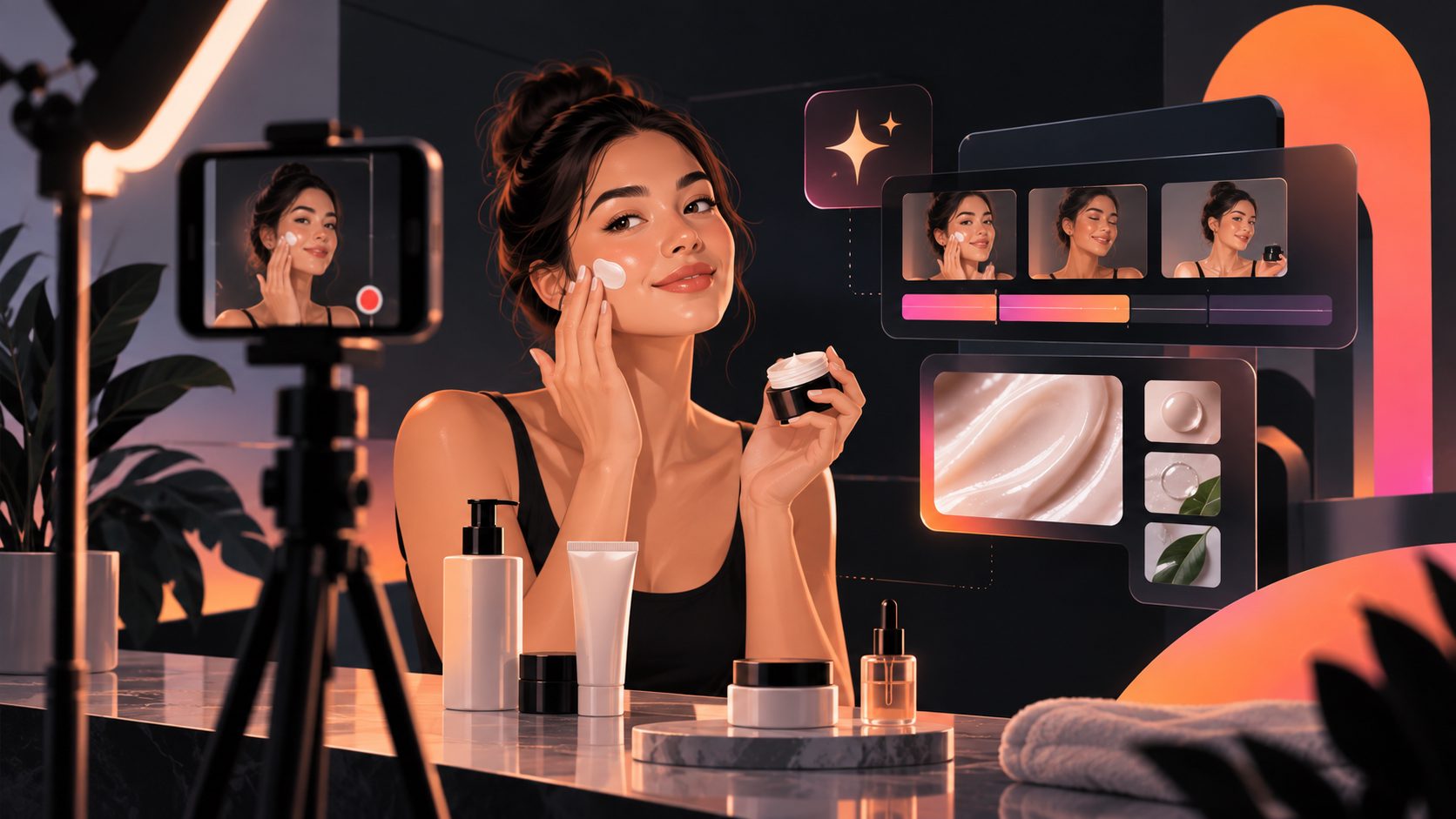
Skincare UGC video ads should not begin with generic praise. They should begin with a visible product question: How does the formula dispense, spread, absorb, layer, or finish? This texture-first approach helps ecommerce teams create credible short-form variations without waiting for influencers while keeping AI presenters in an honest role—not pretending to be customers.
What makes a skincare UGC ad believable?
A believable skincare UGC ad shows observable product behavior before making a benefit claim. Viewers should be able to inspect the packaging, formula consistency, application method, finish, and position in a routine. These details reduce uncertainty more effectively than an actor saying the product is “amazing.”
Useful proof depends on the product:
- Serum: drop speed, spread, tackiness, and layering
- Moisturizer: density, absorption, and visible finish
- Cleanser: amount used, lather, and rinse sequence
- Face mask: coverage, application thickness, and removal
- Beauty device: setup, contact points, and actual controls
UGC-style content can be creator-shot, customer-supplied, or brand-produced. What matters is not simulated amateurism but clear evidence presented in a native social format. A generated presenter can explain a routine or introduce a product, but should not invent personal use, clinical outcomes, or a customer history.
How do you build a texture-first skincare storyboard?
Build the ad around one product question, one demonstration, and one next action. A compact 15–20 second storyboard should show the concern, provide tactile evidence, explain where the product fits, and end with a low-friction call to action.
-
0–2 seconds: Name the friction.
Try “Why does my moisturizer pill under makeup?” rather than opening with the brand logo. -
2–5 seconds: Show the package in use.
Film a full pump, drop, scoop, or spray without hiding the action behind a cut. -
5–9 seconds: Demonstrate texture.
Spread the formula under neutral light so viewers can see thickness, slip, and coverage. -
9–13 seconds: Show the immediate finish.
Capture shine, residue, tint, or absorption without smoothing filters. -
13–16 seconds: Place it in the routine.
Explain whether it goes after cleansing, before moisturizer, or under makeup. -
16–20 seconds: Close with a bounded CTA.
Invite viewers to inspect ingredients, see the routine, or choose the appropriate variant.
For more complex products, adapt the inspection-led structure used in this 12-shot ecommerce authentication video guide.
How can you produce variations without booking creators?
Separate the presenter layer from the product-proof layer. Use AI actors for hooks, explanations, multilingual narration, and calls to action. Use accurate product imagery or controlled close-ups for dispensing, texture, packaging, and application evidence.
AdsTurbo Product Video supports JPG or PNG product images up to 10MB and can generate product review, introduction, and demonstration formats. Sellers can optionally provide selling points and promotional information. AdsTurbo also offers more than 300 AI actors and over 100 product advertising templates.
A practical workflow is:
- Upload a clear product image, ideally against a plain background.
- Generate three presenter hooks for different buyer concerns.
- Add real or product-accurate texture shots where physical behavior matters.
- Use Lip Sync or Video Translation for localized narration.
- Export separate versions instead of changing several variables in one edit.
This resembles the broader no-filming production workflow for solo ecommerce teams. If adapting a reference ad, preserve the strategic pattern—not protected footage, creator identity, or unlicensed claims. The rights-safe workflow for remaking expired UGC ads explains that distinction.
What is the 12-cell skincare ad testing matrix?
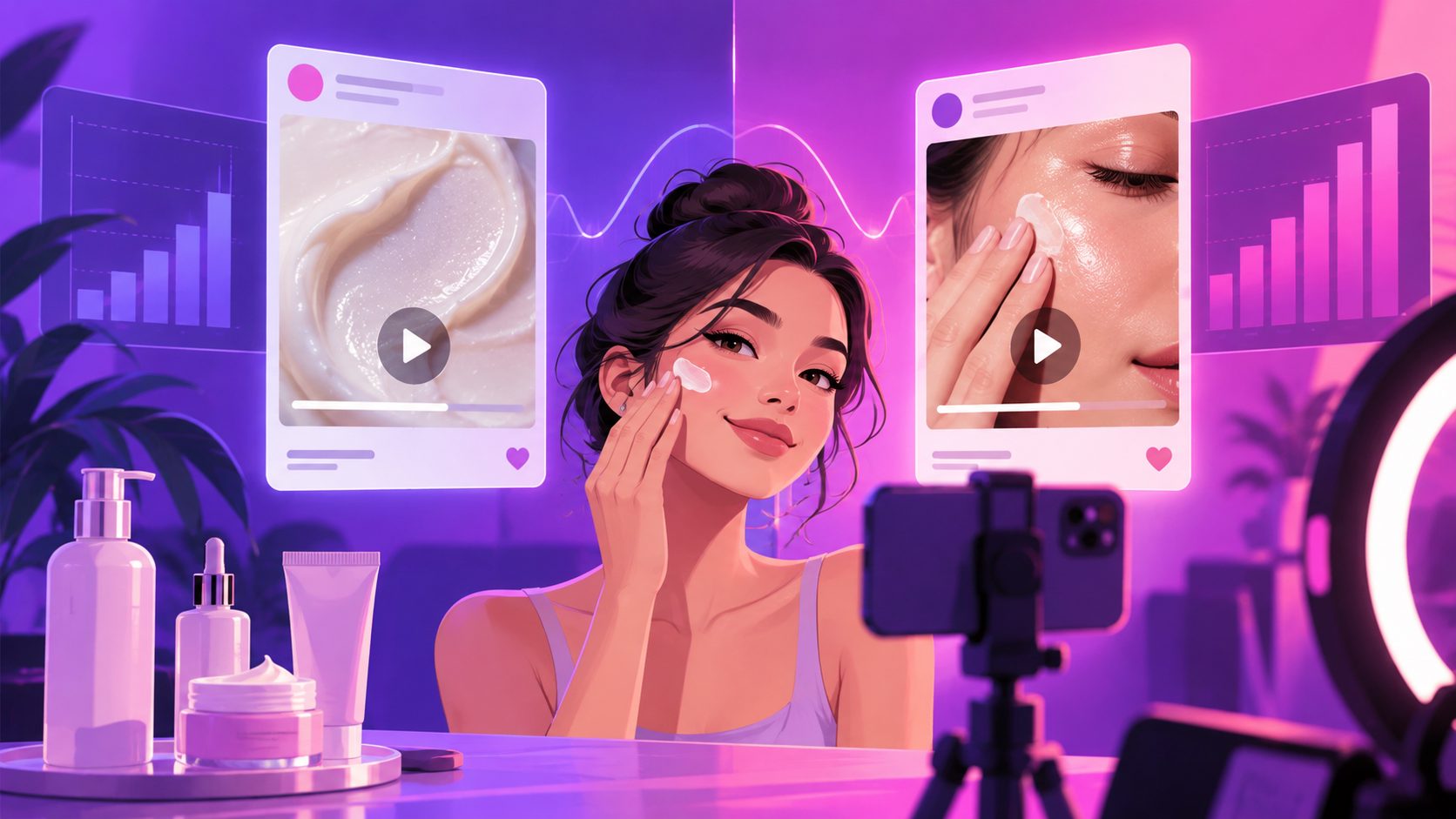
The 12-cell matrix tests three hooks, two proof shots, and two presenter personas while holding the offer, product page, runtime, and CTA constant. It reveals why a creative wins instead of producing one-off videos whose successful elements cannot be identified.
| Variable | Versions | Example |
|---|---|---|
| Hook | 3 | Texture concern, routine confusion, makeup compatibility |
| Proof shot | 2 | Spread-and-absorb test, layering test |
| Persona | 2 | Minimalist beginner, ingredient-aware shopper |
| Total combinations | 12 | 3 × 2 × 2 |
Label every file by variables, such as H2-P1-A2, and use the same opening-frame brightness, subtitle style, offer, landing page, and CTA.
As an operating heuristic—not an industry benchmark—wait for roughly 1,500 impressions per cell before removing a version solely for weak early attention. Compare each cell with the account median rather than a universal view-rate target. For conversion decisions, avoid declaring a winner from five or ten clicks; collect at least 30 landing-page visits per surviving cell or run the test long enough to reach your normal decision threshold.
Judge performance in sequence:
- Three-second hold or platform-equivalent attention metric
- Click-through rate
- Product-page engagement
- Add-to-cart rate
- Purchase conversion and acquisition cost
How should skincare scripts handle claims and disclosures?
Describe what the camera can prove and reserve efficacy statements for claims the brand can substantiate. Product texture, packaging, application order, and immediate cosmetic appearance are safer creative inputs than promises to cure acne, heal eczema, regenerate cells, or guarantee results within a fixed period.
The FDA’s cosmetics claims guidance explains that claims about treating disease or affecting the body’s structure or function may cause a product to be regulated as a drug. Cosmetic claims must also be truthful and not misleading. (fda.gov)
For AI presenters, replace false experience statements such as “I used this for 30 days” with accurate narration:
- “Here is how the gel spreads.”
- “This step goes between cleansing and moisturizer.”
- “The finish shown here is under neutral window light.”
- “Check the product instructions for recommended use.”
When a real creator has a material relationship with the brand, the FTC says the disclosure should be clear, conspicuous, and hard to miss. Video disclosures should not rely only on audio because some viewers watch without sound. (ftc.gov)
How do you turn a winner into a weekly creative system?
Scale the winning mechanism, not just the finished video. Once a test identifies a strong hook-and-proof pairing, keep that pairing stable while varying one secondary element at a time: presenter, opening wording, subtitle treatment, language, or CTA.
Use this weekly cycle:
- Monday: Review comments, returns, and customer-service objections.
- Tuesday: Convert three objections into hooks.
- Wednesday: Produce the 12-cell test batch.
- Thursday: Run a visual QA and claims review.
- Friday: Launch, label, and document every variant.
- Next cycle: Retain the winning proof shot and replace fatigued hooks.
For mature campaigns, track how frequently each concept has been served and use a defined Facebook creative refresh workflow rather than replacing every ad on an arbitrary schedule.
Frequently asked questions
How long should a skincare UGC video ad be?
Start with 15–20 seconds for a single demonstration. Use 25–35 seconds only when the routine, objection, or product setup requires additional context. Remove any scene that neither proves something nor advances the decision.
Can an AI actor give a skincare testimonial?
An AI actor can present brand-approved information, demonstrate a workflow, or narrate visible product features. It should not claim to be a real customer, describe fictional long-term use, or imply personal results that never occurred.
Which skincare proof shot should be tested first?
Start with the uncertainty most likely to block a purchase. For serums, that may be texture and absorption. For moisturizers, test finish and layering. For cleansers, show dispensing, lather, and rinsing.
Do these ads need before-and-after images?
No. A controlled texture or layering demonstration can be more credible than an inconsistent before-and-after comparison. If comparison footage is used, match the camera, angle, lighting, timing, and image processing.