TikTok Shop Product Showcase Video Batch Generation: A Six-Variant Testing System

Summarize with
Summary
Learn a practical TikTok Shop product showcase video batch generation workflow using six hook variants, controlled testing, product demos, and reusable creative systems.
By adsturbo.ai | Published 2026-11-10 | Updated 2026-11-10
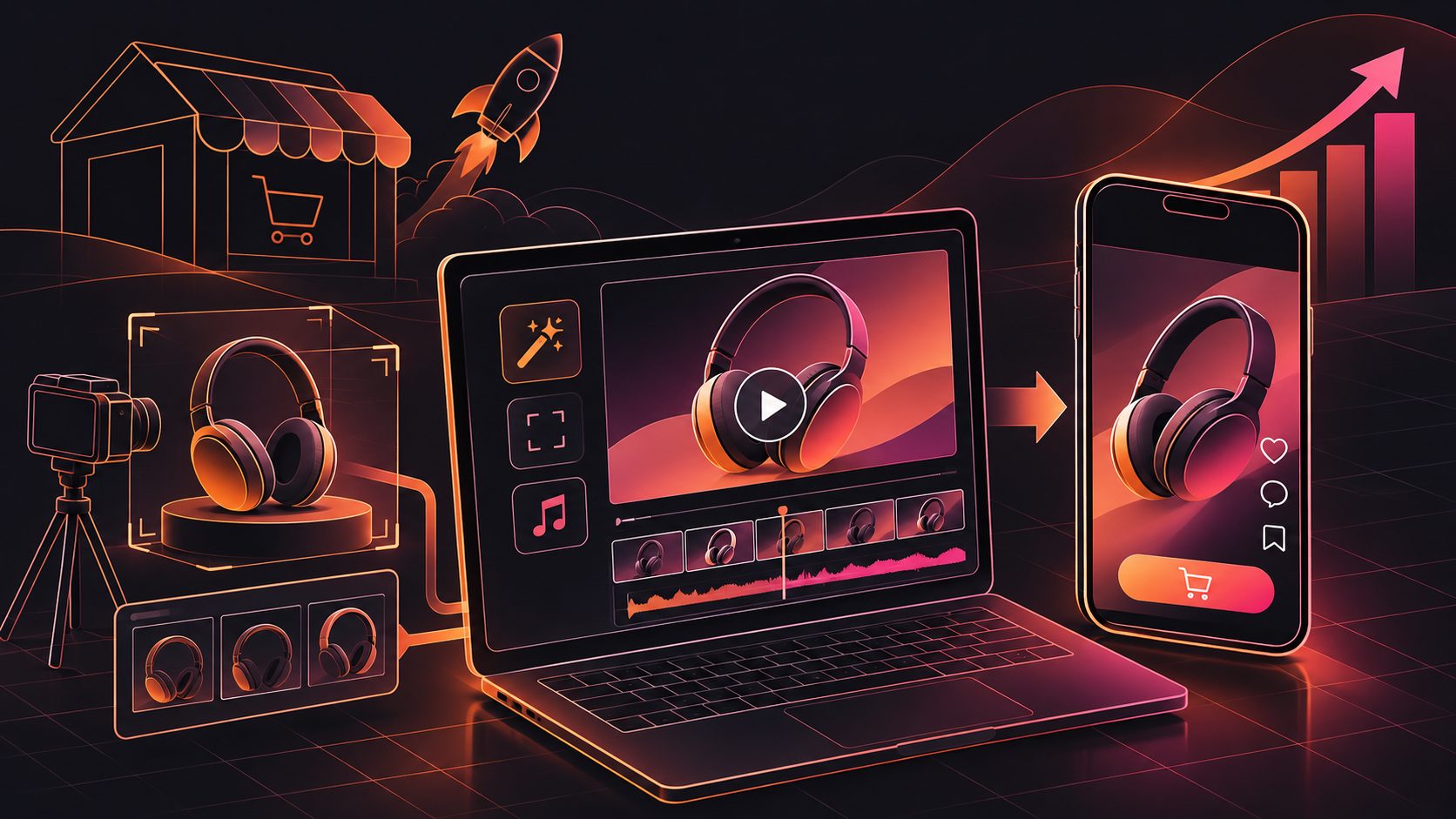
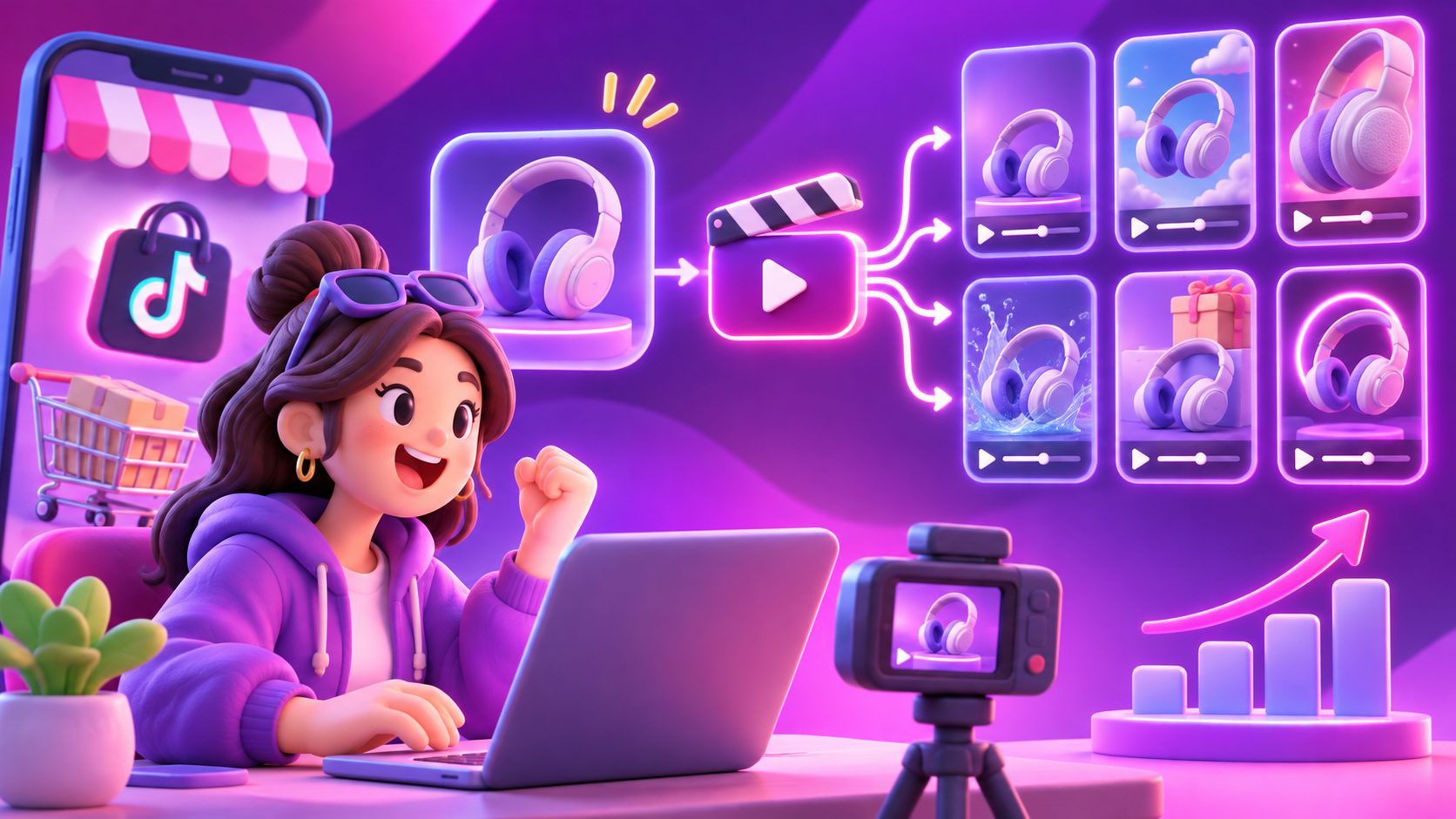
TikTok Shop product showcase video batch generation is a system for turning one product, offer, and creative brief into several controlled video variations for organic posts, affiliate content, and shopping ads. The goal is not to publish six random videos. It is to isolate which hook, proof style, and presentation earns attention and product clicks.
TikTok Shop supports shopping through in-feed videos and the Showcase tab, while TikTok’s own creative guidance emphasizes showing products in use, reviews, tutorials, and clear product benefits. (ads.tiktok.com)
What is TikTok Shop product showcase video batch generation?
TikTok Shop product showcase video batch generation means creating a coordinated set of short-form product videos from the same product data, then changing selected creative variables such as the opening hook, voiceover, proof sequence, or offer framing.
A useful batch keeps four elements fixed:
- Product SKU and product link
- Core offer and landing experience
- Main product claims
- Video length and publishing environment
Then it changes one major creative variable at a time. This makes the results more useful because a winning video teaches you why it worked instead of simply showing that one combination performed well.
The strongest batch structure is usually six variants: three hook angles crossed with two proof formats. For example:
| Variant | Hook angle | Proof format |
|---|---|---|
| 1 | Problem-first | Product demonstration |
| 2 | Problem-first | Voiceover B-roll |
| 3 | Benefit-first | Product demonstration |
| 4 | Benefit-first | Voiceover B-roll |
| 5 | Deal-first | Product demonstration |
| 6 | Deal-first | Voiceover B-roll |
This is an original testing framework rather than a recommendation to generate six unrelated concepts. It creates enough variation to learn while keeping production and measurement manageable.
Why a six-variant matrix is better than making six random videos
Random creative production creates noise. If every version uses a different creator, offer, length, soundtrack, and product angle, a seller may find a winner but fail to reproduce it.
A six-variant matrix separates message testing from production testing. Start with one product and one offer. Change the first two seconds, the product proof, or the narration—not everything at once.
TikTok’s creative guidance reports that showing a product in use can improve conversion rate, while product reviews and tutorials are also established showcase formats. (ads.tiktok.com) However, format popularity should not be confused with product-market fit. A recent observational analysis of 51,843 US TikTok Shop videos found stronger sales-per-view associations for price-or-deal hooks and voiceover B-roll, while noting that the data was not a controlled experiment. (medialabs-co.com)
The practical conclusion is simple: use these patterns as hypotheses, then test them against your own SKU.
How to build the six creative variants
1. Problem-first hook
Open with the shopper’s frustration, not the product name.
Examples:
- “Still dealing with this every morning?”
- “This is why your small space feels cluttered.”
- “If your setup takes too long, try this.”
The product should appear immediately after the problem is introduced. Avoid delaying the visual proof with a long logo animation or generic introduction.
2. Benefit-first hook
Lead with the outcome the product helps create.
Examples:
- “A faster way to organize your daily essentials.”
- “Make your desk look cleaner in seconds.”
- “The simple upgrade that changes how this works.”
Benefit-first videos are useful for products that are easy to understand visually and do not require extensive education.
3. Deal-first hook
Lead with the promotion, bundle, limited-time incentive, or value comparison when the offer is genuinely central to the buying decision.
Examples:
- “This bundle is cheaper than buying the pieces separately.”
- “A practical upgrade with a limited-time offer.”
- “Here is what you get in the current deal.”
Prices, discounts, and promotional terms should match the actual TikTok Shop listing at publishing time. Do not place an expired offer in a scheduled batch.
4. Demonstration proof
Show the product in use within the first few seconds. Include a close-up, a before-and-after state when appropriate, or a short sequence that makes the product’s function obvious.
A basic demonstration structure is:
- Show the problem.
- Introduce the product.
- Demonstrate the key action.
- Show the result.
- Direct viewers to the product card.
5. Voiceover B-roll proof
Use product close-ups, hands-in-frame footage, packaging, material details, and lifestyle shots while a voiceover explains the value.
This format is useful when the seller has strong product information but limited access to a professional presenter. It can also support localization because the same visual sequence can be paired with different narration and subtitles.
For teams that begin with existing footage, an AI video enhancer can help prepare low-resolution or highly compressed clips before they are reused in a batch. The enhancement should support clarity, not replace honest product proof.
A production workflow for ecommerce sellers
Step 1: Prepare a product evidence sheet
Before generating videos, collect:
- Product name and category
- Three verified benefits
- One clear use case
- One important limitation or qualification
- Offer details
- Target customer
- Product image and reference footage
A clean product image is especially useful when creating product-led video concepts. AdsTurbo Product Video supports JPG and PNG product uploads and can generate UGC-style product review, introduction, and demonstration videos from product images, optional selling points, and promotion details.
Step 2: Create a shared visual system
Keep the following consistent across the six variants:
- Product appearance
- Brand colors
- Product link
- Main claim
- Approximate duration
- Caption placement
- Call to action
Then vary only the designated hook or proof format. This reduces accidental differences that make performance analysis difficult.
Step 3: Generate and review the batch
AdsTurbo supports product video generation, ad cloning, motion control, lip sync, character replacement, translation, subtitles, background replacement, and clip-by-clip editing. These functions can support different production paths, but each output should be reviewed for product accuracy, readable text, natural motion, and correct promotional details.
For creator-style variations, use a consistent presenter or a clearly documented character brief. Changing the presenter in every version can make the test measure creator identity instead of the hook.
Step 4: Add captions and product context
Many viewers watch without sound. Use concise on-screen text that reinforces the spoken point rather than duplicating every sentence.
AdsTurbo Video Subtitle can automatically transcribe speech, create time-synced subtitles, translate captions, and export either a video with embedded subtitles or a separate subtitle file. Its subtitle layouts are designed for short-form formats such as TikTok, Instagram Reels, and YouTube Shorts.
How to measure the batch without misleading yourself
Measure the six variants using the same observation window and the same decision rules. Useful metrics include:
- Three-second or early retention
- Average watch time
- Completion rate
- Product-card clicks
- Add-to-cart rate
- Orders or attributed GMV
- Cost per purchase for paid distribution
Do not select a winner from views alone. A high-view video with weak product-card clicks may be entertaining but commercially inefficient. Conversely, a lower-reach video may deserve more distribution if it generates stronger product intent.
TikTok Shop provides performance views for shopping videos, and scheduled shoppable videos can be prepared in advance. TikTok’s seller guidance describes scheduling from 30 minutes to 30 days ahead and allows up to 50 scheduled videos per account. (seller-us.tiktok.com)
A practical decision rule is:
- Adopt: strong retention and product action
- Re-cut: good attention but weak click or purchase behavior
- Re-check: insufficient distribution or incomplete data
- Mismatch: the hook attracts viewers who are not the target buyer
- Cut: weak attention and weak product action
Wait until each version has comparable exposure before drawing conclusions. If distribution differs dramatically, treat the result as directional rather than definitive.
Common mistakes in batch-generated showcase videos
Changing too many variables
A new hook, creator, soundtrack, duration, offer, and CTA in one version prevents useful learning.
Showing the product too late
Product showcase content should make the item recognizable quickly. Avoid spending the opening on abstract claims or decorative motion.
Treating AI output as final
Generated videos still require checks for product shape, color, packaging, text, pronunciation, and claim accuracy. Product images should be clear, and AdsTurbo recommends pure-background product photos for the best Product Image results.
Reusing one winner without learning from it
A winning video is a starting point. Extract its opening structure, proof order, pacing, and CTA. Then create controlled variations rather than duplicating it unchanged.
Frequently asked questions
How many TikTok Shop product videos should I create first?
Six is a practical starting batch for one product because it allows three hook angles and two proof formats without creating an unmanageable testing set.
Should every video use a different product presenter?
No. Keep the presenter consistent when testing hooks. Change presenters in a separate creator-style test so the variables do not overlap.
Can I use one product image to create multiple showcase videos?
Yes. AdsTurbo Product Video supports JPG and PNG product uploads and can use product details, selling points, and promotion information to create product-focused short videos.
Should I test organic videos or paid ads first?
Use organic publishing when you need inexpensive directional feedback. Use paid distribution when you need more controlled delivery, but keep the product, offer, audience, and measurement window consistent.
How can a cross-border seller localize the same batch?
Keep the visual product proof consistent, then adapt voiceover, subtitles, on-screen copy, and presenter style by market. AdsTurbo supports video translation, multilingual subtitles, lip sync, and character replacement for localization workflows.