Turn Ecommerce FAQ Into Video Ads: A Proof-First Workflow


Summarize with
Summary
Turn ecommerce FAQ into video ads with a proof-first workflow for sizing, materials, setup, and use-case objections. Build clearer short-form creatives with AdsTurbo.
By adsturbo.ai | Published 2026-10-29 | Updated 2026-10-29
To turn ecommerce FAQ into video ads, convert each buyer question into one short scene that shows the answer. This approach helps shoppers evaluate size, material, setup, fit, durability, and everyday use before they click or purchase.
Amazon’s own video guidance recommends addressing common customer questions, demonstrating scale, and showing products in use. Its seller guidance also reports that product videos can improve understanding and reduce uncertainty when product details are difficult to communicate with still images. (sellercentral.amazon.com)
What makes an ecommerce FAQ worth turning into a video?
An ecommerce FAQ is video-worthy when the answer requires visual proof rather than explanation. Questions about dimensions, texture, installation, compatibility, movement, or results usually perform better as demonstrations than as text blocks.
A useful test is:
If a shopper can still misunderstand the answer after reading it once, show it on video.
Prioritize questions that create purchase hesitation:
- “Will this fit my space?”
- “Is the material thick or lightweight?”
- “How does this attach or assemble?”
- “Will the color look the same in person?”
- “Can it hold the stated weight?”
- “Does it work with my device?”
- “What exactly comes in the package?”
- “How do I clean, store, or use it?”
Do not treat every FAQ equally. A question about shipping may need a text answer, while a question about whether a storage bin fits under a bed deserves a visual demonstration.
Which FAQ categories create the strongest video angles?
The most useful categories are fit, function, appearance, setup, and proof. Mapping questions into these categories prevents repetitive product videos that only repeat listing copy.
| FAQ category | Buyer concern | Best visual proof |
|---|---|---|
| Size and fit | “Will it fit?” | Compare against a familiar object or real space |
| Material and texture | “What does it feel like?” | Macro close-up, bend, stretch, or surface test |
| Setup and operation | “Can I use it easily?” | Hands-on installation or step-by-step demo |
| Compatibility | “Will it work with my item?” | Connect, pair, mount, or compare interfaces |
| Durability | “Will it hold up?” | Controlled stress, shake, drop, or weight test |
| Package contents | “What will I receive?” | Unboxing with every included component visible |
| Maintenance | “How do I care for it?” | Cleaning, folding, charging, or storage demonstration |
This table creates a production queue. Start with questions that combine high purchase friction and easy visual proof.
For example, “Is the fabric stretchy?” is stronger than “What is the product made of?” when the real concern is whether the item will fit comfortably. The first question points directly to an action: stretch the fabric, show the range, and display the result.
How do you turn one FAQ into a 15-second video?
Use a simple Question–Proof–Payoff structure:
- Question, 0–3 seconds: State the buyer’s concern in natural language.
- Proof, 3–11 seconds: Demonstrate the answer with the product visible.
- Payoff, 11–15 seconds: Show the practical result and a clear next step.
Example:
- Question: “Will this phone case protect the corners?”
- Proof: Show the raised edge around the case and a controlled drop test.
- Payoff: Show the phone working afterward, then display the product name.
The key is to answer one question per video. Combining size, material, cleaning, and warranty information in one clip often produces a crowded script with no memorable proof.
Amazon recommends keeping product videos focused on features and functionality, while its advertising guidance emphasizes matching the video’s message to the product detail page. (sellercentral.amazon.com)
How should you write the script from a customer question?
Rewrite the FAQ in the shopper’s language before creating the script. Brand language describes benefits; buyer language describes uncertainty.
| Listing language | Buyer-language hook |
|---|---|
| “Premium flexible construction” | “Will it bend without cracking?” |
| “Compact design” | “Will it fit in a small drawer?” |
| “Easy installation” | “Can I set this up without tools?” |
| “Multiple color options” | “Will the color look different indoors?” |
| “Universal compatibility” | “Will this work with my model?” |
Then add a proof instruction to every line. A useful script template is:
“Wondering whether [product] can [solve a specific concern]? Here is the real test: [show action]. The result is [observable outcome].”
Avoid claims that the footage cannot support. If the video only shows a product surviving one controlled test, do not describe it as indestructible. Clear demonstrations build more trust than exaggerated wording.
How can sellers create FAQ videos from existing product assets?
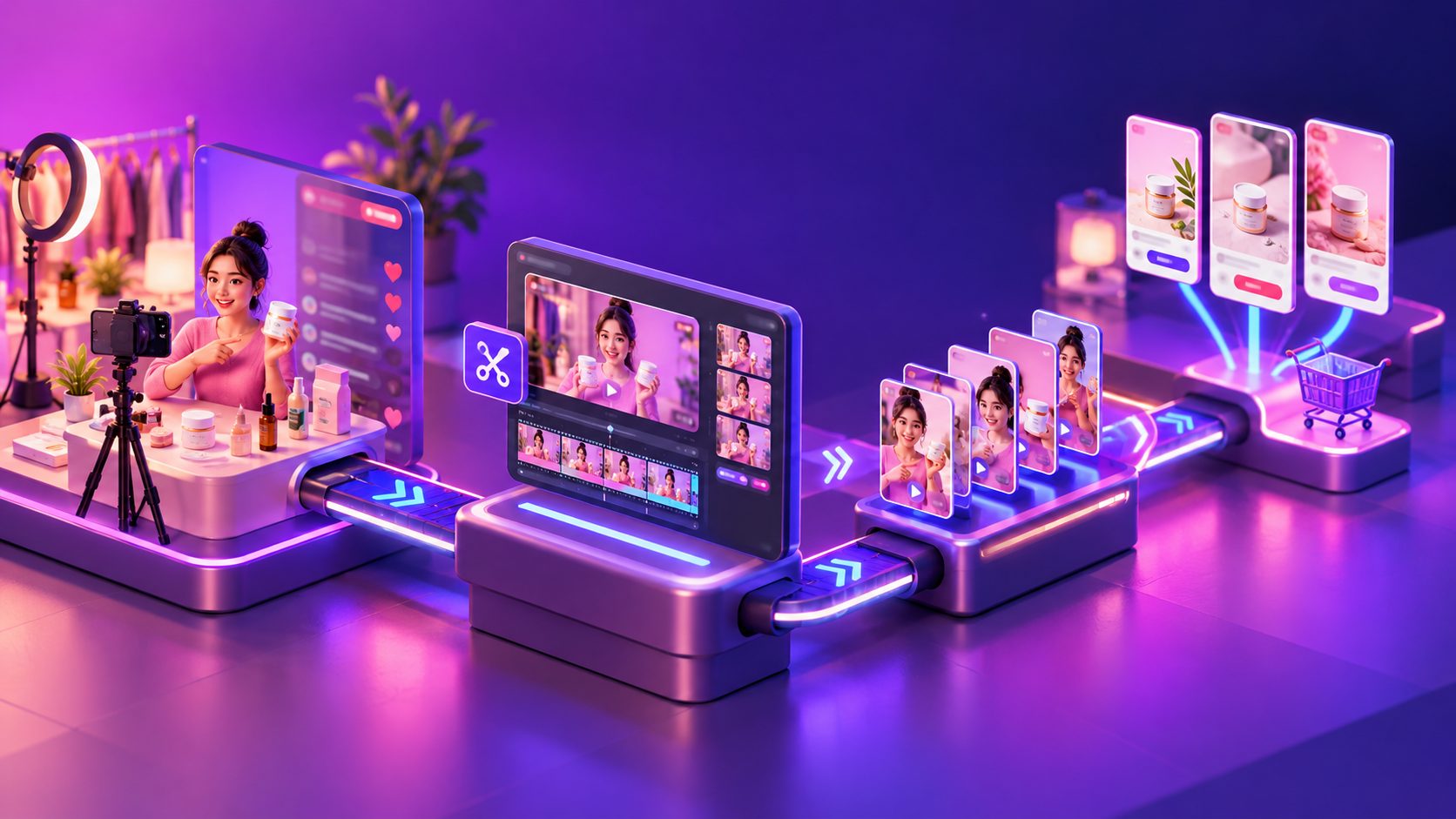
You do not always need a new filming session. Existing product photos, listing videos, customer questions, support tickets, and creator footage can become a structured FAQ video library.
A practical workflow is:
- Export the top questions from customer support, reviews, live chat, and marketplace Q&A.
- Group duplicate questions by objection rather than by wording.
- Rank each objection by purchase impact and visual demonstrability.
- Match each question with a product photo, reference video, demonstration clip, or new shot.
- Produce one vertical version for short-form feeds and additional aspect ratios when needed.
- Add captions so the answer remains understandable without sound.
- Review every measurement, compatibility statement, and visual claim before publishing.
AdsTurbo can support this asset workflow through product video generation, clip-by-clip editing, video subtitles, product image creation, background replacement, and video translation. Its Product Video workflow accepts JPG or PNG product images, while Product Image works best with a clear product photo on a plain background.
For listing and marketplace use, keep product identity consistent. The product shown in the video should match the product page, variant, color, and included components. This alignment matters because shoppers expect the landing page to confirm what the video promised. (advertising.amazon.com)
A related workflow is the Amazon listing FAQ video generator, which focuses on converting buyer questions into product demonstrations.
How do you organize multiple FAQ videos for testing?
Use a FAQ objection matrix instead of producing random creative variations. Each row represents one concern, while each column changes the way the answer is presented.
| Objection | Demonstration | Presenter angle | CTA |
|---|---|---|---|
| “Will it fit?” | Measure it in context | Hands-only demo | “Check your dimensions” |
| “Is it durable?” | Controlled stress test | UGC-style explanation | “See the test” |
| “Is setup difficult?” | Fast installation | AI actor tutorial | “Watch the setup” |
| “Does it match?” | Color comparison | Product close-up | “Compare the finish” |
This creates meaningful variation. Instead of changing only the opening sentence, you can test whether the same answer works better as a hands-on demo, creator explanation, comparison, or tutorial.
AdsTurbo supports more than 300 AI actors and over 100 product advertising templates, making it possible to vary presenter style while keeping the core product proof consistent. For localization, its video translation and subtitle tools can create multilingual versions with translated audio or captions.
The goal is not to make the video look different for its own sake. The goal is to learn which proof format resolves the objection most efficiently.
What should be measured after publishing?
FAQ videos should be evaluated by the question they answer, not only by views. Track:
- Three-second hold rate
- Average watch time
- Completion rate
- Click-through rate
- Add-to-cart rate
- Conversion rate
- Return or support-ticket themes
- Performance by product variant and audience
A useful diagnostic rule is:
- High views but low clicks: the hook may be interesting but commercially weak.
- High clicks but low conversion: the video may create interest without resolving the final concern.
- Low retention: the proof starts too late or the question is unclear.
- High watch time but low add-to-cart: the answer may be informative but not connected to a buying decision.
Amazon reports stronger performance for campaigns using video in some Sponsored Products comparisons, but platform-level benchmarks should not replace your own product and audience data. (advertising.amazon.com)
For a deeper proof-first example, see the phone case drop test video ad guide. For size and material objections, the apparel stretch test video guide shows how a physical question can become a focused demonstration.
Common questions about FAQ-to-video ads
Should every FAQ become a video?
No. Prioritize questions that affect purchase confidence and can be shown clearly. Shipping policies, warranty terms, and return windows may be better handled with text unless a video adds genuine clarity.
How long should an FAQ video be?
Use the shortest length that proves the answer. A simple size or package-contents question may need 10–15 seconds; installation or comparison questions may need longer. The first few seconds should identify the concern.
Should the presenter read the FAQ word for word?
Not necessarily. Use the customer’s wording for the hook, then simplify the answer. The presenter should sound conversational, while on-screen text reinforces the exact measurement, material, or action being shown.
Can one FAQ video work across TikTok, Reels, Shorts, and product listings?
The core proof can be reused, but the framing, captions, aspect ratio, and CTA should be adapted to each placement. AdsTurbo Video Subtitle supports social-style caption formatting, and its tools support multiple output formats for ecommerce creative workflows.
How can a store scale this process?
Build a question library once, then produce videos in batches by product, objection, or market. AdsTurbo supports asynchronous generation with status polling or Webhook completion events, while higher-level plans support team workflows, API access, and custom workflows.
The strongest FAQ video is not the one with the most claims. It is the one that answers a specific buyer question with visible, credible proof.