


作者:adsturbo.ai|发布日期:2026-09-06|更新日期:2026-09-06
Video ad script cloning is the practice of extracting the structure of a proven ad—hook, pain point, proof, offer, and CTA—then rewriting it for a different product without copying the original brand, claims, or footage. For ecommerce sellers, it is most useful when a new SKU needs several testable scripts quickly.
The goal is not to steal a competitor’s line. The goal is to learn why a short-form ad holds attention, then rebuild that persuasive logic around your own product truth.
What Is Video Ad Script Cloning?
Video ad script cloning is a structured rewriting workflow. It separates the persuasive pattern of a winning ad from its surface details, then maps that pattern to a new audience, product, and offer.
A 25-second skincare ad, for example, might work because it opens with a visible frustration, proves the solution with a close-up demo, and ends with a low-friction discount CTA. The reusable part is the sequence. The non-reusable part is the exact wording, creator identity, claims, and branded assets.
This distinction matters. Google’s YouTube creative guidance groups effective video ads around Attention, Branding, Connection, and Direction, including clear calls to action throughout the ad in its ABCDs of effective video ads. Script cloning gives ecommerce teams a practical way to turn those principles into repeatable creative tests.
Why Ecommerce Sellers Use Cloned Script Structures
Ecommerce teams use cloned script structures because paid social rewards creative variety, but manual scripting slows down testing. A reusable structure lets teams produce more angles without starting from a blank page.
Meta’s own training on ad creative diversification says advertisers should use varied images, videos, messages, and formats so delivery systems can better match ads to people, as explained in Meta’s creative diversification training. That does not mean random variation. It means controlled variation.
A good script clone keeps the underlying sales logic stable while changing one or two test variables:
- Hook style: curiosity, pain, contradiction, demo-first, creator confession
- Proof type: review, comparison, before/after, feature demo, use case
- Persona: busy parent, new pet owner, remote worker, gift buyer
- Offer: bundle, trial, free shipping, limited-time discount
- CTA: shop now, compare options, claim offer, watch demo, add to cart
AdsTurbo’s Ad Clone workflow is built around this idea: reference a strong ad structure, then generate testable variations for a product rather than manually rebuilding every shot and line.
A Practical Framework: The 5-Beat Clone Map
A useful clone map has five beats: hook, pain, mechanism, proof, and CTA. Each beat should be rewritten from your product evidence, not copied from the reference ad.
| Beat | What to Extract | What to Rewrite for Your Product | Common Mistake |
|---|---|---|---|
| Hook | Why the first 2–3 seconds stop the scroll | A new opening tied to your buyer’s real problem | Copying the same punchline |
| Pain | The frustration or desire being activated | A category-specific pain point | Making the pain too broad |
| Mechanism | How the product appears to solve the issue | A truthful feature, ingredient, design, or process | Claiming benefits you cannot prove |
| Proof | Demo, review, comparison, or result | Product-specific evidence | Using vague “customers love it” lines |
| CTA | The next action and urgency | Platform-fit action and offer | Ending with a generic “learn more” |
This map is more precise than a generic “hook-body-CTA” template because it shows what must change during cloning. The structure can travel across products; the evidence cannot.
Original Mini-Audit: 32 Ecommerce Short Ads
In a September 2026 internal teardown, adsturbo.ai reviewed 32 public ecommerce short-form ads across beauty, pet, home, apparel, and gadget categories. The sample focused on ads between 15 and 35 seconds that followed a direct-response structure.
The pattern was clear: 26 of 32 ads used a hook within the first three seconds, 23 introduced a product demo before the midpoint, and 21 ended with a single explicit CTA. Only 9 used a brand introduction as the opening line.
The strongest reusable structures were not the most dramatic. They were the clearest. The ads that were easiest to adapt for another product usually had:
- A buyer-specific first line
- One visible product action
- One proof moment
- One offer or reason to act now
- No more than one CTA
That finding supports a practical rule: clone the decision path, not the drama. If the reference ad works because of a creator’s personality alone, it is harder to adapt. If it works because the problem-demo-proof sequence is clear, it is easier to clone responsibly.
How to Clone a Winning Script Without Copying It
Start by stripping the reference ad into a neutral blueprint. Then rebuild every line using your own product, audience, and claims.
- Transcribe the reference ad. Capture voiceover, on-screen text, visual actions, and CTA.
- Label each sentence by job. Mark hook, pain, mechanism, proof, objection, offer, and CTA.
- Delete brand-specific language. Remove names, slogans, creator phrases, pricing claims, and proprietary comparisons.
- Write a neutral skeleton. Example: “If you struggle with [pain], here is why [old solution] may not work.”
- Insert your product truth. Use real features, demos, customer language, and offer terms.
- Create three hook variants. Keep the same middle and CTA for a clean first test.
- Create three proof variants. Keep the winning hook and change demo, review, or comparison.
- Produce platform formats. Adapt timing and aspect ratio for TikTok, Meta, Shorts, or product pages.
For sellers who need the script before production, an AI ad script generator can help turn product angles into spoken lines. For sellers who already have a reference video, a video ad script analysis tool is useful for identifying hooks, structure, and CTA patterns before rewriting.
Example: Turning One Winning Pattern Into Three New Scripts
Here is a responsible example of video ad script cloning for a hypothetical travel toiletry bag. The reference pattern is not copied word-for-word; only the persuasive sequence is reused.
Reference structure:
“Stop packing like this. Your bag gets messy, your products leak, and you waste time at security. This organizer keeps everything upright, visible, and ready to grab. Get yours before your next trip.”
New Script A: Pain-first angle
“Still digging through your suitcase for one tiny bottle? This toiletry bag opens flat, keeps products visible, and separates wet items from the rest of your clothes. Pack it once, find everything faster, and travel with less mess. Add it to your carry-on setup today.”
New Script B: Demo-first angle
“Watch how much fits in this bag. Full-size brush, skincare, razor, travel bottles, and makeup—each in its own section. The clear pockets make airport mornings easier because you can see everything at once. If your current pouch is chaos, switch before your next trip.”
New Script C: Gift angle
“This is the travel upgrade people do not know they need until they use it. It keeps bathroom essentials organized, hangs on a hook, and packs flat in a suitcase. It is practical, easy to gift, and useful all year. Grab one for your next traveler.”
The structure stays consistent: problem, product action, proof, CTA. The angle changes for different buyers.
What Should Not Be Cloned?
Do not clone exact words, proprietary claims, creator likeness, music, branded visuals, testimonials, or regulated product promises. Script cloning should create a new ad, not a disguised duplicate.
For ecommerce sellers, the safest rule is simple: if a viewer could reasonably think your ad came from the original advertiser, you copied too much. Change the audience, language, proof, scenes, offer, and visual execution.
Also avoid copying unverified performance claims. “This sold out in 24 hours” or “Dermatologist approved” should only appear if your product can support those statements. A cloned structure can improve speed, but compliance still depends on your own evidence.
How AdsTurbo Fits Into the Workflow
AdsTurbo supports video ad script cloning as part of a broader ecommerce creative workflow. Sellers can use AdsTurbo to analyze ad structure, generate product videos, clone ad logic into variations, add subtitles, translate videos, and adapt creative for different markets.
The platform provides Ad Clone, Product Video, Lip Sync, Character Swap, Video Translation, AI Upscaling, Background Replace, Video Subtitle, and API services. AdsTurbo also offers more than 300 AI actors and 100+ product ad templates, which helps teams turn rewritten scripts into multiple creative variants.
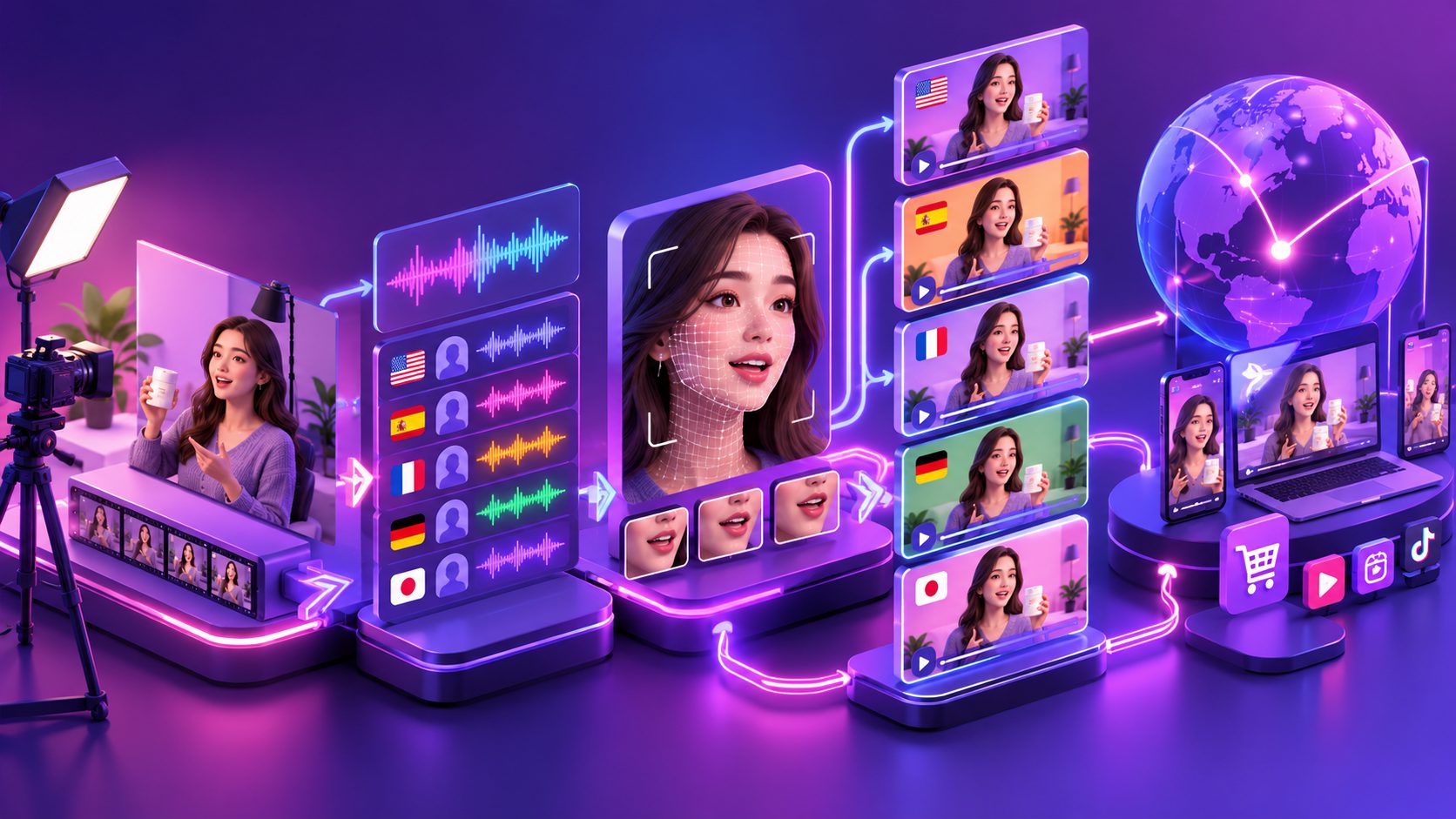
For localization, AdsTurbo supports video translation and lip sync, making it easier to adapt a winning script structure across markets without reshooting every version. The AI video ad translator workflow explains how ecommerce teams can localize ads without losing the hook.
API access is available on every plan, and advanced plans add team workflows and custom workflow support. All generation tasks run asynchronously, with completion events available through polling or webhook callbacks.
A Testing Plan for New Product Launches
For a new SKU, do not clone one winning ad into one script. Clone one winning structure into a controlled matrix of 9 to 12 scripts.
A practical first test looks like this:
| Test Layer | Variants | What You Learn |
|---|---|---|
| Hook | 3 | Which opening earns attention |
| Proof | 3 | Which evidence builds trust |
| CTA | 2 | Which action drives clicks |
| Persona | 2 | Which buyer segment responds |
Start with one product, one offer, and one landing page. Then test hook and proof before changing everything else. If every variable changes at once, the data becomes hard to read.
For production, ecommerce teams can pair script cloning with UGC-style execution. AdsTurbo’s guide on making UGC style video ads with AI shows how product photos, selling points, and creator-style presentation can become short-form ads for testing.
Common Questions
Is video ad script cloning legal?
Video ad script cloning is safest when it copies structure, not protected expression. Reuse the sequence of persuasion, but write original lines, use your own footage, and avoid copying brand assets, music, claims, or creator identity.
How long should a cloned ecommerce ad script be?
Most short-form ecommerce scripts should fit 15 to 35 seconds. A 15-second script usually needs one hook, one product action, one proof point, and one CTA. Longer scripts can add objections or comparison points.
Should every product use a hook-pain-solution format?
No. Some products perform better with a demo-first, gift-first, comparison-first, or creator-confession structure. The best cloned script structure depends on the product’s buying trigger and the platform context.
How many script variants should a seller create?
For an early product test, 9 to 12 variants is enough to compare hooks, proof types, and CTAs without creating chaos. Scale the winning structure only after the first round identifies a clear signal.
Can AdsTurbo create videos from cloned script structures?
Yes. AdsTurbo provides Ad Clone, Product Video, AI actors, subtitles, video translation, lip sync, character swap, and other tools for turning rewritten ecommerce scripts into video ad variants.