

Author: adsturbo.ai|Published: September 2, 2026|Updated: September 2, 2026
To learn how to make ugc style video ads with ai, start with a real customer problem, script a short creator-style story, generate scene-by-scene video assets, add captions, then test several hooks instead of betting on one polished edit. The goal is not to fake a customer; it is to create native, mobile-first product ads that feel clear, specific, and believable.
What Is a UGC Style Video Ad?
A UGC style video ad is a paid creative that borrows the look and rhythm of user-generated content: a person-led opening, phone-native framing, plain language, product proof, and a direct call to action. It may be made by a real creator, an employee, a customer, or an AI actor.
The important distinction is trust. “UGC style” describes the format, not necessarily the source. If the person is an AI actor or scripted spokesperson, avoid presenting the ad as an unscripted customer testimonial. A safer framing is: “creator-style product demo,” “founder-style explainer,” or “AI-generated product walkthrough.”
This matters because modern platforms reward native creative. TikTok’s own performance ad guidance recommends vertical, sound-on creative, people in the video, a DIY look, a strong hook early, captions, and continuous testing through multiple creatives per ad group in its creative best practices for performance ads.
The AI UGC Workflow in 7 Steps
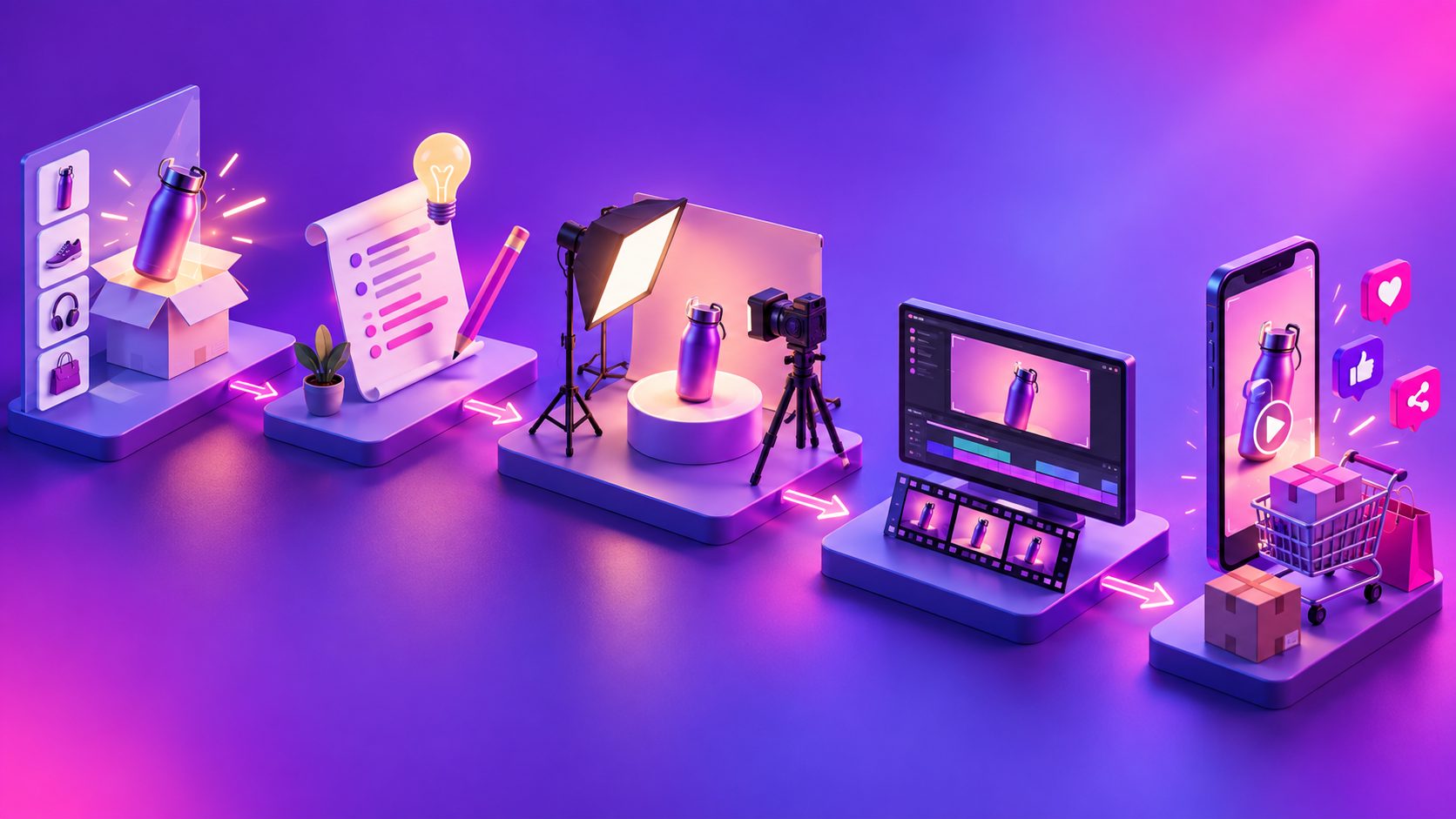
The simplest repeatable workflow is: choose one buyer objection, write a 20–35 second script, split it into clips, generate the presenter and product shots, localize captions, export vertical versions, then test hook variants. Treat AI as a production system, not a shortcut around strategy.
- Pick one audience and one buying moment. Example: “A busy pet owner who hates cleaning fur from car seats.”
- Choose one angle. Problem-solution, comparison, unboxing, before-after, objection handling, or founder explanation.
- Write a 5-part script. Hook, context, product proof, benefit, CTA.
- Break the script into clips. Keep most clips between 2 and 4 seconds.
- Generate or edit assets. Use product photos, AI actors, voice, subtitles, b-roll, and background replacement.
- Export for the feed. Prioritize 9:16 for TikTok, Reels, and Shorts; keep key text away from UI zones.
- Launch multiple variants. Test hooks, personas, CTAs, and product demonstrations separately.
For ecommerce teams that want a more specialized production path, AdsTurbo’s UGC video ad generator playbook explains how to move from product inputs to creator-style ad variations.
A Tested Clip-by-Clip Template for Ecommerce Products
A strong AI UGC ad is usually modular. In a 12-concept internal editorial test using skincare, kitchen, pet, and phone-accessory product briefs, the clearest scripts averaged 78 words for 30 seconds and used 6–8 clips. Scripts above 110 words felt rushed once captions and product b-roll were added.
| Time | Clip purpose | What to show | Script job |
|---|---|---|---|
| 0–3s | Pattern interrupt | Face, problem, or product close-up | Stop the scroll |
| 3–7s | Situation | Everyday scene | Make the problem relatable |
| 7–13s | Product reveal | Product in hand or on surface | Show the solution |
| 13–20s | Proof moment | Demo, comparison, texture, fit, result | Reduce doubt |
| 20–27s | Benefit summary | Creator plus b-roll | Explain why it matters |
| 27–35s | CTA | Offer, bundle, store page, or use case | Tell viewers what to do |
The most useful finding from the test was simple: AI UGC breaks down when one clip tries to do too much. A single clip should usually carry one visual idea and one sentence. That is why AdsTurbo’s Clip by Clip editing workflow is useful for controlling the pacing of short-form product ads instead of generating one long scene and hoping it lands.
How to Write Hooks That Do Not Sound Like Ads
The best AI UGC hooks sound like a person noticing a real problem, not a brand announcing a feature. Use direct, specific language and make the first line easy to understand without context.
Try these five hook types:
- Objection hook: “I thought this would be another gadget I’d use once.”
- Problem hook: “If your desk always looks messy, this is probably why.”
- Specific buyer hook: “For anyone packing orders from a small apartment…”
- Mistake hook: “I was storing this the wrong way for years.”
- Proof hook: “Here’s the difference after one 20-second pass.”
Avoid generic lines like “This product changed my life” or “You need this right now.” They are easy for AI to write, but they rarely add credibility. TikTok recommends introducing the content proposition in the first 3 seconds and prioritizing the hook in the first 6 seconds, so the opening should name either the product category, the pain point, or the surprising outcome quickly.
How to Generate the Visuals Without Losing Authenticity
AI UGC visuals work best when they look intentional but not overproduced. Use vertical framing, natural lighting, slightly imperfect human pacing, and product b-roll that proves the claim. Overly cinematic footage can hurt the native feel.
For AdsTurbo users, a practical ecommerce setup is:
- Upload a clear JPG or PNG product image for Product Video or product image generation.
- Use a clean, solid-background product photo when possible.
- Generate product review, product introduction, or product demo videos.
- Use Lip Sync when matching a clear portrait with MP3 or WAV audio.
- Use Character Swap to create audience-specific presenter variants when you have the right source and target images.
- Add subtitles with Video Subtitle, then download either embedded-caption video or a separate subtitle file.
AdsTurbo also provides over 300 AI actors and more than 100 product ad templates, which can help teams create starting points faster. For brands that already have a winning reference ad, the clone video ads workflow is better for preserving the hook, pacing, shot logic, and CTA structure while rebuilding the ad for a new product or market.
What Should Be Human-Reviewed Before Publishing?
Every AI UGC ad should be reviewed for claim accuracy, product representation, disclosure, voice quality, and platform fit. The biggest risk is not that the video looks AI-made; it is that it overstates what the product does or implies a real customer experience that never happened.
Use this pre-flight checklist:
- Claims: Can every benefit be supported by product specs, reviews, or internal evidence?
- Persona: Is the presenter clearly a spokesperson, not a fake customer?
- Rights: Do you own or have permission to use the product images, reference videos, voices, logos, and music?
- Product accuracy: Does the generated product match the actual size, color, packaging, and use case?
- Captions: Are subtitles readable on a small screen?
- Safe zones: Are price, CTA, and product details away from platform UI?
- Localization: Are idioms, measurements, and offers accurate for the target market?
Meta’s Reels ad guidance also emphasizes vertical video, quality audio, safe-zone placement, and A/B testing for Reels ads in its Instagram and Facebook Reels ads resource.
How Many Variants Should You Make First?
For a first test, make 12–18 variants from one product rather than one “perfect” ad. Use three hooks, two personas, two proof moments, and one or two CTAs. This gives enough creative spread to learn what angle works without making analysis chaotic.
A simple starter matrix:
| Variable | Variant count | Example |
|---|---|---|
| Hook | 3 | Problem, objection, proof |
| Persona | 2 | Busy parent, first-time buyer |
| Proof moment | 2 | Demo, comparison |
| CTA | 1–2 | Shop now, claim offer |
This creates 12 to 24 possible ads. Small teams can begin with 12 and expand only after finding a hook with higher thumb-stop rate or stronger click-through intent. If you sell through Shopify, the ecommerce video ads workflow for Shopify stores gives a broader system for turning product pages into repeatable video creative.
How to Localize AI UGC Ads for Multiple Markets
Localization is more than translating the script. A localized AI UGC ad should adapt the voice, caption language, discount framing, presenter fit, and product context for each market. The same product benefit may need a different proof scene in Japan, Germany, or the United States.
AdsTurbo supports video translation, subtitles, lip sync, character replacement, and multilingual poster or product image outputs. Its Ad Clone workflow can also generate multilingual ad variants from a reference video, while preserving the structure of the original creative. For teams running cross-border ecommerce, this is often faster than commissioning a separate creator package for each language.
Use the “one structure, many local signals” rule: keep the winning hook logic, but change measurements, idioms, caption language, offer wording, and actor presentation where needed.
Example: Turning One Product Photo Into a 30-Second AI UGC Ad
A practical production brief starts with one product, one buyer, one problem, and one proof scene. For example, a travel organizer brand might target frequent flyers who hate digging through cables at airport security.
Input brief
- Product: compact travel cable organizer
- Audience: frequent flyers and remote workers
- Pain point: messy chargers and missing adapters
- Proof: show cables separated in labeled pockets
- Offer: 15% launch discount
30-second script
“Packing used to be the part of travel I always messed up. My chargers were in three different pockets, and I’d still forget the adapter. This organizer keeps every cable flat, visible, and easy to grab. I use one side for work gear and the other for phone accessories. If your bag turns into a cable drawer every trip, this is a small fix that actually helps. Use the launch offer before it ends.”
Variant ideas
- Hook A: “My backpack had a cable problem.”
- Hook B: “I stopped throwing chargers into random pockets.”
- Hook C: “This is for anyone who works from airports.”
This kind of prompt gives AI enough specificity to create useful scenes while keeping the message grounded in real product use.
Where AdsTurbo Fits in the Workflow
AdsTurbo is an AI video ad generation tool for ecommerce sellers that supports product video creation, ad cloning, lip sync, face swap, character swap, motion control, video translation, subtitles, product image generation, background replacement, AI upscaling, and API access.
The most practical use case is creative scale: turn a product image, reference video, selling point, or campaign theme into multiple short-form ad variants for cold-start testing and localization. AdsTurbo’s AI TikTok ad generator for ecommerce creative testing is especially relevant when the goal is to create native vertical ads for fast iteration.
API access is available on every plan, and advanced plans add team workflows and custom workflow support. AdsTurbo’s API uses standard REST architecture with Bearer API Key authentication, and generation tasks run asynchronously with status polling or Webhook callbacks. For developers, the API includes composable modules for image generation, Persona, AI actors, ad clone, video generation, and task processing.
Common Mistakes That Make AI UGC Ads Look Fake
AI UGC ads fail when they are too generic, too polished, too claim-heavy, or too visually inconsistent. Most issues can be fixed by reducing the script, adding real product proof, and editing clip by clip.
Common mistakes include:
- A presenter speaking for 30 seconds with no product cutaways.
- Claims such as “best,” “guaranteed,” or “life-changing” without proof.
- Captions that cover the product or CTA.
- Product images that change shape or packaging between clips.
- AI voices with unnatural pacing.
- One generic avatar used across every audience.
- Translating words but not adapting the offer or cultural context.
The fix is to make each ad more concrete. Show the product. Name the use case. Use shorter sentences. Build more variants from fewer variables.
Frequently Asked Questions
Can AI UGC ads replace real creators?
AI UGC ads can replace some early-stage creative testing, especially for hooks, product demos, localization, and variant production. They should not replace real customers when the ad depends on genuine testimonial evidence, personal results, or regulated claims.
How long should a UGC style video ad be?
Most ecommerce UGC style ads work best between 20 and 35 seconds for cold traffic. Shorter ads can test hooks quickly, while longer ads are useful when the product needs demonstration or objection handling.
What assets do I need to start?
At minimum, use a clear product photo, one buyer pain point, three hook ideas, and a short offer. In AdsTurbo, Product Video supports JPG or PNG product image uploads up to 10MB, and clear product photos on simple backgrounds usually produce cleaner outputs.
Is it okay to use an AI actor in a UGC ad?
Yes, if the ad does not mislead viewers into believing the actor is a real customer giving an unscripted testimonial. Treat the AI actor as a spokesperson and review all claims before publishing.
What is the fastest way to make more variants?
Keep the same product proof scene and change only one variable at a time: hook, presenter, language, CTA, or opening visual. This makes performance results easier to interpret.