Bath Mat Water Absorption Test Video Ad: A Proof-First Ecommerce Framework

Summarize with
Summary
Build a bath mat water absorption test video ad with timed drops, close-up proof, and product visuals. Use this practical framework to create stronger ecommerce creatives.
By AdsTurbo.ai | Published 2026-11-08 | Updated 2026-11-08
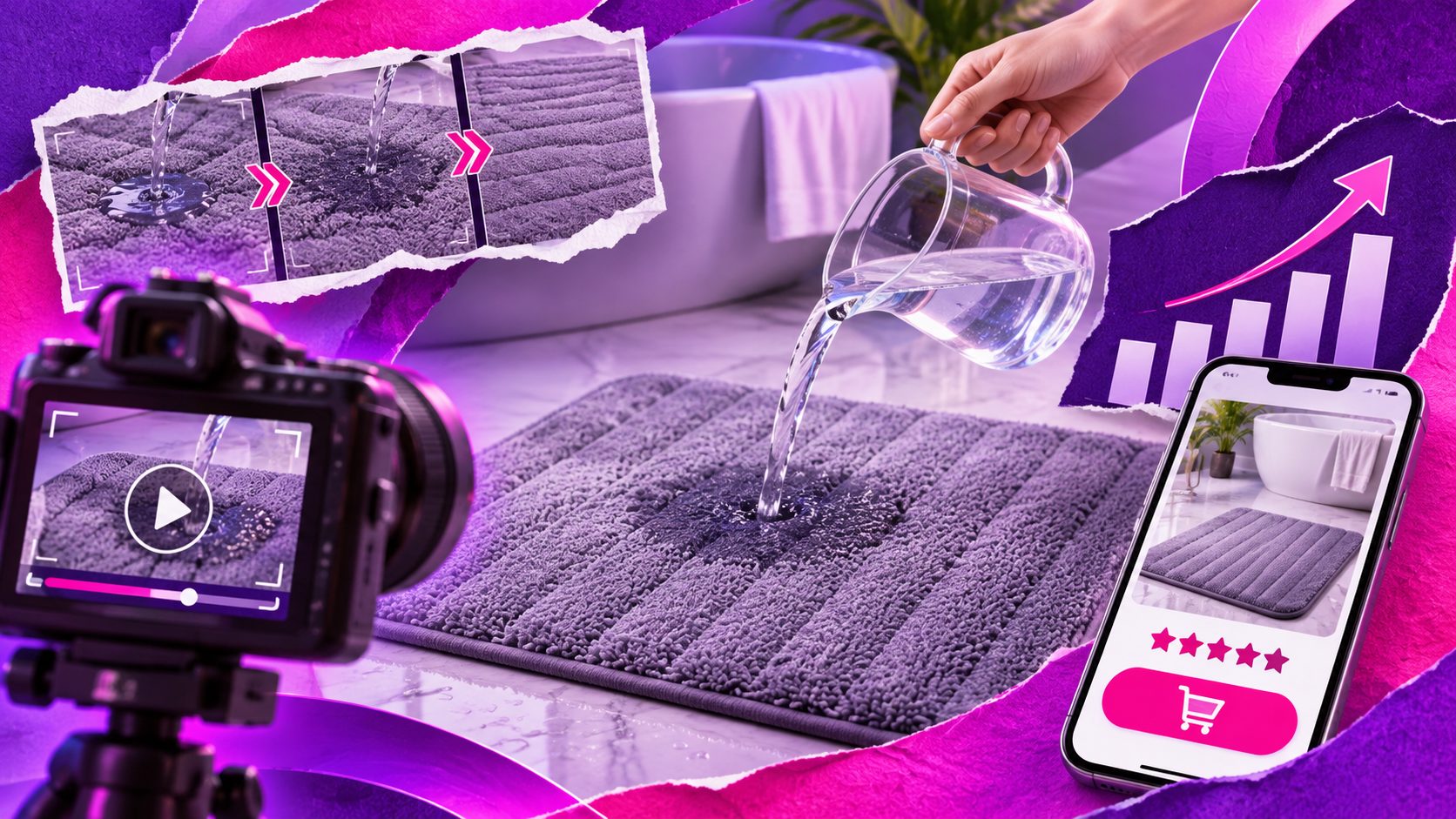
A bath mat water absorption test video ad turns an abstract product claim into visible proof. Instead of saying “quick-drying” or “super absorbent,” the video shows water being poured, absorbed, spread, or compared against another surface within seconds.
For ecommerce sellers, this format works because it demonstrates a specific household problem: wet feet, puddles near the shower, and a mat that remains damp after repeated use. The strongest creative does not rely on a single dramatic shot. It combines a controlled test, a realistic bathroom scenario, and a clear reason to buy.
What makes a bath mat water absorption test video ad persuasive?
A persuasive absorption ad answers three questions quickly: How much water was used? How fast did the surface respond? What does the result mean in everyday use?
The visible test should be simple enough to understand without sound. A transparent cup, measuring spoon, or spray bottle can make the water volume easier to judge. A split-screen comparison can also clarify the result, but only when both mats receive the same amount of water under similar conditions.
A useful benchmark is not merely whether water disappears from view. The ad should also show:
- The surface immediately after the water lands
- Whether water spreads toward the edge
- Whether a hand or tissue detects leftover moisture
- How the mat looks after repeated applications
- How the product fits under a real shower or bathtub
Search results for bath mat advertising commonly emphasize “quick dry,” “non-slip,” and stone or diatomaceous materials. However, the more valuable creative angle is repeat-use proof: showing what happens after the first wet footstep, then after several more. Existing bath mat ad collections also suggest that many running ads use direct shopping calls to action rather than question-based hooks, leaving room for a more evidence-led opening. (sprites.ai)
How should you structure the absorption test?
Use a four-part sequence: problem, controlled test, real-life repetition, and offer-focused close. This structure keeps the video understandable while giving the viewer a reason to continue watching.
1. Open with a visible bathroom problem
Start with a wet footprint, a small puddle, or a traditional mat that looks saturated. Avoid a long product introduction. The first frame should communicate the inconvenience before presenting the solution.
Possible hooks include:
- “Does your bath mat stay wet after every shower?”
- “We tested how quickly this mat handles a full splash.”
- “Same water. Two mats. Watch where it goes.”
- “A bath mat should absorb water—not move it around.”
The hook should match the proof. If the video only tests a small splash, avoid implying that it represents an entire shower.
2. Establish the test conditions
Place the bath mat on a flat, dry surface. Show the container briefly and use a repeatable quantity of water. Marking the test area with a small visual overlay can help viewers understand where the water lands.
For a stronger creative, record three passes:
- A small measured pour
- A second pour on a nearby dry area
- A footprint or hand-contact test after absorption
This creates a more useful story than one isolated pour. It also gives editors multiple moments for captions and jump cuts.
3. Show the real-use scenario
After the close-up test, cut to a person stepping out of the shower. Show the feet, the mat, and enough bathroom context to establish scale. The product should remain the visual subject rather than becoming a background prop.
If the product claims include non-slip performance, keep that claim separate from absorbency. Water absorption and floor grip are different properties. A responsible ad can say, “The surface absorbs the water in this test,” without implying that the mat prevents every slip in every situation.
4. End with a specific shopping reason
The final frame should show the mat in place with a concise benefit and product view. Examples include:
- “Designed for wet bathroom exits”
- “See the absorption test before you buy”
- “Choose your size and color”
- “Create a drier-looking bathroom routine”
A strong close connects the demonstration to the shopper’s decision rather than repeating every feature.
What test data should appear on screen?
The most useful on-screen data is test-specific, not invented performance statistics. Show the water amount, elapsed time, number of applications, and comparison conditions used in that particular video.
| Test element | What to show | Why it matters |
|---|---|---|
| Water volume | Measured cup, spoon, or spray count | Makes the test easier to judge |
| Starting condition | Dry mat and dry surrounding floor | Establishes a clear baseline |
| Time | Stopwatch or elapsed-time label | Supports a visual speed comparison |
| Repeat count | “Pass 1,” “Pass 2,” “Pass 3” | Demonstrates repeated use |
| Surface check | Tissue, hand, or close-up view | Shows whether moisture remains visible |
| Comparison | Same water amount on another mat | Adds context without overstating results |
This framework is an original creative-testing model: volume × time × repetition × surface check. It helps sellers avoid a common weakness in product demos—showing a visually impressive moment without enough context to interpret it.
Do not label a mat “the most absorbent” unless you have a defensible comparison across products and controlled conditions. A retailer or editorial tester may evaluate multiple mats using real-home conditions, but a short ecommerce ad should make narrower, verifiable claims. (hgtv.com)
How can product images become a test-style video?
You can begin with a clean JPG or PNG product photo, then build a visual sequence around it: product hero shot, water-pour scene, close-up texture, bathroom placement, and final call to action.
AdsTurbo Product Image can analyze a product’s shape, color, and category. It supports JPG and PNG uploads, and clear product photos on a plain background generally produce the best starting material. The output can be adapted to multiple aspect ratios for marketplaces and social platforms, including Amazon, Shopify, TikTok Shop, and Instagram.
For a full short-form workflow, combine:
- Product Image for clean product visuals
- Product Video for a UGC-style product demonstration
- Video Subtitle for readable captions
- AI Upscaling when the source footage is soft or compressed
- Background Replace for a cleaner bathroom setting
The TikTok Shop product video workflow is especially relevant when the objective is to turn one product asset into a short, mobile-first demonstration.
Which versions should ecommerce sellers test?
Do not create one “perfect” ad and stop. Build a small test matrix where each version changes one major variable.
| Version | Opening angle | Main proof | Best use |
|---|---|---|---|
| A | Wet-foot problem | Close-up pour | Cold traffic |
| B | Same water, two mats | Side-by-side comparison | Feature-aware shoppers |
| C | Repeated footsteps | Three-pass test | Family or high-use bathrooms |
| D | Product photo to bathroom scene | Visual transformation | Catalog and retargeting |
| E | Voiceover review | Personal demonstration | UGC-style placements |
Keep the product, offer, and landing page consistent when testing hooks. Otherwise, you will not know whether performance changed because of the creative or the conversion environment.
You can also adapt one master video into 9:16, 1:1, and 16:9 versions. AdsTurbo’s ecommerce ad creative variation workflow can support the planning of hook and format variations, while bulk AI video ad generation is useful when several product or audience variations need to be prepared.
Common mistakes in bath mat absorption ads
The most common mistake is using a large pour that looks dramatic but does not resemble normal bathroom use. A second mistake is showing water disappear without showing the surrounding floor, making it difficult to understand whether the water was absorbed or simply moved out of frame.
Avoid these problems:
- Do not use different water amounts in a comparison.
- Do not crop out the edges of the mat.
- Do not claim “instant dry” from a single frame.
- Do not combine absorbency and anti-slip claims without separate proof.
- Do not hide the mat’s texture, thickness, or actual size.
- Do not use a bathroom scene that makes the product look disproportionately large.
A product demonstration earns trust when the viewer can reproduce the logic of the test mentally.
Frequently asked questions
What is a bath mat water absorption test video ad?
A bath mat water absorption test video ad is a short ecommerce creative that demonstrates how a bath mat responds to a measured amount of water. It typically uses a pour, spray, footprint, or comparison test to make absorbency easier to evaluate.
How long should the video be?
For social placements, a compact 15–30 second edit is usually practical. The first few seconds should establish the wet-floor problem, followed by visible proof and a clear product close.
Should I compare the mat with another product?
A comparison can improve understanding, but only when the setup is fair. Use the same water volume, timing, camera angle, and surface conditions for both products.
Can a product image be used to create the ad?
Yes. A clear JPG or PNG product image can serve as the starting point for product scenes, bathroom placement visuals, and short product-video concepts. Real test footage should still be used when making specific performance claims.
How can I add captions for silent viewing?
Use short, time-synced captions such as “Measured water,” “Pass 1,” “After 10 seconds,” and “Repeat-use check.” AdsTurbo Video Subtitle can transcribe speech, generate synchronized captions, and export either a captioned video or a separate subtitle file.
Final checklist
Before publishing, confirm that the ad shows:
- A clear wet-floor or wet-feet problem
- A visible and repeatable test method
- The amount of water or test setup
- Elapsed time or repeated-use context
- A close-up result
- Separate treatment of absorbency and slip resistance
- Product size and bathroom placement
- Captions for silent viewers
- A direct, relevant call to action
The best bath mat creative is not the one with the biggest splash. It is the one that makes the shopper understand what was tested, what changed, and why that result matters in daily use.