Cleanroom Video Production Medical Manufacturing: A Buyer-Trust Guide

Summarize with
Summary
Learn how cleanroom video production medical manufacturing teams can show facility controls, production flow, and quality evidence without creating compliance risk.
By adsturbo.ai | Published 2026-11-06 | Updated 2026-11-06
Cleanroom video production medical manufacturing is the process of documenting controlled production environments, manufacturing steps, personnel practices, quality checkpoints, and material flow in a way that helps medical buyers evaluate a supplier. The strongest videos do more than show stainless-steel equipment: they make the factory’s operating logic visible without overstating certifications or product claims.
For overseas medical device OEMs and contract manufacturers, this type of video can support supplier discovery, RFQ conversations, trade-show presentations, distributor outreach, and technical due diligence.
What should a medical manufacturing cleanroom video prove?
A buyer-trust video should answer three questions quickly: Where is the product made? How does the process move? What evidence supports the supplier’s quality discipline? It should not attempt to replace an audit, validation package, or regulatory submission.
Search results for cleanroom manufacturing videos commonly emphasize factory tours, equipment demonstrations, ISO-class environments, packaging, and production capacity. Examples include medical consumables OEM video libraries, cleanroom injection molding footage, and facility walkthroughs from medical device manufacturers. (medsupplyoem.com)
A more useful structure is to organize the video around buyer decisions:
- Facility credibility: entrance controls, gowning, airlocks, cleanroom boundaries, and visible environmental discipline.
- Process clarity: material entry, preparation, assembly, inspection, packaging, and finished-goods movement.
- Quality visibility: inspection stations, traceability practices, measurement steps, and documented handoffs.
- Commercial relevance: product categories, customization points, lead-time implications, and capacity context.
This approach turns a “factory tour” into a visual explanation of how a supplier manages risk.
Which shots matter most in a cleanroom walkthrough?
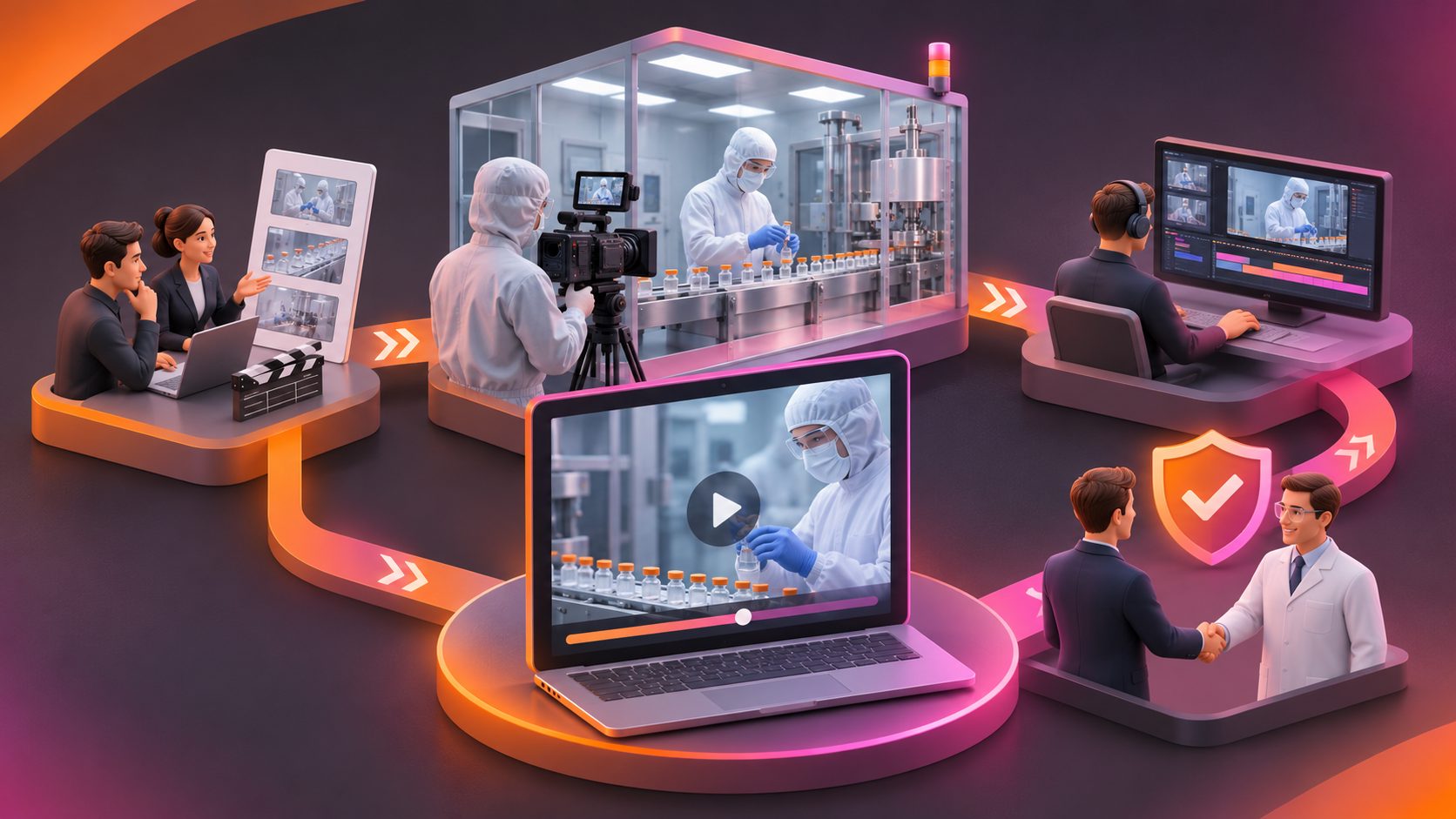
The best shot list follows the production route rather than the building map. A practical video can be planned in five sequences.
1. Controlled entry and gowning
Show the transition from general factory space into the controlled area. Useful shots include personnel preparation, protective clothing, hand hygiene, airlocks, material transfer points, and signage.
Avoid presenting protective equipment as proof of compliance by itself. PPE is visual evidence of a procedure, not evidence that every process requirement has been satisfied.
2. Material and component flow
Buyers need to understand how incoming materials reach the production area. Film labeled containers, staging zones, transfer windows, carts, and the separation between raw materials, work-in-process goods, and finished products.
A simple animated overlay can clarify the route:
Receiving → Preparation → Cleanroom Entry → Assembly → Inspection → Packaging → Dispatch
This is often more informative than wide shots of machinery because it shows how the facility controls movement and reduces confusion.
3. Production and assembly
Use medium and close-up shots to explain what operators and machines actually do. Capture loading, molding, joining, sealing, assembly, kitting, or packaging according to the manufacturer’s real process.
For complex equipment, add short labels rather than long narration. For example:
- “Component preparation”
- “Automated assembly”
- “In-process inspection”
- “Primary packaging”
- “Batch identification”
This keeps the video understandable for procurement teams, engineers, and non-specialist executives.
4. Inspection and quality checkpoints
Quality footage should show where decisions are made, not merely a person standing beside a machine. Film gauges, inspection benches, sampling steps, visual checks, measurement tools, and record-review moments when permitted.
Do not display confidential customer information, uncontrolled batch data, proprietary formulas, or documents that could be misinterpreted outside their original context. Blurring sensitive details is usually better than removing the entire scene.
5. Packaging and dispatch
End with the finished product’s next step. Show sealed packaging, labeling controls, carton preparation, warehousing, or shipment staging. For overseas buyers, this connects manufacturing capability to practical fulfillment.
A cleanroom video becomes commercially stronger when the final sequence answers: What can this supplier deliver, and how does the product leave the facility?
How can production footage avoid compliance and trust problems?
The central rule is simple: show observable facts and label claims carefully. A video may show an ISO-class room, but it should not imply that every product, process, or facility area carries the same certification unless the claim is verified and explicitly scoped.
Use a three-layer evidence system:
| Layer | What to show | What to avoid |
|---|---|---|
| Visual evidence | Rooms, equipment, operators, material flow | Calling appearance “proof” |
| Process evidence | Checkpoints, work instructions, inspection steps | Invented process names |
| Documentary evidence | Approved certificates or controlled records | Unverified or outdated documents |
The same principle applies to phrases such as “FDA approved,” “sterile,” “GMP compliant,” or “validated.” These terms can have specific legal or technical meanings. If the video includes them, the scope and source should be clear.
A strong narration line is factual: “This area is used for controlled assembly and packaging.” A risky line is broad: “This facility guarantees contamination-free production.”
What is the ideal length and format?
For a B2B medical manufacturing overview, a 90-second to three-minute master video is usually long enough to establish the facility story without overwhelming the viewer. From that master, create shorter cuts for different buyer stages:
- 15 seconds: cleanroom entry, equipment, and finished product
- 30 seconds: one production process or capability
- 60 seconds: facility overview for landing pages and outreach
- 2–3 minutes: full supplier introduction or trade-show presentation
Different audiences need different evidence. A sourcing manager may need capacity and packaging context. An engineer may care about process sequence and inspection. A distributor may need a clear product and customization overview.
AdsTurbo can support this repurposing workflow through clip-by-clip editing, video subtitles, translation, and video generation. Its subtitle tool can create synchronized captions and export either a captioned video or a separate subtitle file. This is useful when one factory master must serve English-speaking buyers and localized markets.
For a related product-content workflow, see the guide to 3D CAD to video for ecommerce and B2B brands.
How should a medical OEM turn one shoot into a buyer evidence library?
A useful information-gain framework is the Capability–Control–Proof–Commercial model:
- Capability: What products, materials, equipment, and processes can the factory handle?
- Control: How are people, materials, movement, and work areas organized?
- Proof: Which visible checkpoints demonstrate disciplined execution?
- Commercial: What should a buyer ask about customization, packaging, sampling, and production scale?
Each pillar can become a separate landing-page asset. This is more effective than publishing one generic “factory video” because buyers can access the exact evidence relevant to their decision.
For example, a medical tubing supplier could produce:
- A cleanroom overview.
- A tubing extrusion or assembly walkthrough.
- A packaging and labeling video.
- A quality inspection explainer.
- A multilingual short-form version for distributor outreach.
AdsTurbo’s Ad Clone workflow can also help restructure a short reference video into multiple advertising variants while preserving its key opening sequence, pacing, shot logic, and call-to-action structure. For regulated B2B communication, the source facts should remain controlled by the manufacturer; creative variation should not introduce unsupported claims.
Common questions
Is a cleanroom tour enough to qualify a medical device supplier?
No. A video supports preliminary evaluation, but buyers still need appropriate certificates, technical documentation, quality agreements, audits, samples, and regulatory evidence.
Should the video show the exact cleanroom classification?
It can, when the classification is verified and applies to the filmed area. The caption should identify the relevant space rather than implying that the entire site has one uniform classification.
Can one video serve international buyers?
Yes, but localization should address more than subtitles. Consider translated voiceover, local terminology, measurement conventions, product naming, and market-specific compliance language. AdsTurbo supports video translation, subtitles, and multilingual creative workflows.
What if the factory cannot film inside every area?
Use a combination of permitted footage, process diagrams, close-ups, interviews, and carefully labeled illustrations. Transparency about restricted areas is more credible than substituting unrelated footage.
How can a supplier create more variations without filming repeatedly?
Plan reusable shots during the original production day, then create versions by process, product family, market, language, and buyer role. A bulk AI video ad workflow for ecommerce testing can inform the variation logic, while the final claims should remain tied to verified manufacturing facts.
Final checklist for a buyer-trust manufacturing video
Before publishing, confirm that the video:
- Shows a logical production route rather than disconnected factory shots.
- Separates visible observations from certification or regulatory claims.
- Includes at least one meaningful quality checkpoint.
- Protects customer names, batch data, formulas, and confidential documents.
- Uses captions for technical terms and silent viewing.
- Produces short versions for outreach, landing pages, and trade shows.
- Localizes language without changing the underlying claim.
- Ends with a clear next step, such as requesting samples, an RFQ, or a facility discussion.
A cleanroom video is most persuasive when it reduces buyer uncertainty. It should help a prospective customer understand not only that a controlled environment exists, but also how materials, people, processes, inspections, and delivery fit together.
For teams building a broader product-content system, AI video advertising workflows for ecommerce creative variation offers a useful framework for turning one verified source asset into structured campaign versions.