Fitness Equipment Delivery Doorway Measurement Video Guide

Summarize with
Summary
Create a fitness equipment delivery doorway measurement video guide that shows customers how to measure doors, turns, stairs, and elevators before ordering. Reduce avoidable delivery failures with Ads
By adsturbo.ai | Published 2026-11-02 | Updated 2026-11-02
For large fitness products, the most important delivery question is not only “Will it fit in the room?” It is “Can the packaged product travel from the curb to the final room?” This fitness equipment delivery doorway measurement video guide shows ecommerce sellers how to turn that question into a short, practical customer video.
Treadmills, ellipticals, power racks, rowers, cable machines, and exercise bikes may need to pass through exterior doors, interior doorways, hallways, corners, stairs, and elevators. A clear measurement video can help buyers identify problems before ordering instead of discovering them when the delivery crew arrives.
What should a fitness equipment delivery measurement video explain?
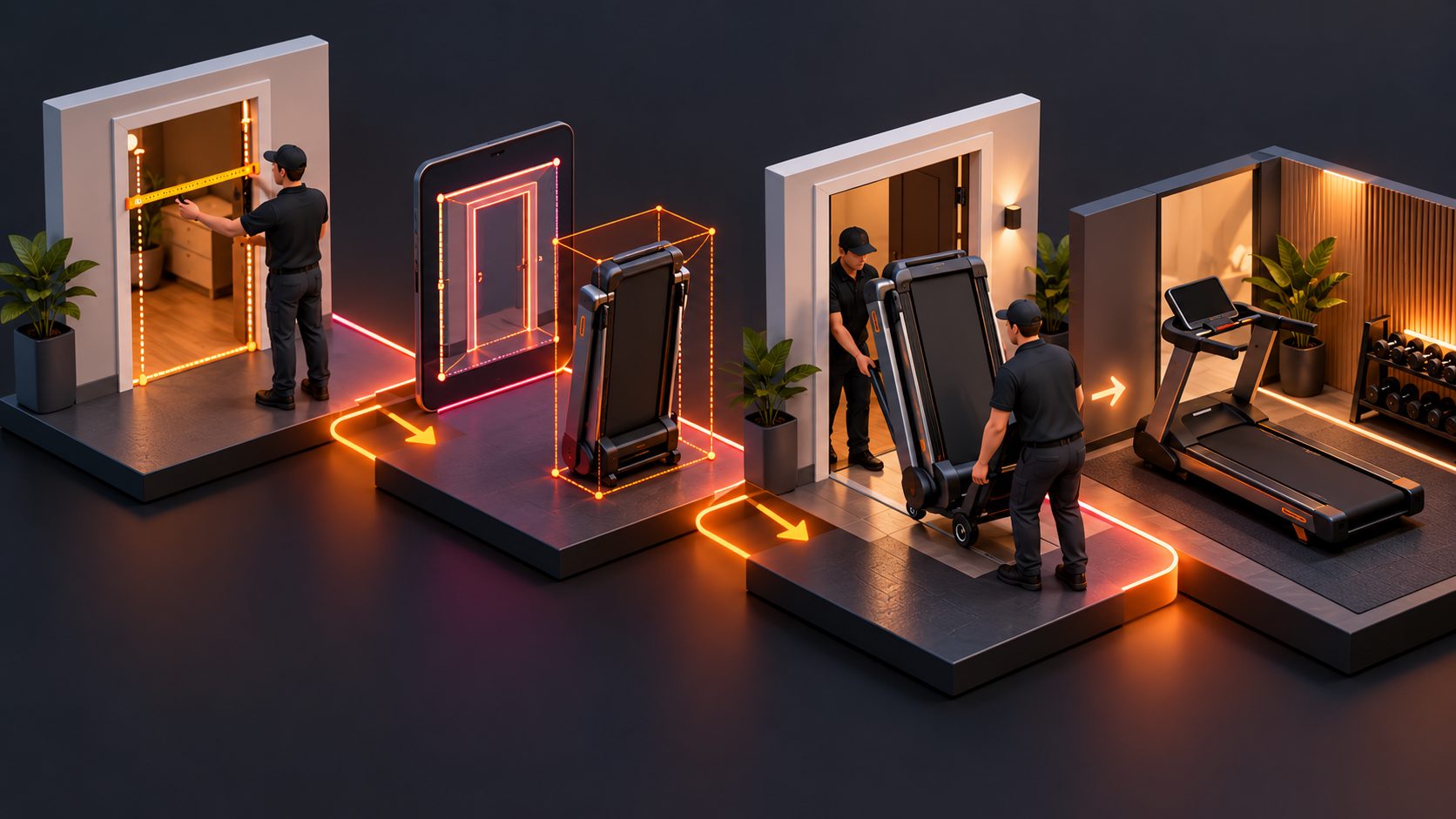
A delivery measurement video should show the complete route, not just the final workout area. Customers need to compare the product’s packed dimensions and delivery orientation with the narrowest point along the path.
The core instruction is simple:
- Identify the delivery entrance.
- Measure every doorway and passage.
- Check turns, stairs, ceilings, and elevator dimensions.
- Compare the smallest clearances with the product’s shipping measurements.
- Record photos or video of any tight section for delivery support.
Major delivery guides commonly recommend measuring door heights, doorway widths, staircases, ceiling clearance, low fixtures, and the distance from an entry door to the opposite wall. Apartment customers should also measure elevator openings and interior depth. (cdn.bfldr.com)
For sellers, the opportunity is to make those instructions visual. A customer may misunderstand “door width,” but a close-up showing the tape measure between the actual door stops is much harder to misread.
Which measurements should the video demonstrate?
Use a route-based sequence so the customer follows the same order that the equipment will travel.
1. Exterior door and threshold
Show the front, garage, patio, or loading entrance that may be used. Measure:
- Clear width with the door opened as far as practical
- Clear height below the frame or trim
- Threshold height and floor transition
- Door handle, closer, screen door, or storm door intrusion
- Space directly inside the entrance
Do not rely on the nominal door size. The useful number is the clear opening after hardware and the door itself reduce the passage.
2. Hallways and interior doors
Measure every internal doorway between the entrance and the destination room. Also show the narrowest hallway section and any fixed obstacles such as shelving, radiators, wall-mounted cabinets, or handrails.
A doorway may be wide enough in isolation but still fail if the product cannot be rotated into it. This is particularly important for long treadmills and boxed strength equipment.
3. Corners and turning space
A straight-line width check is not enough. Film each sharp turn from both directions and measure the approach distance before the turn, the width of the turn, and the clearance after it.
A useful seller-created rule is the Three-Point Route Check:
- Opening: Can the packaged item pass through the narrowest doorway?
- Rotation: Can it be tilted or turned at the corner?
- Reach: Is there enough space beyond the corner to lower or reposition it?
This framework adds a practical decision layer that standard measurement checklists often omit. It helps customers understand why a 32-inch doorway does not automatically prove that a long, rigid package can enter the room.
4. Stairs, landings, and ceiling obstacles
For stairs, demonstrate measurements between handrails, at landings, and beneath the lowest ceiling point. Include beams, ducts, pendant lights, sprinkler heads, and sloped ceilings.
Fitness retailers should ask customers to count every flight and identify whether the route includes a basement, split-level landing, or upper-floor apartment. Some delivery services limit stair access or require an elevator for higher floors, so the customer should confirm the service terms before purchase. A Best Buy fitness delivery checklist, for example, instructs customers to clear the path, plan for stairs, and account for arrival access and parking. (files.bbystatic.com)
5. Elevators and apartment access
Apartment videos need a dedicated elevator segment. Show customers how to measure:
- Elevator door opening width and height
- Interior width and depth
- Distance from the elevator door to the opposite wall
- Ceiling height or diagonal clearance when the product must be tilted
- Hallway width outside the apartment
Also remind buyers to check freight-elevator reservations, loading zones, building time windows, and protective requirements with property management.
How should sellers structure the video?
A useful customer-facing video is usually easier to follow when it uses a fixed storyboard rather than a general warning.
Recommended 60–90 second storyboard
- Hook: “Before ordering, measure the full path from delivery entrance to workout room.”
- Product reference: Display the packed length, width, height, and weight on screen.
- Door demonstration: Show clear width and height, not just the door panel.
- Route walk-through: Film hallways, corners, stairs, and elevators in order.
- Tight-space warning: Explain that the narrowest point and hardest turn determine feasibility.
- Final-room check: Show operating footprint, ceiling height, and access for assembly.
- Action step: Ask customers to submit measurements or route photos before delivery.
Use on-screen labels such as “clear opening,” “narrowest point,” “turning space,” and “packed dimensions.” Keep each label visible long enough to read on a phone.
For ecommerce sellers, the video can sit on the product page, appear in post-purchase email, or be sent by customer support when a buyer selects room-of-choice delivery. A related Shopify product page sizing video workflow can help teams turn static size information into visual buyer guidance.
What product information should appear beside the video?
The video cannot solve missing product data. Place a compact measurement panel next to it:
| Customer needs | Seller should provide |
|---|---|
| Delivery clearance | Packed length, width, and height |
| Final placement | Assembled footprint and height |
| Handling | Product weight and package weight |
| Orientation | Whether the item may be tilted or carried vertically |
| Route planning | Minimum doorway and hallway guidance |
| Installation | Whether assembly occurs in the final room |
| Building access | Elevator, stairs, loading-zone, or appointment notes |
Do not present one “standard doorway” number as a universal guarantee. Delivery feasibility depends on the product’s rigid dimensions, packaging, turning angle, route geometry, and service conditions.
How can AI make this video easier to produce?
Sellers can build the first version from a product photo, packed-dimension sheet, and a short script. AdsTurbo supports product video creation from JPG or PNG product images, with optional selling points and promotional information. That makes it practical to create a product-specific measurement explainer instead of publishing one generic video for every machine.
For a catalog with multiple equipment types, create reusable variants:
- Treadmill delivery route
- Power rack and weight-stack delivery route
- Elliptical and stair-climber ceiling-clearance route
- Apartment elevator delivery route
- Basement gym staircase route
AdsTurbo also supports video subtitles, translation, AI upscaling, background replacement, and clip-by-clip editing. Sellers can use subtitles to emphasize dimensions and create localized versions for different markets. Its subtitle workflow can export either a video with embedded captions or a separate subtitle file, which is useful for product pages and short-form social placements.
For teams managing many SKUs, the video-to-URL workflow for Shopify and Meta Ads can support direct distribution of finished instructional videos, while ecommerce FAQ-to-video production can turn repeated delivery questions into buyer education content.
Common mistakes to avoid
Showing only the final room. The product may fit the room but fail at the entrance or first turn.
Measuring the door slab instead of the clear opening. The frame, hardware, and open-door position change the usable width.
Using assembled dimensions for delivery. The packaged item may be larger, smaller, or shaped differently from the assembled machine.
Ignoring diagonal movement. Long equipment often needs to be tilted, rotated, or approached from a specific angle.
Leaving out apartment logistics. Elevator reservations, loading zones, and hallway restrictions can cause failed delivery even when the door measurements work.
Using unsupported promises. Say “confirm with the delivery team” when the route is tight. Avoid guaranteeing successful delivery from one measurement alone.
Frequently asked questions
What is the most important measurement for fitness equipment delivery?
The most important measurement is the smallest clear opening or turning point on the complete route. Measure from the delivery entrance to the final room, including doors, hallways, corners, stairs, and elevators.
Should customers measure the boxed or assembled product?
They should compare the route with the packed dimensions first, then check the assembled footprint and operating clearance in the final room. The two checks answer different questions.
Do treadmill delivery videos need to show ceiling height?
Yes. Ceiling height matters when the treadmill is tilted during handling, when stairs are involved, or when the final room has low beams, lights, or sloped ceilings.
What should an apartment buyer record besides measurements?
Record a short route video, elevator details, loading instructions, stair count, hallway constraints, and any building delivery rules. This gives the seller or carrier more context than a single doorway number.
Can one delivery guide work for every fitness product?
A general checklist can introduce the process, but product-specific videos are safer. Treadmills, racks, ellipticals, and cable machines have different package shapes, handling orientations, and final-space requirements.
A strong delivery measurement video does more than reduce customer confusion. It sets expectations before checkout, gives support teams a repeatable answer, and helps sellers address the real cause of many large-product delivery failures: an unverified route.