Remake a Viral Ad Without Copying: A Practical Ecommerce Workflow


Summarize with
Summary
Learn how to remake a viral ad without copying its protected expression. Break down hooks, pacing, proof, and CTAs, then rebuild an original version for your store.
By AdsTurbo.ai | Published 2026-11-16 | Updated 2026-11-16
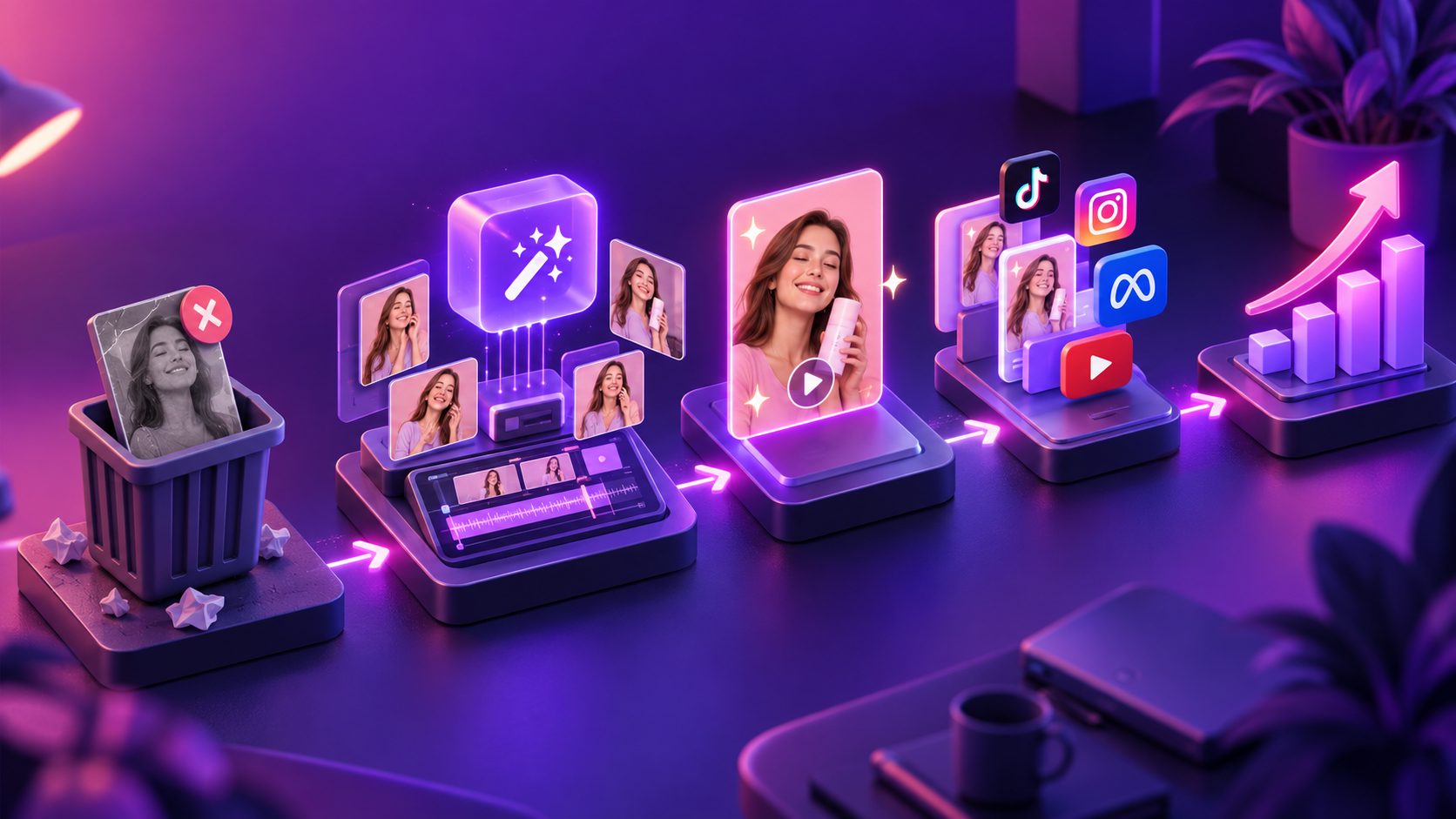
To remake a viral ad without copying, borrow the ad’s functional structure—such as its hook, pacing, proof sequence, and CTA logic—while replacing its footage, script, creator, music, claims, and brand assets with original material. This approach helps ecommerce teams learn from proven creative patterns without producing a lookalike ad.
What can you borrow from a viral ad?
You can usually study an ad’s idea-level mechanics, but not reproduce its protected expression. In practical terms, analyze what the ad is doing rather than collecting the exact elements that make it recognizable.
A useful distinction is:
| Usually safe to study | Replace or clear before publishing |
|---|---|
| Hook type | Exact opening line |
| Problem-to-solution sequence | Original script |
| Number and order of beats | Original footage |
| General pacing | Creator’s face or voice |
| Proof format | Music and sound effects |
| CTA placement | Logos, packaging, slogans |
| Audience angle | Specific claims or testimonials |
For example, you may observe that a winning ad opens with a product failure, demonstrates a quick fix, shows proof, and ends with an offer. You can rebuild that sequence for your own product, but the words, visuals, people, demonstrations, and evidence should be yours.
This is also consistent with TikTok’s creative guidance, which emphasizes a clear hook, body, and close rather than a single universal visual formula. (ads.tiktok.com)
The practical rule: preserve the function, change the expression
A useful editing test is this:
If viewers could identify the original ad from your first three seconds—even with your logo removed—you changed too little.
Change at least four high-recognition variables:
- The audience: Move from “busy parents” to “frequent travelers,” for example.
- The problem: Replace the original frustration with a product-specific pain point.
- The proof: Use your own demonstration, review, comparison, or product detail.
- The visual language: Change the setting, camera position, colors, typography, and transitions.
The goal is not to make a disguised duplicate. It is to use a proven communication pattern as a starting hypothesis.
How to teardown a viral ad before rebuilding it
A viral ad teardown should be a written recipe, not a transcript. Record what each moment is meant to accomplish, then discard the original execution.
Use this five-part framework:
1. Hook
Identify the attention mechanism:
- A surprising visual
- A direct question
- A strong opinion
- A visible product problem
- A before-and-after contrast
- A curiosity gap
Do not copy the original sentence. Rewrite the hook around your own buyer and product promise.
2. Context
What does the viewer need to understand before the product appears? Some ads introduce a lifestyle, a failed workaround, or a frustrating situation. Your version should create a comparable amount of context with completely different scenes and language.
3. Product moment
Note when the product enters and what job it performs. Is it demonstrated, worn, unboxed, compared, or shown in use? The product moment should answer one question: why is this item relevant to the problem introduced in the opening?
4. Proof
Proof may come from a demonstration, a close-up, a result, a user reaction, or an explanation of the mechanism. Replace borrowed testimonials or claims with evidence your business can support.
5. Close
Record how the original ad moves from interest to action. Your CTA can use a similar function—learn, compare, shop, or claim an offer—but the wording and offer should be specific to your brand.
This teardown produces a beat map. It is more useful than copying a transcript because it tells you why each shot exists.
A remake workflow for ecommerce sellers
To clone winning ads responsibly, use this sequence.
Step 1: Choose a reference you can lawfully analyze
Use an ad you own, have permission to use, or are otherwise authorized to process. Keep a record of the source, permission, creator agreement, music license, and any usage restrictions.
Do not assume that a public TikTok, Instagram Reel, YouTube video, or competitor ad is available for commercial reuse simply because it can be viewed online.
Step 2: Convert the reference into a neutral brief
Write a short brief using labels such as:
- Audience
- Problem
- Hook mechanism
- Number of beats
- Approximate pacing
- Product demonstration type
- Proof type
- CTA function
Avoid copying names, dialogue, jokes, distinctive gestures, recognizable framing, or brand-specific visual motifs.
Step 3: Create a replacement map
For every recognizable element, define an original replacement.
| Reference function | Original replacement |
|---|---|
| Creator says the product failed | Customer shows a different use-case problem |
| Fast unboxing | Hands-on setup or comparison |
| Dramatic reveal | Close-up of a measurable product detail |
| Testimonial | Verified customer language or demonstration |
| Discount CTA | Your own offer, benefit, or next step |
This is the most important step in the process. It forces your team to create new material before production begins.
Step 4: Prepare your assets
Gather your own product photos, packaging, brand fonts, approved claims, product benefits, offer details, and footage. If you use people, confirm that you have the right to use their likeness and voice.
For product-led creative, clean product photography is especially valuable. A consistent workflow such as Shopify product photos can give your remake enough original visual material to avoid relying on the reference ad’s look.
Step 5: Generate several structural variations
An AI ad cloner should be used to accelerate analysis and variation—not to reproduce another advertiser’s assets. AdsTurbo Ad Clone can analyze a reference video you own or have permission to use, turn its content, style, and structure into an editable prompt, and help generate new variations from your own people, products, and scenes. See the AI ad cloner workflow for this use case.
Change one major creative variable per version:
- Hook angle
- Audience
- Product benefit
- Proof style
- CTA
- Aspect ratio
- On-screen text treatment
This makes performance results easier to interpret than changing everything at once.
What makes a remake feel original?
Originality is not just swapping the product. A stronger remake changes the reason the viewer should care.
For example, a reference may sell convenience through a fast demonstration. Your version could use the same demonstration logic but focus on durability, portability, ease of cleaning, or gifting. The structure remains familiar; the customer promise becomes yours.
A simple originality scorecard can help:
- Script: newly written from your product facts
- Footage: recorded, licensed, or generated for your brand
- Person: owned, contracted, or properly authorized
- Audio: licensed or original
- Visual identity: your colors, typography, setting, and packaging
- Proof: supported by your own evidence
- CTA: aligned with your own offer and landing page
If two or more of these still point clearly to the source ad, rebuild the concept again.
Clone video ads, not competitor identity
The phrase clone video ads can be misleading. The productive thing to clone is a repeatable production logic: a hook category, a sequence of objections, a demonstration format, or a rhythm of cuts.
The unproductive thing to clone is a competitor’s identity. That includes their founder, creator, slogan, packaging, signature phrase, logo, music, and distinctive performance.
This distinction also improves advertising quality. A copied ad advertises the original brand in the viewer’s memory. An original remake should make the audience remember your product, your promise, and your reason to believe.
For a broader production system, the DTC video ads workflow can help organize recurring angles, formats, and testing inputs.
Final pre-launch checklist
Before publishing your remake viral ad, ask:
- Do we own or have permission to use the reference?
- Is every spoken line newly written?
- Are the visuals, creator, music, and product shots original or licensed?
- Could a viewer confuse this with the source brand?
- Are all product claims accurate and supportable?
- Does the ad work without the reference beside it?
- Does the CTA lead to our product and offer?
- Have we checked text, subtitles, and logos frame by frame?
For low-resolution source material that you are authorized to use, an AI video enhancer can improve clarity before analysis or editing. Enhancement does not create usage rights, however; permission and originality remain separate requirements.
Frequently asked questions
Is it legal to recreate a competitor’s ad?
It may be possible to use a general advertising structure, but legal risk depends on the specific assets, jurisdiction, permissions, claims, likeness rights, trademarks, and platform rules. This article is general information, not legal advice. Get professional advice when the remake uses a competitor’s identifiable brand elements or a creator’s identity.
Can I copy the hook from a viral ad?
Do not copy the exact wording, distinctive joke, or signature phrase. Instead, identify the hook mechanism—such as a question, contrast, or problem reveal—and write a new line for your audience and product.
How do I remake a viral ad with AI?
Start with a reference you own or may use, convert it into a neutral beat map, replace every protected expression, add your own assets, and generate multiple original variations. Review the output for accidental likeness, copied text, unsupported claims, and brand confusion.
What does “clone winning ads” actually mean?
It should mean learning from the structure and testing logic of effective ads, not duplicating their footage, script, identity, or branding. The safest useful output is a new ad built from a documented creative hypothesis.