Small Appliance Safety Test Video Ads: A Proof-First Guide

Summarize with
Summary
Learn how to plan small appliance safety test video ads with credible proof, GFCI awareness, safer demonstrations, and scalable creative variations. Start building your next ad.
By adsturbo.ai | Published 2026-11-05 | Updated 2026-11-05
Small appliance safety test video ads should make a safety claim understandable without encouraging viewers to recreate a dangerous experiment. For D2C sellers, the strongest format combines controlled evidence, clear limits, product context, and a short call to action.
A toaster, kettle, blender, coffee maker, or countertop cooker may be evaluated for electrical safety, heat behavior, cord condition, grounding, and protection near water. However, a marketing video should not present an improvised shock or leakage test as entertainment. Safety claims need qualified testing, accurate labeling, and careful editing.
What should a small appliance safety test video prove?
A safety test video should answer one practical question: what was tested, under what conditions, and what did the result show? It should not imply that one demonstration proves every aspect of product safety.
For a small kitchen appliance, organize the evidence into four layers:
- Visual condition: Show the housing, plug, cable, seams, controls, and safety labels.
- Use environment: Explain whether the appliance is used near water, heat, food, or a grounded outlet.
- Controlled testing: Show qualified equipment, test conditions, and a result or report reference.
- Consumer behavior: Demonstrate correct use, cleaning, unplugging, and storage.
This structure is more credible than a dramatic “danger versus safe” scene. The U.S. Consumer Product Safety Commission warns that electricity and water can create shock or fire hazards, and recommends attention to damaged cords, appliance placement, and GFCI-protected outlets. (cpsc.gov)
What is a GFCI demonstration?
A GFCI, or ground-fault circuit interrupter, monitors the electrical flow and interrupts power when it detects an imbalance that may indicate current traveling through an unintended path. In a video, explain the purpose without asking customers to create a fault themselves.
A responsible scene might show:
- A labeled GFCI outlet with its Test and Reset controls.
- A qualified tester operating the device safely.
- A simple overlay: “Protection depends on the electrical system and correct installation.”
- A disclaimer directing viewers to a licensed electrician for inspection or repair.
Do not claim that a GFCI makes an appliance automatically safe. It is one part of a broader protection system, not a substitute for product compliance, correct wiring, or safe operation.
How should sellers structure the test footage?
The best sequence moves from context to proof, then to everyday use. This reduces confusion and gives viewers a reason to keep watching.
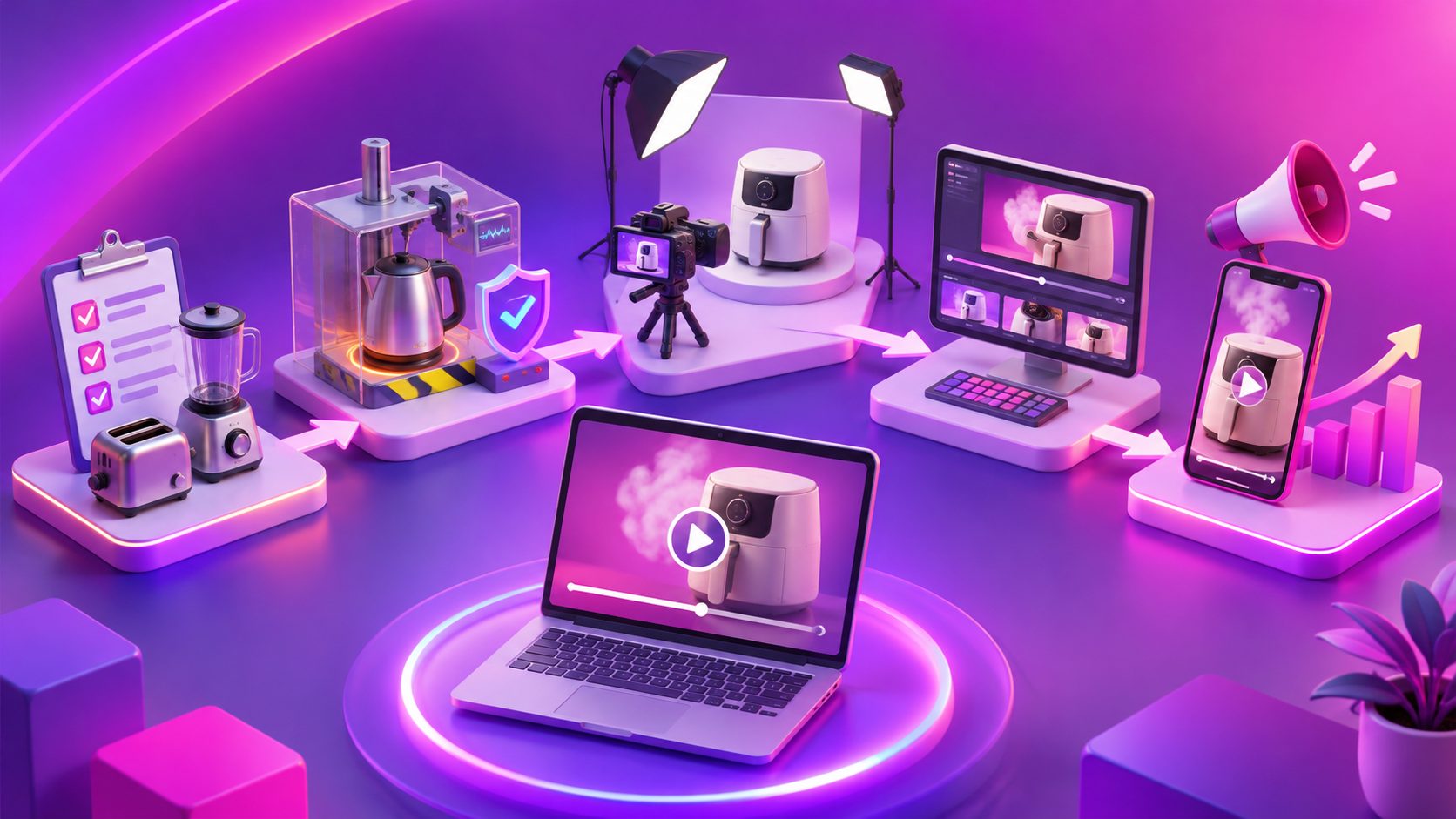
A proof-first 15-second storyboard
This editorial framework is designed for short-form ads and can be adapted for TikTok, Reels, Shorts, or paid social placements:
| Time | Visual | On-screen message |
|---|---|---|
| 0–2 sec | Close-up of the appliance and its plug | “What happens when safety is tested?” |
| 2–5 sec | Controlled lab or inspection setup | “Tested under defined conditions” |
| 5–8 sec | Meter, checklist, or test report detail | “Electrical and physical checks documented” |
| 8–11 sec | Product operating normally | “Designed for everyday countertop use” |
| 11–13 sec | Correct placement away from water and heat | “Use as directed” |
| 13–15 sec | Product, offer, and CTA | “See the full product details” |
The key creative decision is to show the test boundary, not just the result. A result without conditions can look like a guarantee. A result with a clear scope feels more trustworthy.
For a longer version, use chapter cards such as “Before use,” “Controlled inspection,” “Normal operation,” and “Safe handling.” This also makes the footage easier to repurpose into product-page modules and customer-support content.
Which safety claims belong in the ad?
Use claims that can be verified and explained. Avoid absolute language such as “shock-proof,” “100% safe,” or “impossible to overheat” unless a qualified authority has specifically certified that exact claim and use condition.
Safer claim patterns include:
- “Tested under defined conditions.”
- “Demonstrates the correct setup for use.”
- “Designed with [documented feature].”
- “Follow the included instructions.”
- “Do not use near water unless the product documentation permits it.”
- “Stop using the appliance if the cord or housing is damaged.”
The U.S. Fire Administration advises unplugging small appliances when they are not in use and replacing appliances with cracked, damaged, or loose cords. (usfa.fema.gov) These recommendations can become practical ad scenes, but they should be presented as user guidance rather than proof that a product cannot fail.
For manufacturer-level substantiation, sellers can reference the type of evaluation performed by recognized testing organizations. UL Solutions describes testing and certification services for small appliances, including electrical safety and performance verification. (ul.com)
How can ecommerce sellers produce multiple safety ad variations?
A single test recording can support several creative angles without changing the underlying claim. This is especially useful when testing hooks across Meta, TikTok, YouTube Shorts, and product pages.
Create variations by changing:
- Hook: “Before you plug in a countertop appliance” versus “What should a safety check show?”
- Audience: First-time buyer, busy parent, small-kitchen owner, or gift shopper.
- Proof emphasis: Cord inspection, GFCI explanation, normal operation, or cleaning guidance.
- Format: 9:16 short video, 1:1 product-page clip, or 16:9 education video.
- CTA: “View the test details,” “See the setup guide,” or “Shop the appliance.”
AdsTurbo can support this production workflow with Ad Clone, product video creation, video subtitles, translation, AI upscaling, background replacement, and clip-by-clip editing. Its Ad Clone workflow can analyze a reference video up to 12 seconds and generate advertising variations, which is useful when the goal is to preserve the opening hook and pacing while adapting the product, language, or offer.
For a broader testing system, see this guide to an ecommerce ad creative variation generator. For multilingual campaigns, the Spanish UGC video ads workflow for ecommerce offers a useful localization reference.
What should the production checklist include?
Before publishing, review the video against this checklist:
- Is the test performed by a qualified person or organization?
- Are the test conditions stated or shown?
- Does the video avoid unsafe DIY instructions?
- Are water, damaged cords, overloaded outlets, and hot surfaces handled responsibly?
- Does the claim match the actual evidence?
- Are subtitles readable on mobile screens?
- Is the product shown in its intended use environment?
- Are disclaimers visible long enough to read?
- Are translated claims checked for technical meaning?
- Does the CTA lead to product information rather than an unsupported safety promise?
AdsTurbo Video Subtitle can automatically transcribe speech, generate synchronized captions, translate subtitles, and export either a captioned video or a separate subtitle file. That helps sellers adapt the same safety explanation for different platforms and markets while keeping the core claim consistent.
For campaign-level assets, the warranty policy video guide for electronics can help connect safety education with post-purchase expectations.
Common questions about appliance safety test ads
Can a seller perform an electrical leakage test at home?
A seller should not improvise a leakage, shock, insulation, or fault test for advertising content. Use qualified testing personnel, suitable equipment, and documented procedures. A home demonstration can show correct operation or safe placement, but it should not simulate a hazardous failure.
Should the ad show a test certificate?
If the document is authentic and applies to the exact product, model, and claim, a brief, readable excerpt can improve transparency. Do not display unrelated certificates or imply that one document covers every market, configuration, or use condition.
Is a GFCI the same as product certification?
No. A GFCI protects against certain electrical faults in the installation. Product certification evaluates the appliance against applicable requirements. The two should not be presented as interchangeable.
How long should the safety video be?
Use 15 seconds for one clear proof point, 30 seconds for a short inspection narrative, and 45–60 seconds when showing multiple checks. The correct length depends on whether the objective is awareness, product-page education, or claim substantiation.
How can a seller localize the same safety ad?
Keep the visual evidence consistent, then adapt voiceover, subtitles, on-screen warnings, units, and regulatory references for each market. Avoid translating technical claims literally without confirming that the wording remains accurate.
A safety ad works best when it demonstrates care rather than manufacturing fear. Show the product, define the test, explain the limits, and give customers a practical next step. For scalable production, AdsTurbo’s AI video advertising platform can help turn one approved concept into product videos, subtitles, translated versions, and creative variations.