

By adsturbo.ai | Published 2026-09-25 | Updated 2026-09-25
Inclusive beauty swatch video ads AI workflows help DTC beauty brands show more shades, models, finishes, and localized messages without reshooting every creative from scratch. The strongest approach is not to let AI invent proof of product performance. Instead, use verified shade information and real product references as the foundation, then use AI to expand formats, hooks, characters, languages, and testing variations.
For foundation and lipstick, this distinction matters. A generated face can improve representation, but it should not replace reliable evidence of how the actual formula looks on skin.
What makes an inclusive beauty swatch video credible?
An inclusive beauty swatch video is a short-form product demonstration that shows how a shade, finish, or application appears across different skin tones, undertones, face shapes, or styling contexts. Its credibility comes from clear product proof, consistent lighting, accurate shade labels, and representation that reflects the intended customer base.
AI can help create more variations, but it cannot automatically solve color accuracy. Research on virtual makeup and foundation rendering continues to identify skin-tone blending, illumination, and realistic material appearance as technical challenges. (arxiv.org)
A useful standard is the Proof Stack:
- Formula proof: Show the real product, packaging, texture, or verified swatch.
- Representation proof: Include a deliberate range of skin depths and undertones.
- Application proof: Show blending, coverage, payoff, or finish in motion.
- Purchase proof: Display shade names, product benefits, offer details, and a clear CTA.
If one layer is missing, the ad may look attractive but still leave shoppers unsure whether the product is right for them.
How should DTC brands plan a shade-inclusive video set?
Do not begin by asking AI to “make diverse models.” Begin with a shade-to-creative matrix that connects each product shade to a customer question.
| Product | Customer question | Best video proof | Useful variation |
|---|---|---|---|
| Foundation | Will this undertone blend into my skin? | Side-by-side swatch and blended close-up | Model, lighting, undertone, finish |
| Lipstick | What does this color look like on me? | Arm swatch plus lip application | Skin depth, lip pigmentation, makeup style |
| Concealer | Does it brighten or cover without looking gray? | Half-face application | Coverage level, texture, lighting |
| Blush | Is the payoff visible on deeper skin? | Layered application | Intensity, finish, outfit, occasion |
This matrix creates better testing variables than producing many random AI videos. For example, a foundation campaign can hold the script constant while testing four variables: skin depth, undertone, opening hook, and finish language.
A practical starting set is:
- One shade-range overview video
- Three foundation videos grouped by undertone
- Three lipstick videos grouped by color family
- One “how to find your shade” explainer
- One comparison video showing finish or coverage
The goal is not to claim that every customer will see an identical result. The goal is to make the path to product selection easier and more transparent.
How can AI expand foundation and lipstick swatch videos?
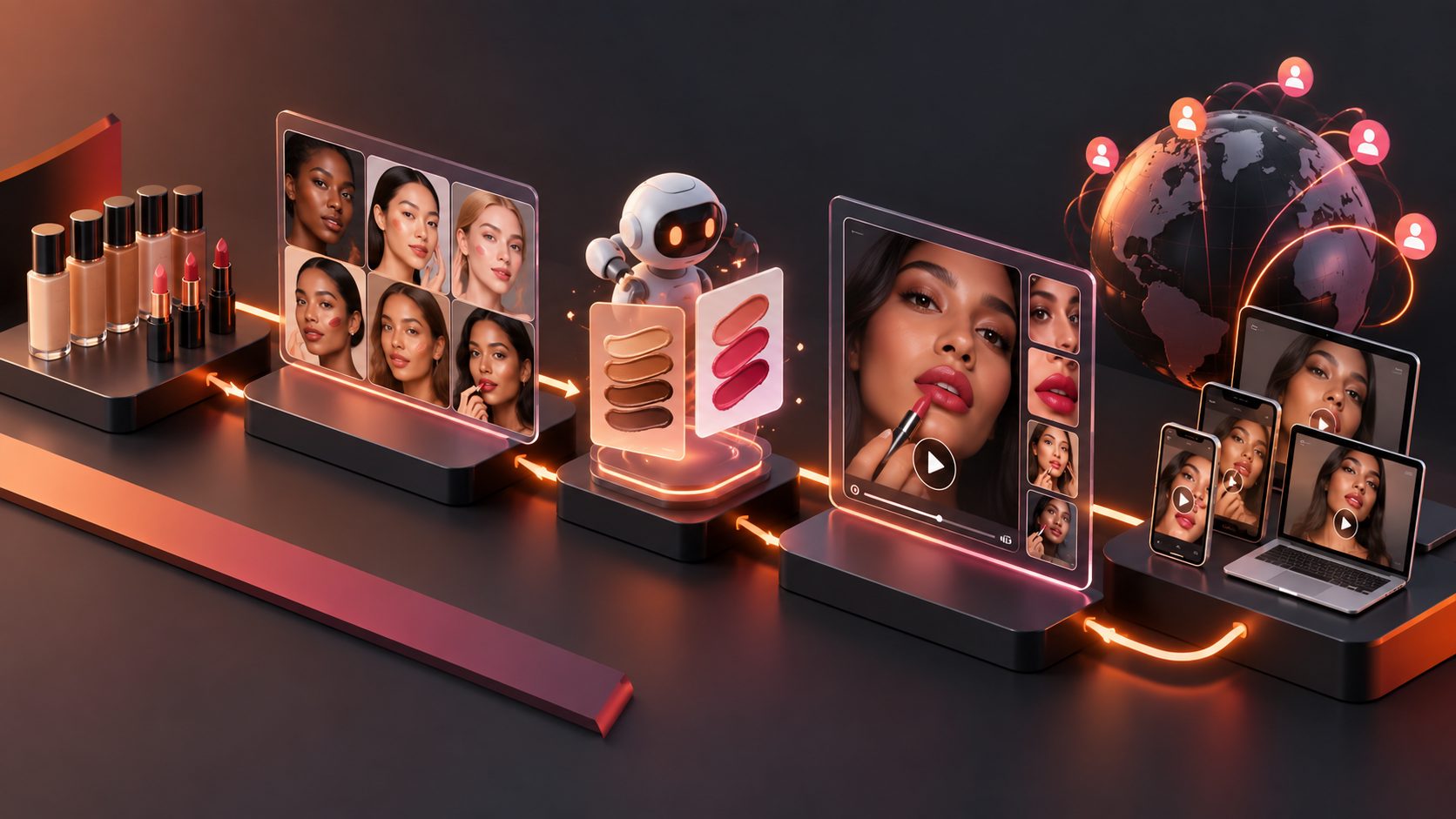
AI is most useful after the creative direction and product facts are fixed. A DTC team can use one approved product reference to build multiple versions for TikTok, Instagram Reels, YouTube Shorts, product pages, and paid social testing.
AdsTurbo Product Image accepts JPG or PNG product images and can analyze product shape, color, and category. It can also generate six image types from one product photo, including banners, lifestyle scenes, close-ups, material-detail images, instruction images, and brand images. Product Image supports nine output ratios for channels such as Amazon, Shopify, TikTok Shop, and Instagram.
For video, AdsTurbo supports product video creation, ad cloning, motion control, lip sync, character replacement, video translation, subtitles, background replacement, and upscaling. Its Ad Clone workflow can analyze a reference video of up to 12 seconds and use the structure to create new advertising variations.
A responsible workflow looks like this:
- Upload the product image or approved reference video.
- Define the shade, finish, audience, offer, and claims that must remain unchanged.
- Choose a creative role: swatch demo, shade guide, product review, tutorial, or comparison.
- Create model, voice, language, and platform variations.
- Add verified shade labels and product footage.
- Review color, packaging, hands, lips, facial consistency, and captions.
- Export several aspect ratios and test one variable at a time.
For brands starting from still product assets, an AI product photo to unboxing video workflow can help turn a single product image into a more familiar creator-style format.
What should the first three seconds show?
The first three seconds should answer the shopper’s most important uncertainty, not simply introduce the brand.
Strong opening structures include:
- Foundation: “Finding your undertone? Compare these three shades.”
- Lipstick: “Here is the same red on three different skin depths.”
- Coverage: “One side blended, one side untouched.”
- Finish: “See the difference between satin and matte in natural light.”
- Shade navigation: “Warm, neutral, or cool? Start here.”
A useful 15-second structure is:
- 0–2 seconds: Show the face, arm, or lips with the shade question on screen.
- 2–6 seconds: Display the product and shade name.
- 6–11 seconds: Show application, blending, or a close-up finish.
- 11–15 seconds: Add the CTA, product page direction, or shade-finder prompt.
Avoid unsupported promises such as “matches everyone” or “looks identical on every skin tone.” Beauty shoppers understand that lighting, undertone, pigmentation, and application can change the result. Honest qualification often creates more trust than universal claims.
TikTok’s beauty guidance also emphasizes showing real results on real skin and notes that supplying brand stock footage can improve the usefulness of AI-assisted creative production. (ads.tiktok.com)
How can brands localize inclusive swatch ads for global markets?
Localization should change more than subtitles. A cross-border beauty ad may need different shade vocabulary, creator presentation, skin-tone representation, offer language, and CTA structure.
AdsTurbo Video Subtitle can automatically transcribe speech, generate synchronized captions, and export either a video with embedded subtitles or a separate subtitle file. Its video translation workflow supports multilingual localization, while Event Poster can generate promotional visuals in seven languages, including English, Chinese, Japanese, and Korean.
For an international shade campaign, create a localization sheet with:
- Local shade naming conventions
- Preferred undertone terms
- Currency and offer format
- Platform-specific caption length
- Model and creator casting requirements
- Regulatory or claim restrictions
- Final CTA for each market
Use AI ecommerce video translation for subtitles, dubbing, and localization when adapting a proven concept. Translate only after the original version has a clear visual sequence; otherwise, you may multiply a weak idea across several markets.
How should teams test AI-generated beauty swatch ads?
The most useful test is not “Which video looks best?” It is “Which proof element reduces uncertainty for the target shopper?”
Run a controlled creative test with:
- The same product and offer
- The same audience and placement
- One changing variable per test
- Multiple skin-tone and undertone versions
- Consistent captions and CTA placement
- A defined success metric before launch
Useful test variables include:
- Swatch-first versus face-application-first
- Shade label shown early versus late
- Creator voiceover versus text-led demo
- Natural-light look versus studio look
- Single shade versus shade-family comparison
- Human footage anchor versus fully synthetic scene
For a new product launch, combine AI-generated variations with at least one verified product proof asset. This hybrid approach gives the campaign creative scale without asking generated visuals to carry the full burden of color accuracy.
AdsTurbo’s asynchronous generation model also supports production pipelines that rely on status polling or Webhook completion events. Advanced plans support team workflows, API access, and custom workflows, which can help teams organize higher-volume creative testing rather than producing files manually one by one.
For a broader testing system, a guide to refreshing the first three seconds of video ads provides a useful framework for managing hook fatigue.
Common questions
Can AI generate realistic makeup swatches?
AI can create realistic-looking visual variations, but realistic appearance is not the same as verified color accuracy. Use approved product references, clear shade labels, and real or validated swatch footage wherever the ad makes a product-performance claim.
Should every skin tone have a separate ad?
Not necessarily. A shade-range overview can introduce the collection, while separate videos can answer more specific questions about undertone, depth, finish, or application. The best structure depends on the number of shades and the buying uncertainty you need to reduce.
What product assets work best?
For AdsTurbo Product Image, use a clear JPG or PNG product image. A sharp product photo on a plain background generally produces the best result. For product video workflows, include accurate packaging, shade names, selling points, and any approved product footage.
Can one swatch concept be used across TikTok, Meta, and Shorts?
Yes, but the edit should be adapted to each placement. AdsTurbo tools support video editing, subtitles, translation, and multiple output formats. Keep the core proof consistent while adjusting pacing, captions, framing, and CTA placement.
How can brands avoid misleading beauty advertising?
Separate inspiration from proof. Label shades clearly, avoid universal matching claims, disclose meaningful limitations, and review every generated frame for color shifts, distorted packaging, inconsistent facial features, and inaccurate text before publishing.