Cross-Border Ecommerce Ad Video Localization Dubbing: A Practical QA Workflow

Summarize with
Summary
Learn how to localize ecommerce ad videos with dubbing, lip sync, subtitles, and market-ready QA. Use this practical workflow to prepare ads for cross-border testing.
By adsturbo.ai | Published 2026-11-17 | Updated 2026-11-17
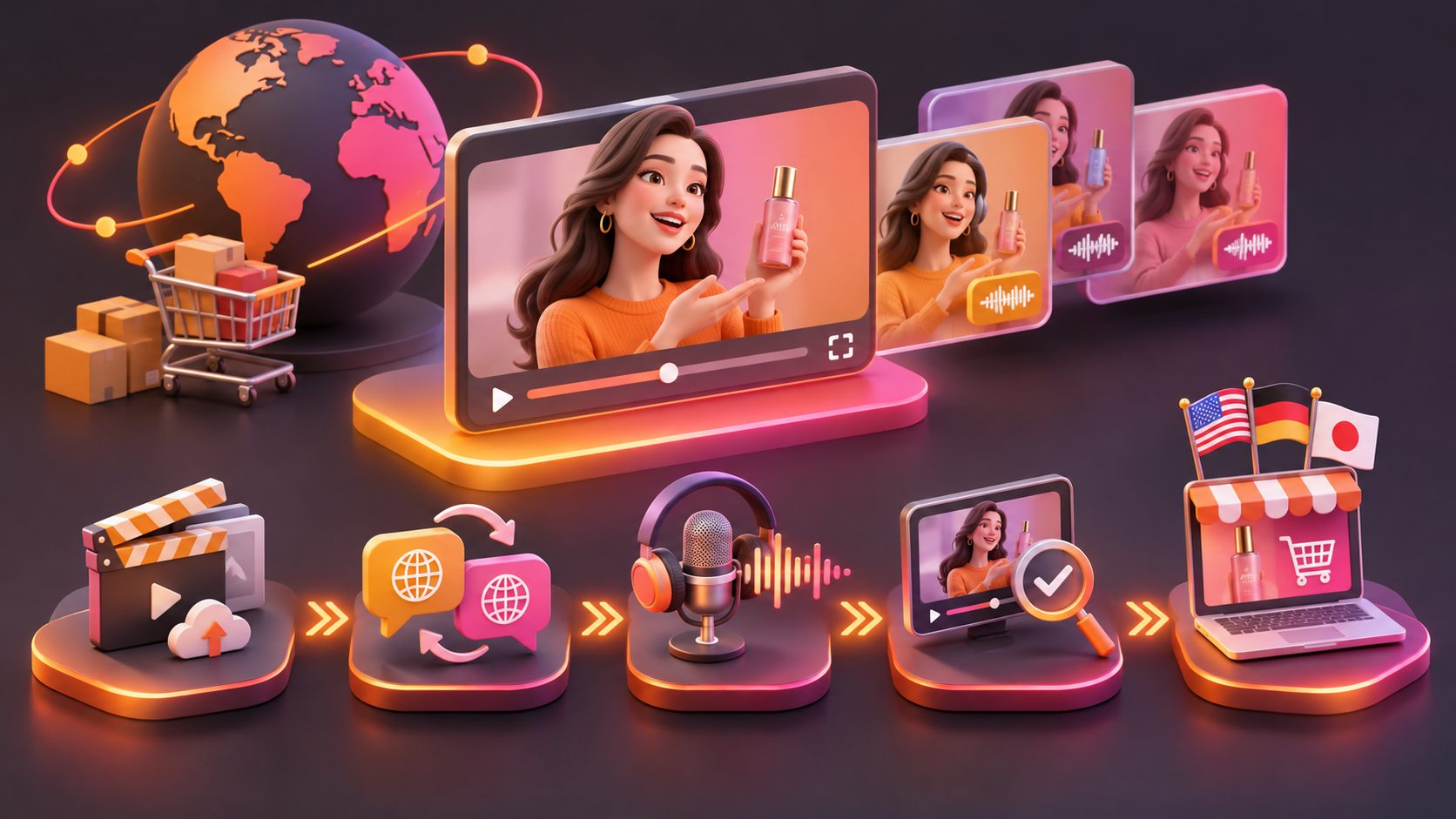
Cross-border ecommerce ad video localization dubbing is the process of adapting one product or UGC ad for another market through translated audio, subtitles, on-screen text, offers, pacing, and sometimes lip synchronization. The goal is not literal translation. It is a version that feels native, remains commercially accurate, and preserves the original ad’s selling logic.
For ecommerce sellers, the most expensive mistake is treating localization as an audio-only task. A translated voice can still fail if the product claim, discount, subtitle layout, landing page, or call to action does not match the target market.
What does ecommerce video localization include?
Ecommerce video localization includes five connected layers: spoken language, visual text, commercial details, performance, and platform delivery. Dubbing changes the voice track, while full localization also adapts what viewers see and what they are asked to do.
The main components are:
- Script translation or transcreation — preserve the hook and benefit, not every original word.
- Dubbing or voiceover — replace or add the target-language audio.
- Lip synchronization — align visible mouth movements when a presenter speaks directly to camera.
- Subtitle localization — translate, re-time, and reformat captions for mobile viewing.
- On-screen text replacement — update product claims, labels, prices, discount codes, and CTAs.
- Platform export — prepare versions for TikTok, Instagram Reels, YouTube Shorts, Meta, or product pages.
Industry localization guidance commonly distinguishes dubbing from subtitling: dubbing replaces the original spoken track, while subtitles preserve the original audio and add translated text. (cris.unibo.it)
Dubbing, subtitles, or lip sync: which should sellers use?
The right choice depends on how visible the speaker is, how quickly the ad communicates, and how much creative risk the offer carries.
| Ad situation | Recommended treatment | Reason |
|---|---|---|
| Product montage with voiceover | Dubbing plus subtitles | The speaker’s mouth is not central to credibility |
| UGC creator speaking to camera | Dubbing, subtitles, and selective lip sync | Natural facial delivery matters more |
| Demonstration with little speech | Subtitles and localized on-screen text | Visual proof carries the message |
| Strong winning ad with a visible presenter | Test dubbed and lip-synced versions | Compare trust and retention |
| Complex claims or legal wording | Human-reviewed script and subtitles | Accuracy is more important than speed |
A useful rule is: apply lip sync only where the viewer is watching the speaker’s mouth. For product shots, cutaways, and hands-on demonstrations, translated audio and well-timed subtitles are often sufficient. Research on professional dubbing also suggests that natural delivery and translation quality can matter more than forcing every syllable into perfect visual timing. (arxiv.org)
AdsTurbo’s video tools support video translation, lip sync, subtitles, video analysis, and resolution enhancement. For a separate explanation of audio and caption tradeoffs, see this guide to AI dubbing vs. subtitles for video ads.
A five-step localization workflow for ecommerce ads
1. Select a proven master video
Start with a video that already has a clear product benefit, credible proof, and a strong opening. Do not localize every asset in the library at once. Choose one or two ads with a defined hook and CTA so the test measures market response rather than creative confusion.
Record the master version’s:
- First three-second hook
- Product promise
- Demonstration sequence
- Social proof or objection handling
- Offer and final CTA
- Original runtime and aspect ratio
The structure should remain recognizable across markets unless the local audience requires a different explanation order.
2. Extract and rewrite the script for timing
Literal translation often creates lines that are too long for the original shots. Instead, translate for meaning, spoken rhythm, and commercial intent.
Create a localization sheet with these columns:
| Field | What to verify |
|---|---|
| Source line | Exact original dialogue |
| Target line | Natural market-language version |
| Duration | Maximum time available |
| Visual action | What is happening on screen |
| Product term | Approved local wording |
| CTA | Market-appropriate next step |
| Review status | Language, legal, and creative approval |
The target script should fit the shot without making the voice unnaturally fast. If a sentence expands, shorten the wording, add a cutaway, or redesign the shot rather than forcing a rushed delivery.
3. Generate the dubbed audio and decide where lip sync belongs
Use a consistent voice direction across all variants. Define the desired tone—such as friendly, expert, energetic, or understated—and keep pronunciation of the brand and product name consistent.
For visible presenters, lip sync can improve continuity. However, it should be evaluated shot by shot. A useful internal decision framework is:
- Mouth clearly visible and central: consider lip sync.
- Face partially covered or moving quickly: compare with standard dubbing.
- Presenter appears briefly: subtitles may be enough.
- Product is the main visual subject: prioritize voice clarity and product visibility.
AdsTurbo supports AI lip sync and asynchronous generation workflows, so teams can receive completion events through status polling or Webhook callbacks when building repeatable production pipelines.
4. Rebuild subtitles and on-screen text
Subtitles should not be copied line-for-line from the source layout. Different languages create different word lengths, punctuation patterns, and reading speeds.
Use these rules:
- Keep each subtitle block short enough to scan on a phone.
- Break lines at natural phrases, not in the middle of product names.
- Keep text inside the platform’s safe area.
- Avoid covering the product, price, or speaker’s face.
- Check that the CTA remains visible long enough to act.
- Replace hardcoded source-language text wherever it affects purchase decisions.
AdsTurbo Video Subtitle can automatically transcribe speech, generate synchronized subtitles, translate them, and export either a video with embedded captions or a separate subtitle file.
For mobile-first composition, compare the final output with a vertical, horizontal, and square video ad export guide.
5. Run a market-ready acceptance check
The most useful QA process is not one general review. It is a six-part acceptance matrix:
- Language: Does the copy sound natural to a native speaker?
- Audio: Are pronunciation, pacing, volume, and emotion credible?
- Mouth movement: Does lip sync look acceptable in close-up shots?
- Visual text: Are subtitles, prices, claims, and CTAs correct?
- Commerce: Does the offer match the destination page and inventory?
- Platform: Does the export preserve safe zones, resolution, and readability?
This matrix is an original operating framework for ecommerce teams because it separates errors that are usually mixed together. A video can pass language review but fail commerce review if the discount code is wrong. It can pass audio review but fail platform review if subtitles are hidden behind interface elements.
How to improve quality without rebuilding every ad
Localization becomes more efficient when the team separates creative invariants from market variables.
Creative invariants are elements that should usually remain stable:
- Product demonstration
- Core proof point
- Shot order
- Brand identity
- Main CTA logic
Market variables can change:
- Voice and language
- Subtitle phrasing
- Discount and currency
- Offer urgency
- Cultural examples
- Presenter or voice style
- End-card layout
This separation allows sellers to create controlled variants. For example, keep the same product demonstration while testing two localized hooks, two voice styles, and two CTA endings. That gives the media buyer interpretable results instead of a completely different creative in every market.
If the source footage is soft, compressed, or heavily cropped, use an AI video enhancer before localization. Better resolution can improve subtitle contrast and facial detail, but it cannot correct an inaccurate translation or weak offer.
Common questions about localized ecommerce video ads
Is AI dubbing enough for cross-border ecommerce ads?
Usually, no. AI dubbing handles the spoken track, but a market-ready ad also needs localized subtitles, on-screen text, offer details, and a final commerce check. Dubbing is one layer of localization rather than the complete workflow.
Should every localized ad use lip sync?
No. Use lip sync when a visible speaker’s mouth is important to trust or authenticity. For narration-led ads, product demonstrations, and fast-cut footage, a natural dub with readable captions may be more effective and easier to review.
How should sellers localize subtitles?
Translate for natural phrasing, re-time each line, and rebuild the layout for the target language. Check mobile safe zones and make sure subtitles do not obscure the product, presenter, price, or CTA.
What source files should be prepared?
Keep the highest-quality video master, a clean audio track when available, the original script, product terminology, approved claims, offer details, logo assets, and destination-page copy. Clean source materials reduce the need for corrective editing later.
How can teams scale localization across many markets?
Use a consistent script sheet, naming system, review matrix, and export specification. AdsTurbo also provides API access and composable modules for image generation, personas, AI actors, ad cloning, video generation, and task processing, which can support structured production workflows.
A successful localized ad is not merely translated. It preserves the original conversion path while making every customer-facing detail feel intentional in the new market. Start with one proven creative, localize the script and visible text, apply lip sync selectively, and require language, visual, commerce, and platform approval before launch.