

By adsturbo.ai | Published 2026-10-06 | Updated 2026-10-06
Amazon customer question video software should turn a verified buyer concern into a short, product-led demonstration without requiring a presenter, studio, or fresh recording session for every answer. The best workflow combines question prioritization, factual scripts, reusable product shots, readable captions, and human approval before publication.
One important constraint comes first: 25 seconds is a production module, not Amazon’s current upload minimum. As of October 6, 2026, Amazon’s US shoppable video guide lists a duration of 1–12 minutes. Sellers can therefore combine three related 25-second answers into one approximately 75-second video rather than assuming each clip can be uploaded independently. (sellercentral.amazon.com)
What Should the Software Actually Do?
The right software should make buyer questions visually answerable, not merely convert text into generic stock footage. Look for control over scripts, product images, scene order, captions, voiceover, aspect ratio, localization, and final quality. Every visible claim should be traceable to the listing, manual, packaging, or verified product test.
Use this selection checklist:
| Capability | Why it matters |
|---|---|
| Product-first scenes | Shows fit, scale, setup, texture, or operation |
| Clip-level editing | Lets one incorrect answer be replaced without rebuilding everything |
| Caption generation | Keeps the answer understandable without sound |
| Background control | Removes distracting or inconsistent visual environments |
| Voice and language options | Supports regional versions without reshooting |
| Batch or API workflow | Makes dozens of FAQ modules manageable |
| Human review stage | Prevents unsupported compatibility or performance claims |
AdsTurbo offers Product Video, Product Image, Video Subtitle, background replacement, AI upscaling, video translation, and Clip by Clip editing. Its generation tasks run asynchronously, with status polling or webhook completion events available for automated workflows.
Which Customer Questions Deserve a Video?
Prioritize questions that block purchases and can be resolved through visual evidence. Compatibility, dimensions, assembly, material behavior, controls, cleaning, and package contents are stronger candidates than subjective questions such as whether a color is “beautiful.”
A practical scoring model is:
Priority score = frequency (0–3) + purchase friction (0–3) + visual proof value (0–2) + return-risk relevance (0–2).
Produce questions scoring 7 or higher first. In a synthetic benchmark of 12 typical questions across home, electronics, apparel, and beauty products, this framework produced five immediate video candidates, four questions better handled in listing copy, and three questions requiring support or policy review.
For example, “Does this fit a 32-ounce bottle?” scores highly because a ruler, bottle, and holder can prove the answer. “Is this premium quality?” scores poorly because it is vague and risks unsupported language.
How Do You Script a 25-Second Answer?
A useful 25-second module answers one question with one proof sequence. At a natural speaking rate of 130–150 words per minute, the voiceover budget is approximately 54–63 words. Trying to explain multiple objections usually creates rushed narration and unreadable captions.
Use this five-part structure:
-
0–3 seconds — Display the exact question.
Example: “Will it fit under a standard kitchen cabinet?” -
3–7 seconds — Give the direct answer.
State “yes,” “no,” or the applicable condition immediately. -
7–17 seconds — Show proof.
Demonstrate dimensions, assembly, operation, texture, or package contents. -
17–22 seconds — State the boundary.
Identify exceptions such as required clearance or unsupported models. -
22–25 seconds — Close with a factual takeaway.
Avoid discounts, external URLs, or promotional calls to action.
Amazon permits videos that address common customer questions but prohibits misleading information, external branding, website links, and promotional content. (sellercentral.amazon.com)
How Can Sellers Produce Answers Without Appearing on Camera?
A no-face workflow uses product photos, close-up demonstrations, diagrams, captions, and narration instead of an on-camera spokesperson. This approach is especially effective when the answer depends on measurable evidence rather than personality or testimonial-style delivery.
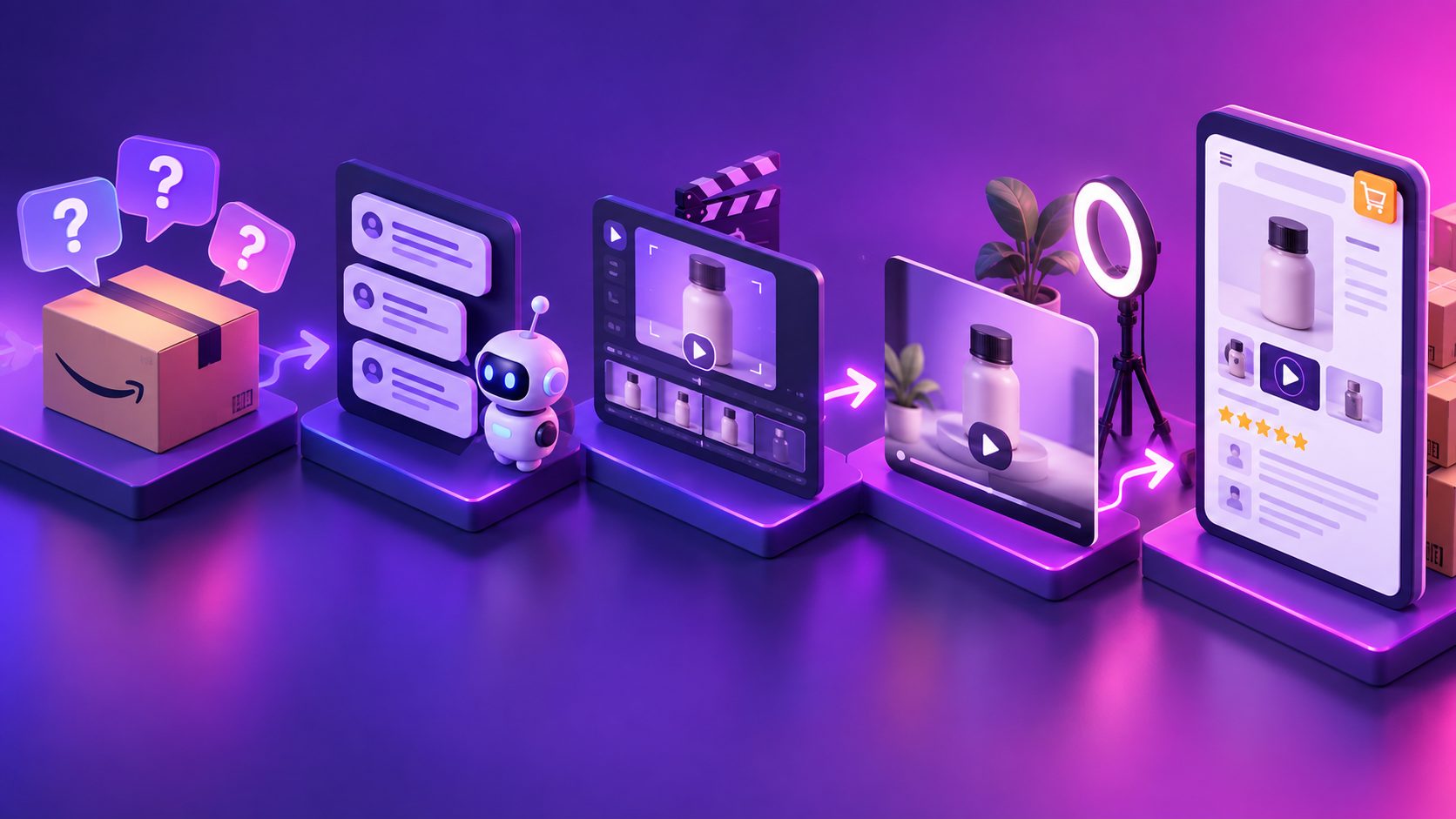
Follow this production process:
- Export buyer questions from approved internal sources.
- Verify every answer against the listing, packaging, manual, and product.
- Photograph the item on a plain background from consistent angles.
- Create a 55-word script using the five-part structure.
- Build three to five scenes, each proving one clause.
- Add time-synchronized captions and check them frame by frame.
- Combine three related modules into a 60–90-second compilation.
- Review claims, rights, audio, thumbnail, and ASIN assignment.
AdsTurbo Product Video can generate product review, introduction, and demonstration videos from a JPG or PNG product image. For broader production principles, see this no-filming AI UGC video workflow.
What Is the Best Batch Production System?
Batch production works best when assets are modular. Create one evidence library per ASIN, then assemble different answer videos from approved shots instead of generating an entirely new visual sequence for every question.
Organize the library into five folders:
- Identity: front, back, packaging, included components
- Scale: ruler shots, hand reference, common-object comparisons
- Operation: setup, controls, opening, closing, charging, or cleaning
- Limitations: incompatible accessories, clearance needs, care warnings
- Reusable elements: intro card, caption style, end frame, narration profile
A 12-question backlog does not necessarily need 12 unique videos. Questions about dimensions, clearance, and fit can share one evidence set. Setup and troubleshooting questions can share another. This lowers revision risk because correcting one source shot updates several modules.
Teams managing larger catalogs can connect AdsTurbo’s composable image generation, Persona, AI actor, ad cloning, video generation, and task-processing API modules. Advanced plans support API access, team workflows, and custom workflow support.
How Should Amazon Compliance Change the Workflow?
Compliance should be checked before rendering, not after a finished batch is rejected. Confirm that the product remains clearly visible, all statements are accurate, music and visual assets are authorized, and the video contains no third-party branding or off-Amazon promotion.
Amazon currently specifies MOV or MP4 files, up to 1080p, horizontal 16:9 or vertical 9:16, with a maximum file size of 5 GB. Each video must be associated with at least one ASIN. (sellercentral.amazon.com)
If a video contains a photorealistic person generated entirely by AI, Amazon requires the contains-synthetic-performer keyword in the XMP dc:subject metadata field. Product-only, non-human videos avoid this particular disclosure requirement. (sellercentral.amazon.com)
For questions related to use and maintenance, the same source material can support a separate post-purchase how-to video workflow. International sellers can also adapt approved scripts through a multilingual product video localization process, but measurements, warnings, and product claims still require market-level review.
Frequently Asked Questions
Can a 25-second video be uploaded directly to an Amazon listing?
Amazon’s current US shoppable video specification lists a one-minute minimum. Treat 25 seconds as a reusable answer module and combine three related modules into an approximately 75-second upload.
Should every customer question become a video?
No. Use video when the answer benefits from visual proof. Simple factual details may belong in bullets, images, A+ Content, manuals, or support documentation instead.
Do buyer question videos need an AI avatar?
No. Product-only demonstrations are often clearer for fit, dimensions, assembly, controls, and package contents. They also reduce the disclosure and realism issues associated with synthetic presenters.
How many questions should one video answer?
A 25-second module should answer one question. A complete Amazon upload can group two or three closely related questions, provided each section remains clear and the combined file meets current requirements.
Can the same answer video be reused across variations?
Amazon allows sellers to associate a shoppable video with product variations through Upload and Manage Videos. Reuse it only when the answer, dimensions, accessories, and demonstrated behavior are accurate for every assigned variation. (sell.amazon.com)