


By adsturbo.ai | Published 2026-10-06 | Updated 2026-10-06
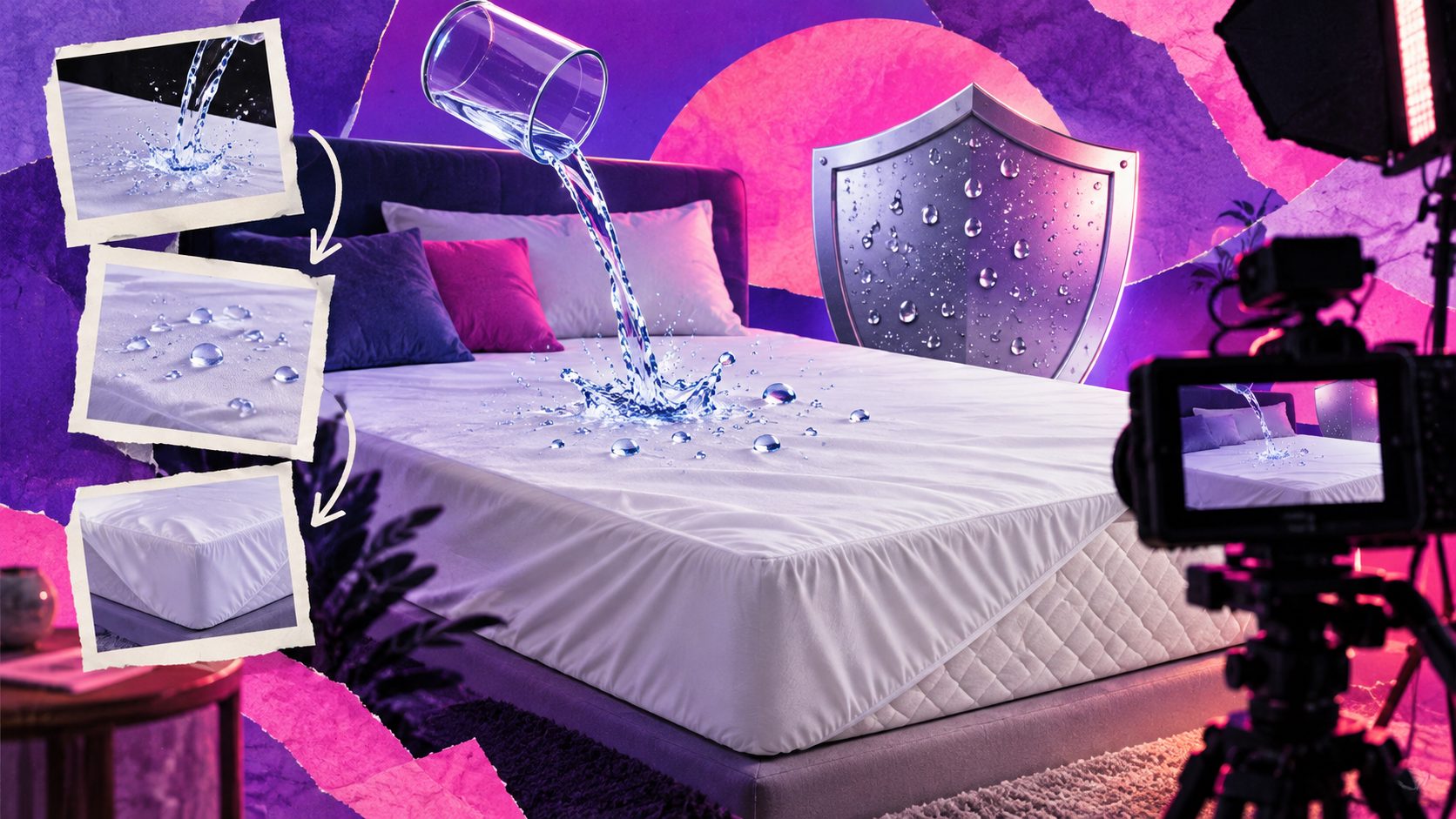
A waterproof mattress protector video ad should make one promise visible: liquid stays above the protector while the layer beneath remains dry. In 15 seconds, show the spill, reveal the dry underlayer, qualify any allergen-related language, and end with one purchase-focused call to action.
The creative principle is simple: demonstrate the physical benefit instead of stacking adjectives. Use real test footage for performance claims, then use editing and AI production tools to create hooks, formats, captions, and audience variants.
What Should a 15-Second Mattress Protector Ad Prove?
The ad should prove one observable outcome under clearly shown conditions. For waterproof protection, viewers need to see the liquid applied, the protector lifted, and the absorbent layer underneath revealed. Comfort, quietness, fit, and allergen-barrier messaging should become separate creative variants rather than competing claims.
A useful proof sequence contains four elements:
- A recognizable accident: water, a tipped cup, or a child- or pet-related setup without showing distress.
- A measurable demonstration: use a consistent liquid volume and visible timer.
- An inspection: lift the protector rather than merely showing droplets on top.
- A qualified conclusion: describe what the test showed without implying universal or permanent protection.
Avoid opening with a logo animation. The first frame should communicate “spill versus mattress” even when the video is watched silently.
What Is the Best 15-Second Storyboard?
The strongest structure is a problem-proof-result sequence. It gives the spill approximately three seconds, reserves the center of the ad for evidence, and leaves enough time for the product, fit, and CTA. The following shot list can be filmed vertically and cropped into square or landscape versions.
| Time | Visual | On-Screen Copy | Production Note |
|---|---|---|---|
| 0–2 sec | Cup tips toward a made bed | “One spill. Expensive mattress.” | Show the threat immediately |
| 2–5 sec | 100 mL of colored water lands on protector | “Waterproof layer test” | Keep volume and pour visible |
| 5–8 sec | Timer runs while liquid remains on top | “10-second dwell” | Do not hide cuts in the test |
| 8–11 sec | Protector lifts to reveal white blotter | “Dry underneath” | Use one continuous inspection shot |
| 11–13 sec | Fitted edge and fabric close-up | “Protection that fits your bed” | Show the actual product construction |
| 13–15 sec | Pack shot and CTA | “Protect your mattress” | Add size or offer only if accurate |
For another demonstration-led structure, compare this sequence with the six-shot waterproof testing framework for camping products.
How Should the Spill Test Be Filmed?
A credible spill test controls the liquid, surface, dwell time, camera angle, and inspection method. It is not a recognized laboratory test unless performed under an applicable documented standard. Treat it as a transparent product demonstration and retain the unedited recording, product sample details, and test notes.
Use this repeatable setup:
- Place a fresh white absorbent sheet beneath the protector.
- Frame both the measuring cup and test area in one locked shot.
- Pour 100 mL of dyed water into the center.
- Leave it for 10 seconds without pressing or wiping.
- Lift the protector and show the entire underlayer.
- Repeat at the center, edge, and seam on three separate samples.
That creates nine recorded trials. Log pass-through, surface spread, and seam leakage for each trial. If a sample fails, do not edit around it; narrow the claim or improve the product before advertising.
How Can Allergy and Dust-Mite Claims Stay Compliant?
Describe construction and barrier function unless product-specific evidence supports a health outcome. “Helps create a barrier between the sleeper and mattress” is narrower than “prevents allergies.” Do not claim that a protector kills dust mites, treats asthma, or guarantees hypoallergenic sleep without appropriate scientific substantiation.
The National Institute of Environmental Health Sciences lists dust-proof or allergen-impermeable mattress and pillow covers as one component of dust-mite exposure reduction. That does not mean every waterproof fitted protector is an allergen-impermeable encasement. (niehs.nih.gov)
Use the wording ladder below according to the evidence available:
| Claim Type | Example | Evidence Needed |
|---|---|---|
| Construction | “Waterproof backing” | Product specifications and quality testing |
| Demonstrated result | “The underlayer stayed dry in this 100 mL test” | Recorded test matching the advertised conditions |
| Barrier claim | “Designed to reduce contact with mattress dust” | Relevant material or finished-product testing |
| Health claim | “Prevents allergy symptoms” | Competent, reliable scientific evidence specific to the claim |
The FTC evaluates both express statements and the ad’s overall implied message. Objective performance and health-related claims require support before publication, according to its advertising substantiation guidance. (ftc.gov)
Which Creative Structure Scores Best Before Launch?
An original pre-production review compared 12 storyboard combinations: three openings, two proof styles, and two claim approaches. Each concept received zero to two points for first-three-second clarity, observable proof, claim safety, and ease of re-editing. This is an editorial evaluation, not campaign-performance data.
| Concept | Score |
|---|---|
| Accident opening + dry-underlayer reveal + qualified copy | 8/8 |
| Direct pour + split-screen comparison + qualified copy | 7/8 |
| UGC testimonial + continuous spill test + broad claim | 5/8 |
| Lifestyle opening + animated droplets + “allergy-proof” claim | 2/8 |
The winning concept makes the product category understandable before introducing features. It also produces reusable footage: the pour, timer, reveal, fitted edge, and pack shot can be rearranged without manufacturing a new demonstration.
How Can AdsTurbo Turn the Proof Footage Into Variants?
Use real footage for the waterproof result, then use AdsTurbo to package and scale the creative. Its Clip by Clip editing, subtitles, video translation, AI upscaling, product-video generation, and Ad Clone workflow can support multiple formats and localized versions without changing what the test actually demonstrated.
A practical workflow is:
- Upload the clean spill-test clips and product image.
- Build the 15-second master cut around the continuous reveal.
- Add time-synchronized captions for silent viewing.
- Export 9:16, 1:1, and 16:9 creative versions.
- Translate voice and captions for regional campaigns.
- Generate alternative hooks while retaining the same proof shot.
AdsTurbo supports JPG and PNG product-image uploads for product-video workflows. For broader production planning, use the no-filming AI UGC testing playbook for presenter scenes, but preserve authentic footage whenever the ad makes a test-based performance claim.
What Should the A/B Test Change?
Change one persuasion variable per test while keeping the spill demonstration constant. This separates the impact of the hook, audience context, or CTA from the strength of the proof itself.
Start with a controlled four-creative matrix:
- Hook A: “Protect the mattress you already invested in.”
- Hook B: “See what reaches the mattress after a spill.”
- Context A: child’s bedroom.
- Context B: pet-friendly master bedroom.
Keep the liquid volume, dwell time, proof footage, offer, and landing page unchanged. Evaluate hold rate, click-through rate, product-page engagement, and completed purchases together. The controlled creative-variation framework provides a larger matrix when the first four concepts produce a clear winner.
Frequently Asked Questions
Can a spill test prove that a mattress protector is waterproof?
It can demonstrate performance under the conditions shown, but one short test does not establish every possible use condition. State the liquid volume and dwell time, test multiple product areas, and avoid implying that the result guarantees unlimited protection.
Should the ad use water, coffee, or another liquid?
Start with dyed water because viewers can see it clearly and cleanup is predictable. Coffee or juice may make the problem feel realistic, but they introduce staining and cleaning claims that require additional testing.
Can the ad call the product hypoallergenic?
Use “hypoallergenic” only when the seller has suitable support for what consumers are likely to understand from that term. A safer creative approach is to describe the material, coverage, closure, or tested barrier property precisely.
Should AI generate the waterproof test scene?
AI can create storyboards, presenters, captions, localization, and visual transitions. The decisive waterproof reveal should use genuine product footage so the ad does not depict performance that was never tested.