Claude
 Cursor
AI Video Translation for Ecommerce Ads: From Chinese Creatives to English Campaigns

Summarize with
Summary
Learn how to turn Chinese ecommerce videos into English ads with localized voiceover, subtitles, lip sync, and platform-ready creative checks. Build a reliable workflow.
By adsturbo.ai | Published 2026-11-20 | Updated 2026-11-20
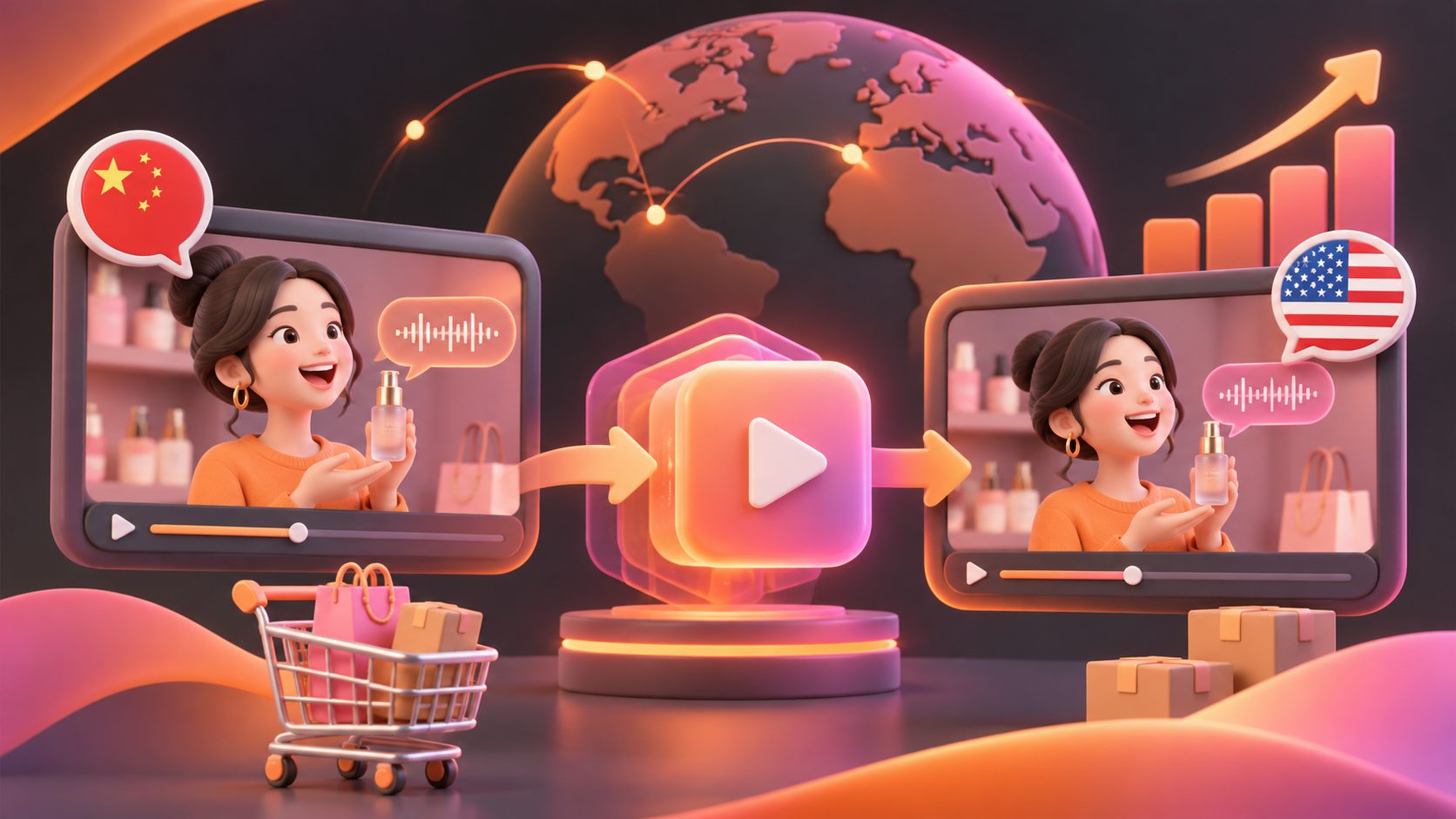
AI video translation for ecommerce ads is the process of adapting an existing product or UGC video for an English-speaking market by translating the script, replacing or recreating the voice track, matching spoken audio to mouth movement, rebuilding subtitles, and adjusting the creative for paid-media placements.
For ecommerce sellers, the goal is not literal translation. It is to preserve the original ad’s hook, product proof, offer, pacing, and call to action while making the message sound natural to US shoppers.
Why translating an ecommerce video is more than changing the language
A Chinese product video may contain strong visual demonstrations, but its spoken script, captions, pricing language, and CTA may not transfer directly to an English campaign.
The most important elements to localize are:
- Voice and delivery: A direct translation may sound formal, unnatural, or too long for the original shot.
- On-screen text: Chinese captions, benefit claims, measurements, and promotional copy need English replacements.
- Lip movement: If a creator speaks on camera, a new English voice without matching mouth movement can look disconnected.
- Offer details: Currency, discount wording, shipping claims, and urgency language may need market-specific review.
- Platform composition: Text may be hidden by TikTok, Instagram, or YouTube interface elements.
This is why the best workflow treats translation as creative adaptation, not a one-click language conversion. Current AI video translation tools commonly combine transcription, translation, dubbing, subtitles, and lip synchronization, but the quality of the final ad still depends on script timing and human review. (geckodub.com)
What should be translated in a Chinese-to-English product ad?
The answer depends on how the original video communicates its selling point. Start with the spoken layer, then check every visual layer that carries meaning.
1. Spoken script and product claims
Translate the script into natural American English rather than preserving sentence structure. For example, a phrase that literally means “solves the trouble of cleaning” may be more persuasive as “makes cleanup much easier.”
Keep product names, technical specifications, safety statements, and measurable claims consistent with the product listing. Avoid adding benefits that do not appear in the source material.
2. Voiceover and creator performance
For a faceless product demo, English voiceover may be enough. For a UGC-style ad, the voice is part of the creative identity. A strong localized version should preserve the original speaker’s energy, pauses, and emphasis where possible.
If the original speaker appears on camera, use lip sync selectively. Close-up talking-head shots benefit most from it, while product-only shots usually need only translated audio and captions.
3. Captions and embedded text
Captions should be rewritten for short-form viewing, not translated word for word. English often requires different line breaks and may occupy more horizontal space than Chinese.
Review:
- Product names and model numbers
- Prices and discount percentages
- Measurement units
- Before-and-after labels
- Call-to-action buttons
- Text inside packaging or screenshots
- Promotional disclaimers
AdsTurbo’s Video Subtitle workflow can automatically transcribe speech, generate time-synced captions, translate subtitles, and export either a video with embedded captions or a separate subtitle file. Its subtitle layouts are designed for formats such as TikTok, Instagram Reels, and YouTube Shorts.
A practical workflow for localizing Chinese ads into English
Use this six-step process to reduce avoidable editing and translation errors.
Step 1: Select a source video with a clear conversion structure
Choose a video that already has a recognizable sequence:
- Problem or attention hook
- Product introduction
- Demonstration or proof
- Benefit explanation
- Offer and CTA
A video with clear visual proof is easier to localize than one that relies almost entirely on spoken cultural context.
Step 2: Extract and clean the original script
Create a transcript before translating. Correct product names, punctuation, speaker changes, and terminology first.
This transcript becomes the reference layer for:
- English voiceover
- Subtitle timing
- On-screen text replacement
- Claim verification
- Final QA
AdsTurbo also provides script extraction and video analysis tools that can help identify the structure and key conversion points in reference creatives.
Step 3: Rewrite for English timing
Do not force the English translation to match the original word count. Match the meaning per shot instead.
A useful editing rule is:
- Keep one main message per shot.
- Shorten repeated explanations.
- Place the strongest benefit near the first few seconds.
- Preserve the original CTA position unless the English version needs a different ending.
- Avoid speeding up speech simply to fit a long translation.
The script should be read aloud before production. If the sentence feels difficult to say naturally, it will probably sound unnatural in the final ad.
Step 4: Generate English audio and decide where lip sync matters
Use translated voiceover for product demonstrations, screen recordings, and B-roll. Consider lip sync for talking-head sections where the creator’s mouth is clearly visible.
This selective approach is often more efficient than applying lip sync to every second of the video. It also reduces the risk of visible artifacts in shots with hands, fast head turns, profile angles, or obstructed faces.
Step 5: Rebuild captions and visual overlays
Replace hardcoded Chinese captions instead of stacking English text on top of them. If the original text is burned into the footage, editing or erasing the old layer may be necessary before adding the English version.
For low-resolution source footage, an AI video enhancer can improve clarity before captions and overlays are added. This matters because compression artifacts become more noticeable around faces, product edges, and small English text.
Step 6: Export platform-specific versions
Create versions for the placements you actually plan to test:
- 9:16: TikTok, Instagram Reels, YouTube Shorts
- 1:1: Square social placements and some feed environments
- 16:9: YouTube and selected display placements
AdsTurbo’s workflow supports multiple output formats for ad creative adaptation. Before launch, check that captions do not overlap platform controls and that the first frame communicates the product without relying on audio.
For a broader production process, see this practical guide to ecommerce video ad templates for social media.
The localization QA scorecard for ecommerce sellers
A translated ad should pass five separate checks. This scorecard is a useful editorial framework because it separates language quality from advertising performance.
| Check | Pass condition |
|---|---|
| Meaning | Product benefits and claims match the original |
| Naturalness | English sounds like ad copy written for US shoppers |
| Timing | Voice, captions, and scene changes remain synchronized |
| Visual clarity | Text is readable and old-language overlays are removed |
| Conversion continuity | Hook, proof, offer, and CTA remain understandable |
A sixth check is often overlooked: landing-page consistency. If the video says “20% off,” but the product page shows a different promotion, the translation is technically correct but commercially weak.
For stores testing multiple versions, keep a simple naming system such as:
product_hook_offer_language_format_version
This makes it easier to compare English creative variants without confusing a translated version with a new concept.
When should you translate an ad instead of making a new one?
Translate an existing ad when its visual proof, product demonstration, and offer structure are already strong. Create a new ad when the original depends on local humor, culturally specific references, or a spokesperson whose credibility does not transfer to the target market.
A translated version is especially useful for:
- Testing a new English-speaking market quickly
- Reusing a proven product demonstration
- Creating multiple voice and subtitle variants
- Localizing creator footage without a reshoot
- Comparing the same hook across regions
AdsTurbo can combine video translation, lip sync, subtitles, video analysis, upscaling, and other editing controls in an ecommerce creative workflow. Its asynchronous generation model also supports status polling or Webhook callbacks for teams connecting production tasks to internal systems.
Common questions about AI video translation for ecommerce ads
Can a Chinese product video be translated directly into English?
It can be processed directly, but direct translation is not always the best final script. Review product terminology, claims, sentence length, and CTA language so the English version fits the video naturally.
Do translated ecommerce ads need lip sync?
Not always. Lip sync is most valuable when a visible person speaks directly to the camera. Product-only footage, voiceover demonstrations, and screen recordings can usually use translated audio with captions.
Should I use subtitles if the ad has English voiceover?
Yes. Captions support sound-off viewing and reinforce key product benefits. Keep them short, readable, and positioned away from platform interface controls.
How can I preserve the original ad’s performance structure?
Keep the sequence of hook, problem, demonstration, benefit, proof, offer, and CTA. Translate the language, but do not casually remove the moments that explain why the original creative worked.
What source files produce better results?
Use the highest-quality video available, with clear speech and minimal background noise. Separate product images in JPG or PNG format can also support new product visuals when the source video lacks clean shots.
Final takeaway
Effective localization preserves the selling logic of the original ad while adapting its language, voice, captions, timing, and format for English-speaking shoppers. Start with a proven creative, rewrite the script for natural delivery, apply lip sync where it creates visible value, rebuild every text layer, and validate the final video against the landing page and offer.
For sellers producing multiple variations, this process turns one Chinese product video into a structured testing asset rather than a simple translated copy.