


By adsturbo.ai | Published 2026-09-28 | Updated 2026-09-28
For most ecommerce brands, the ecommerce video ads agency vs AI tool decision is not simply about choosing human creativity or automation. It is about choosing the right production model for the campaign stage: proving a product, multiplying creative variations, or scaling winners across audiences and markets.
An agency can provide strategy, creative direction, production management, and quality control. An AI tool can reduce the time and marginal cost required to turn one product, script, or reference ad into multiple testable assets. The best option depends on how much uncertainty your campaign still has.
What is the difference between an agency and an AI video ad tool?
An ecommerce video ads agency sells a managed production service. The agency usually handles briefing, scripting, creator sourcing, filming, editing, revisions, and sometimes media strategy. An AI video ad tool provides a production system that your team operates directly or connects to through an API.
The practical difference is where the bottleneck sits:
- Agency model: More external expertise, but more coordination, approvals, and scheduling.
- AI tool model: More internal control, faster iteration, and lower marginal production friction.
- Hybrid model: Human strategy and review combined with AI-assisted production and localization.
Recent comparison pages commonly frame AI as the stronger option for volume, speed, and predictable production, while agencies remain valuable for major campaigns that require real creators, original filming, or premium brand storytelling. (roassuite.com)
The important distinction is that an AI tool does not automatically replace creative judgment. It changes how quickly a team can execute and learn.
Ecommerce video ads agency vs AI tool: which is cheaper?
An AI tool is usually cheaper for producing many variations from existing inputs, while an agency may be more economical when the project requires original shoots, complex logistics, or strategic ownership from brief to media execution.
| Decision factor | Ecommerce video ads agency | AI video ad tool |
|---|---|---|
| Initial setup | Briefs, calls, contracts, creator sourcing | Product assets, prompt, script, or reference video |
| Production speed | Often days to weeks | Often minutes to hours, depending on workflow |
| Cost structure | Retainer, project fee, creator and revision costs | Subscription, credits, or usage-based costs |
| Creative volume | Limited by team capacity and approvals | High variation volume from the same source assets |
| Brand strategy | Stronger managed guidance | Requires internal direction and review |
| Localization | New edits, voiceovers, or shoots may be needed | Translation, subtitles, lip sync, and character changes can be streamlined |
| Best use | Hero campaigns and high-stakes launches | Testing, iteration, repurposing, and scale |
A useful way to compare cost is not “price per video.” Use cost per validated creative concept:
Cost per validated concept = total creative production cost ÷ number of concepts that generate a usable performance signal
A $3,000 production that produces one unproven video may be less efficient than a lower-cost workflow that generates 20 distinct hooks and identifies two promising angles. This does not mean the cheaper video will always win. It means testing economics should be measured by learning output, not only finished-file quality.
When should an ecommerce brand hire an agency?
An agency is usually the better choice when the creative problem is strategic, operational, or highly dependent on real-world production.
Choose an agency when you need:
- Original footage that AI cannot reliably create, such as a detailed product demonstration, physical installation, factory process, or real customer experience.
- A flagship campaign where art direction, casting, set design, and brand consistency matter more than iteration speed.
- External strategic ownership, especially when your internal team lacks a clear testing plan or creative director.
- High-touch creator production, including negotiation, usage rights, reshoots, and coordinated deliverables.
- Complex stakeholder management, where the agency absorbs revisions and production coordination.
Agencies can also bring broader creative range. A single marketer using one AI workflow may generate many variations, but those variations can still reflect one narrow interpretation of the product. Human teams can introduce different cultural references, filming styles, and audience insights.
For high-consideration products, premium launches, or campaigns built around authentic customer proof, that additional perspective can justify the higher cost.
When is an AI video ad tool the better choice?
An AI tool is generally stronger when your main constraint is creative throughput rather than access to production expertise.
It is a practical fit when you need to:
- Test multiple hooks for a new product before committing to a larger shoot.
- Turn one product image into several short-form ad concepts.
- Adapt an existing ad into different aspect ratios for TikTok, Meta, and YouTube Shorts.
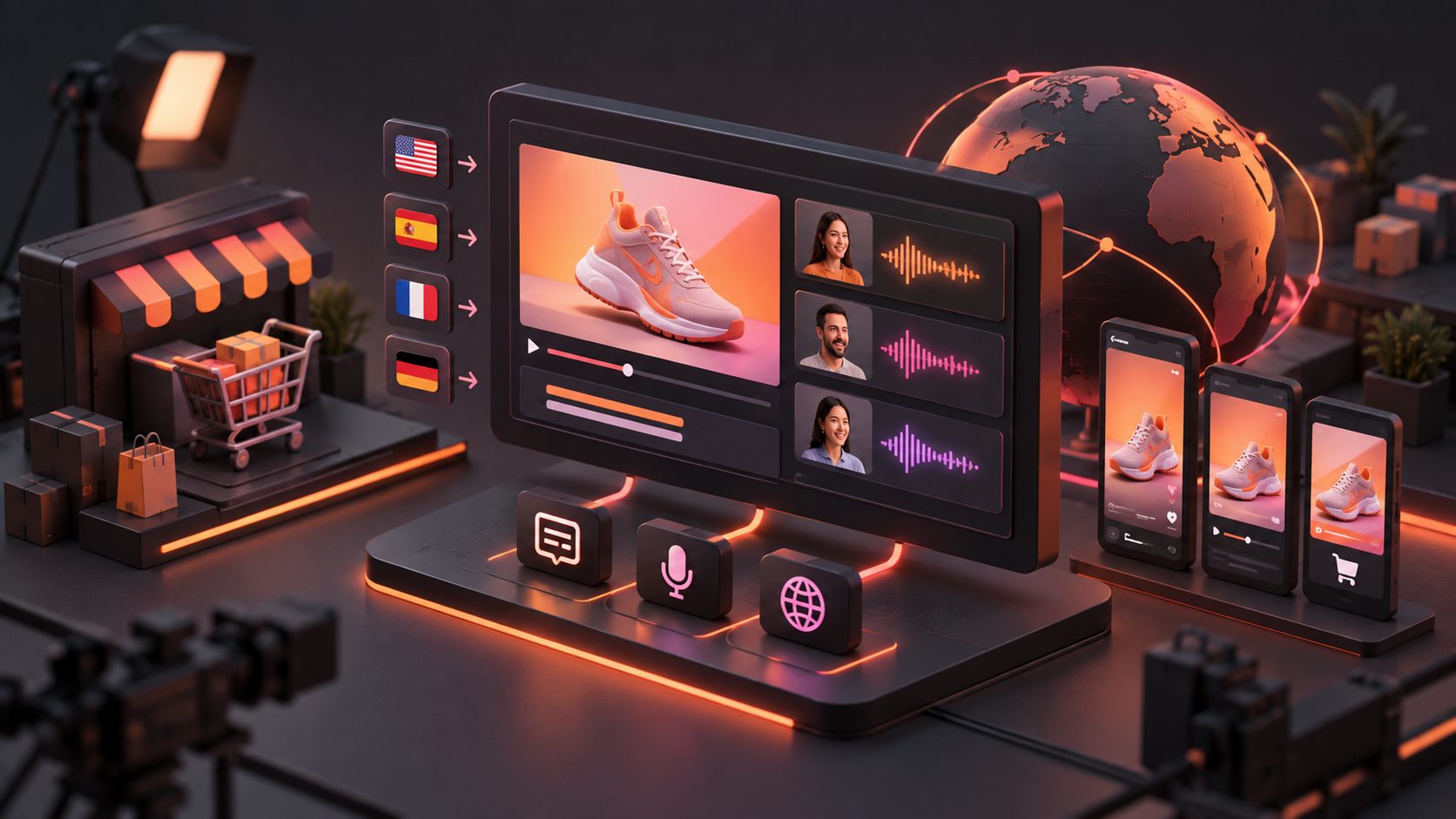
- Create multilingual versions for cross-border ecommerce.
- Refresh fatigued creative without rebuilding every asset from zero.
- Produce product videos for a large SKU catalog.
- Repurpose long videos into shorter, captioned clips.
With AdsTurbo, ecommerce teams can combine product images, selling points, and reference videos to create short-form product ads. Its tools include Ad Clone, Product Video, Lip Sync, Character Swap, Motion Control, Video Translation, AI Upscaling, Background Replace, and Video Subtitle.
For example, TikTok Shop bulk video generation can be approached as a SKU testing matrix rather than a one-video project. Each SKU can receive multiple combinations of hook, benefit, proof point, and call to action.
Which option improves ROAS testing efficiency?
Neither an agency nor an AI tool directly guarantees higher ROAS. The stronger option is the one that helps you test meaningful creative variables without changing too many variables at once.
A practical testing structure is:
- Keep the product and offer constant.
- Change one major variable, such as the opening hook, spokesperson, proof point, or CTA.
- Create three to five variations for that variable.
- Use the same audience and landing page during the initial comparison.
- Measure early signals and downstream outcomes, including thumb-stop rate, hold rate, click-through rate, add-to-cart rate, conversion rate, and contribution margin.
- Promote winners into a second production round.
This produces a more useful learning loop than ordering one polished video and judging the entire channel from its result.
AdsTurbo’s Ad Clone workflow adds another useful layer: a reference video can be analyzed for structure, pacing, shot logic, and CTA patterns, then rebuilt into brand-specific variants. The reference video can be analyzed for up to 12 seconds through the Ad Clone API, with parallel generation available for creative variation workflows.
The strategic advantage is not copying a competitor’s message. It is identifying the mechanics of attention—the opening promise, proof sequence, visual rhythm, and conversion transition—then applying those mechanics to your own product.
The best operating model: prove, multiply, then polish
A strong ecommerce workflow often uses all three production modes in sequence:
1. Prove the angle
Use customer research, existing performance data, and a small number of creator-led or agency-produced assets to identify credible positioning. This is where human judgment matters most.
2. Multiply the variations
Use an AI video ad tool to create different hooks, characters, languages, subtitles, aspect ratios, and product demonstrations. The goal is to increase the number of testable ideas without multiplying production meetings.
AdsTurbo supports multilingual subtitles, video translation, lip sync, character replacement, and product video generation. Its video subtitle workflow can also produce videos with embedded captions or export separate subtitle files for platform-specific editing.
3. Polish the winners
Once a concept shows promising performance, invest in a higher-production version, stronger creator execution, or a campaign-level agency project. This reverses the traditional order: instead of spending heavily before learning, you spend more after evidence appears.
For product-led brands, turning Amazon product images into video ads can support the early validation stage, while a larger production partner can be reserved for validated products and seasonal campaigns.
Frequently asked questions
Is an AI video ad tool suitable for small ecommerce brands?
Yes. It is particularly useful when a small team needs to create several ad concepts without hiring a full production team. The team still needs to provide accurate product information, review outputs, and interpret campaign data.
Are agency-made ads always better than AI-generated ads?
No. Agency production may offer stronger storytelling and authenticity, but a polished ad can still fail if the hook or offer is wrong. AI-assisted production can outperform a single agency asset when it enables faster and more disciplined testing.
Can an AI tool replace a UGC agency?
It can replace some repetitive production tasks, such as variation creation, localization, captioning, and format adaptation. It does not fully replace real creator relationships, original filming, usage-rights management, or campaigns where lived experience is central to trust.
What should a brand test first?
Start with the opening three seconds, the customer problem, and the product demonstration. These variables often reveal whether the audience understands the offer before you optimize transitions, music, or visual polish.
What is the safest choice for a growing ecommerce brand?
Use a hybrid system: human-led strategy and approval, AI-assisted production for volume, and agency or creator support for high-impact campaigns. This approach keeps creative quality under control while improving testing speed.
Final decision
Choose an agency when you need original production, strategic ownership, or a premium campaign experience. Choose an AI tool when you need speed, variation, localization, and efficient testing across products and platforms.
For many ecommerce sellers, the most defensible answer to ecommerce video ads agency vs AI tool is not “one or the other.” Use human expertise to decide what deserves testing, AI to expand the testing set, and higher-production resources only after the data shows which ideas deserve investment.