


By adsturbo.ai | Published 2026-10-06 | Updated 2026-10-06
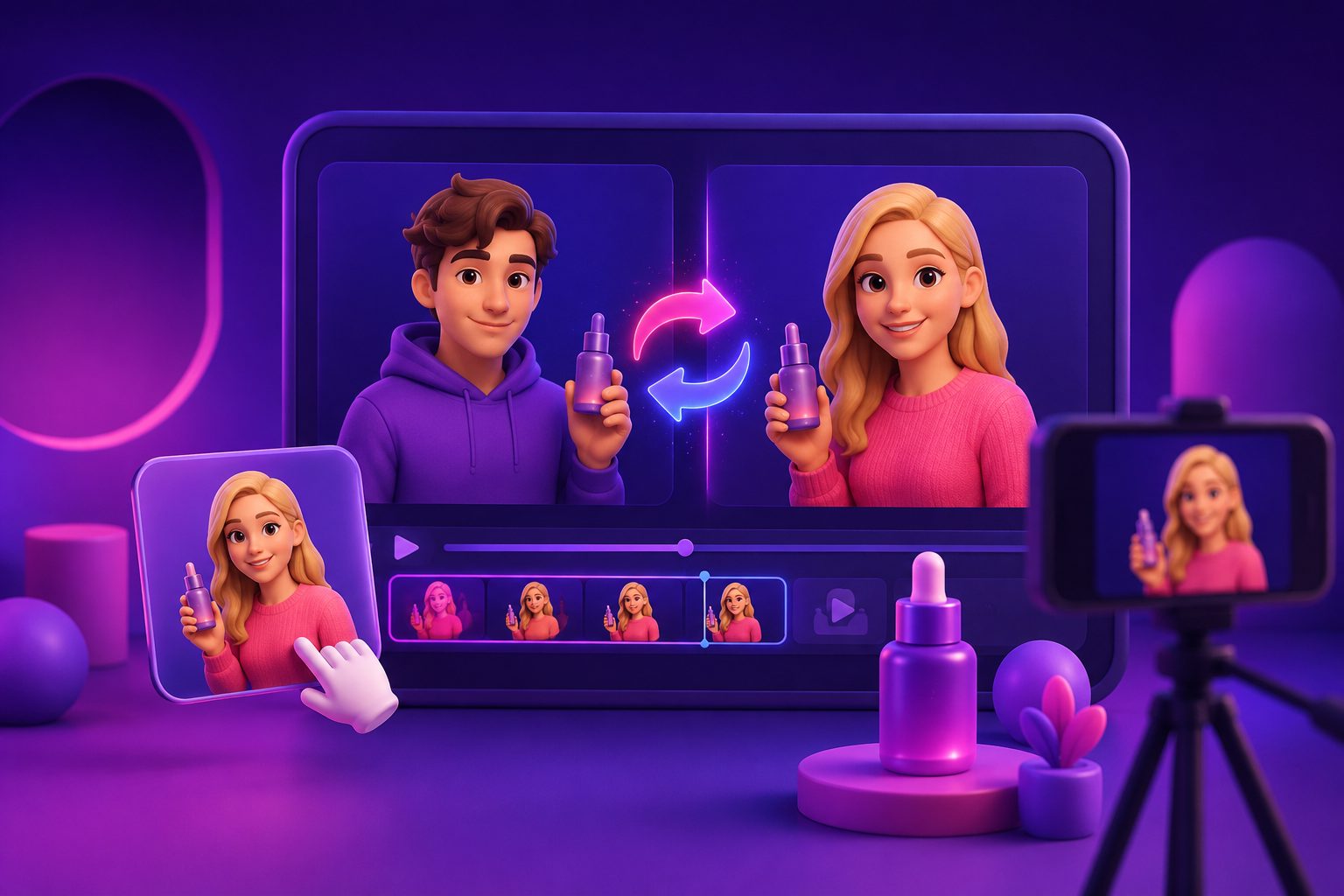
To swap character in an ecommerce video is to replace the visible performer while using the original clip as a reference for movement, timing, lighting, and scene composition. For sellers, this can extend useful creative when a model agreement expires or when an ad needs a locally relevant presenter—without organizing another full shoot.
The replacement is not automatically rights-safe, however. Sellers must review the original production agreement, secure permission for the new identity, disclose significant AI editing where required, and inspect every generated frame before publishing.
What Does It Mean to Swap a Character in a Video?
A character swap replaces the person’s broader visual identity—not merely the face—while retaining useful elements of the source performance. Depending on the shot, that identity can include the face, hair, body appearance, and clothing, with the original pose, gesture, framing, and timing acting as references.
This makes character replacement different from several related techniques:
| Technique | What changes | What normally remains |
|---|---|---|
| Character swap | The visible performer or character | Motion, timing, scene, and camera rhythm |
| Face swap | Primarily the face | Body, wardrobe, movement, and background |
| Motion control | A still character receives reference movement | The target character’s designed identity |
| Video translation | Spoken language and possibly lip movement | Performer, product demonstration, and scene |
| Full regeneration | Most or all visual elements | Only the underlying concept or script |
A full-body replacement is usually better than face swapping when the performer occupies most of the frame, wears distinctive clothing, or demonstrates a product with visible arm and body movement.
When Can Character Replacement Rescue an Existing Ad?
Character replacement is most valuable when the performance remains commercially useful but the performer identity no longer fits the campaign. Common examples include expiring model permissions, regional casting requirements, audience testing, or a localized campaign that should not look like a translated copy of a foreign ad.
An important limitation is often missed: replacing the person does not necessarily clear every right connected to the source footage. The original contract may separately govern the recorded performance, voice, wardrobe, choreography, derivative edits, paid-media territory, and usage period.
The U.S. Copyright Office has identified legal gaps surrounding unauthorized digital replicas and recommends specific federal protection while recognizing existing state publicity laws. Sellers should therefore treat the original footage and the replacement identity as two separate rights checks, not assume that one technical edit solves both. Review the U.S. Copyright Office digital replicas report and obtain legal advice for disputed or high-value campaigns.
Is a Source Clip Ready for an AI Character Swap?
A suitable clip has one clearly visible performer, stable motion, limited occlusion, and enough visual detail to guide identity replacement. Fast cuts, crossed limbs, foreground objects, reflective surfaces, and hands covering the face increase the likelihood of flicker or identity drift.
Use this original Recast Readiness Score before spending production resources. Assign zero, one, or two points to each factor:
| Factor | 0 points | 1 point | 2 points |
|---|---|---|---|
| Rights certainty | Unclear or expired | Partial documentation | Written approval confirmed |
| Subject visibility | Frequently blocked | Brief occlusion | Clear throughout |
| Motion stability | Fast or chaotic | Moderate movement | Controlled movement |
| Product separation | Product overlaps the body | Occasional overlap | Product remains distinct |
| Localization value | Cosmetic change only | One meaningful adaptation | New market or audience use |
Interpretation: 8–10 points indicates a strong candidate, 5–7 calls for a short proof test, and 0–4 suggests reshooting or rebuilding the scene. This is a planning framework rather than a legal or technical guarantee; rights certainty remains mandatory regardless of the total.
How Do You Swap a Character Without Damaging the Product Story?
The safest workflow isolates identity replacement from translation, voice, captions, and final enhancement. Changing everything in one pass makes defects harder to diagnose and can accidentally alter product details that buyers rely on.
- Audit the source rights. Confirm the permitted term, territories, channels, derivative edits, paid advertising, voice use, and AI modification.
- Choose a short source segment. Start with a clean five-to-ten-second section containing one person and a clearly visible product.
- Prepare the target character image. Use a sharp image with one person, even lighting, and visible body proportions that match the source shot.
- Generate the identity replacement. In AdsTurbo Character Swap, provide the source video or image and the target character image. The generated version uses the source motion and timing as references.
- Review product-critical frames. Check hands, labels, packaging, buttons, jewelry, hair edges, shadows, reflections, and contact between the performer and product.
- Localize in separate passes. Adapt the script, voice, lip movement, subtitles, and on-screen text after the replacement is visually stable.
- Export controlled variants. Change one variable at a time—character, language, hook, or offer—so performance differences remain interpretable.
For broader market adaptation, combine this process with a multilingual product video localization workflow rather than translating dialogue alone.
What Quality Checks Should Every Replacement Pass?
A usable output must preserve both identity continuity and product truth. Watch the video at normal speed, then inspect difficult frames individually; a clean thumbnail can hide flicker that becomes obvious during motion.
Use this acceptance gate:
- The same replacement identity persists through every frame.
- Eyes, teeth, hair, hands, and body proportions remain plausible.
- Product shape, color, logo placement, and controls do not change.
- Fingers do not merge with packaging or demonstration surfaces.
- Lighting direction and skin shadows match the environment.
- Reflections do not reveal the original performer.
- Mouth movement is believable if speech remains.
- Captions do not cover the product or required disclosures.
- The first and final frames do not jump between identities.
If the visuals pass but the speech does not, correct the audio separately through dubbing or lip synchronization. A structured AI video dubbing workflow for ecommerce ads helps keep language adaptation from destabilizing the replacement.
How Should Sellers Handle Consent and AI Disclosure?
Use only source footage and replacement identities that your business is authorized to use. Keep the release, contract, source-file record, approved markets, campaign dates, and final exported versions together so the production history remains auditable.
Synthetic presenters should not be framed as real customers with experiences they never had. The FTC explains that AI stock avatars are not categorically prohibited, but their use may become deceptive when the underlying testimonial is false or when consumers could reasonably believe an unauthorized celebrity endorsed the product. See the FTC guidance on AI avatars and testimonials.
Platform requirements also matter. TikTok requires disclosure for ads containing significantly AI-generated or manipulated media and can reject or restrict undisclosed content. Its policy also prohibits unauthorized likeness misuse and false endorsements; review TikTok’s edited-media advertising policy before launch.
How Can AdsTurbo Support a Controlled Recasting Workflow?
AdsTurbo supports Character Swap using a source video or image plus a target character image. The workflow is designed to retain the source action, lighting, and scene realism while replacing the visible person, but every result should still receive human quality and rights review.
After the character pass, sellers can use separate AdsTurbo capabilities for Lip Sync, Video Translation, Video Subtitle, Video Upscaling, and clip-by-clip editing. This modular approach is useful because teams can approve the new identity before changing language or resolution.
For testing, build a limited matrix instead of producing uncontrolled variations. One source performance can become two authorized characters across two markets, creating four comparable versions. Keep the hook, product proof, offer, and call to action unchanged, then evaluate whether casting and localization—not unrelated creative changes—explain the result. The same principle is expanded in this controlled AI ad variation matrix.
Common Questions
Can a character swap fix an expired model release?
It may remove the model’s visible identity, but it does not automatically clear rights to the underlying performance or recording. Review the original agreement for derivative-edit, AI-modification, voice, territory, channel, and term provisions before reusing the footage.
Is character replacement the same as face swapping?
No. Face swapping usually modifies the face while retaining the original body and wardrobe. Character replacement can recast the broader person, making it more suitable for full-body motion and market-specific presenter variations.
What source material produces the best results?
Use a short video with one unobstructed performer, controlled movement, stable lighting, and minimal overlap between hands, hair, products, and foreground objects. Pair it with a clear target-character image that matches the source framing.
Should every AI-edited ecommerce ad be labeled?
Requirements vary by platform and jurisdiction. When a real source has been significantly altered or a synthetic person appears realistic, transparent labeling is the safer operational default. Always follow the current rules of each advertising platform.
Can the same performance be localized for several countries?
Yes, provided the source and replacement rights permit those territories. Treat character, language, voice, captions, gestures, on-screen text, product claims, and disclosure requirements as separate localization layers.