

By adsturbo.ai | Published 2026-10-07 | Updated 2026-10-07
A vintage camera lens eBay listing video should do more than show that the lens exists. It should help a buyer judge the optical glass, internal condition, aperture, focus movement, mount, and visible wear before purchase. For older lenses, that proof can reduce uncertainty, prevent avoidable condition disputes, and make a carefully described item easier to trust.
eBay’s seller guidance recommends using relevant listing keywords, accurate condition details, self-shot photos, and clear information about what is included. Its camera-selling guide also emphasizes that listing titles influence search visibility and that condition descriptions should explain defects rather than rely on vague wording. (pages.ebay.com)
What should a vintage lens listing video prove?
A useful listing video answers five buyer questions: Is the glass clear? Is the coating intact? Does the focus ring move smoothly? Does the aperture operate correctly? Is the mount compatible and undamaged?
Still photos are useful for fine detail, but video adds movement and sequence. It can show the difference between a clean focus throw and a gritty or uneven one, demonstrate aperture blades closing, and reveal whether a haze-like reflection changes as the lens is tilted under light.
The goal is not cinematic production. The goal is verifiable condition evidence that matches the written description.
A strong video should show:
- The exact lens being sold, including brand, model, and serial number when appropriate.
- Front and rear glass at an angle under a controlled light source.
- Internal dust, fungus, haze, separation, coating marks, or scratches.
- Focus-ring travel from minimum focus to infinity.
- Aperture-ring movement and blade response.
- Mount, contacts, threads, filter ring, caps, and visible dents.
- Any included accessories, such as hoods, cases, caps, or adapters.
This approach builds on the same principle used by experienced used-gear sellers: buyers need multiple views of the actual item, not a stock image or a generic statement such as “looks good.” (theframefinder.com)
How do you film the optical glass clearly?
Begin with the lens uncapped and point it toward a bright but indirect light source. Avoid shining a harsh flashlight directly into the glass for the entire clip; excessive glare can hide defects and make clean glass look damaged.
Use a three-angle optical check:
- Straight-on view: Show the front element with the lens centered in the frame.
- Oblique tilt: Slowly rotate the lens so reflections travel across the coating.
- Rear view: Repeat the inspection from the mount side, especially around the rear element and aperture opening.
The oblique view is often the most informative. A coating mark may appear as a localized change in reflection, while haze can look like a broad veil. Fungus may appear as branching threads, web-like patterns, spots, or circular growth. Do not label every internal mark as fungus; describe what is visibly present and, when uncertain, use cautious language such as “possible internal haze” rather than making a definitive diagnosis.
Do not disassemble the lens to create better footage. eBay-hosted product documentation specifically warns against disassembly, and lens-cleaning guidance notes that optical coatings are delicate. (docs.ebay.com)
How can you demonstrate focus and aperture operation?
A buyer cannot feel the focus ring through a photo, so movement should be recorded in one uninterrupted shot. Hold the lens securely, rotate the focus ring slowly from one end to the other, and pause briefly at any rough, tight, loose, or uneven section.
For a manual lens, describe the result precisely:
- “Focus ring turns smoothly with moderate resistance.”
- “Slight stiffness appears near the minimum-focus end.”
- “There is visible play before the focus movement engages.”
- “The ring stops before the infinity mark.”
Avoid broad claims such as “perfect focus” unless the lens has been tested on a compatible camera body.
Next, rotate the aperture ring through its marked settings. Point the rear of the lens toward the camera and show the blades closing and opening. If the lens has an automatic aperture lever, move it carefully without forcing it. Note whether the blades are dry and responsive, slow to return, oily, or stuck.
This is a high-value distinction: a lens can look excellent externally while having a sticky aperture or rough focusing mechanism. Showing both functions gives buyers information they cannot reliably infer from cosmetic photographs.
What is the best shot order for an eBay lens video?
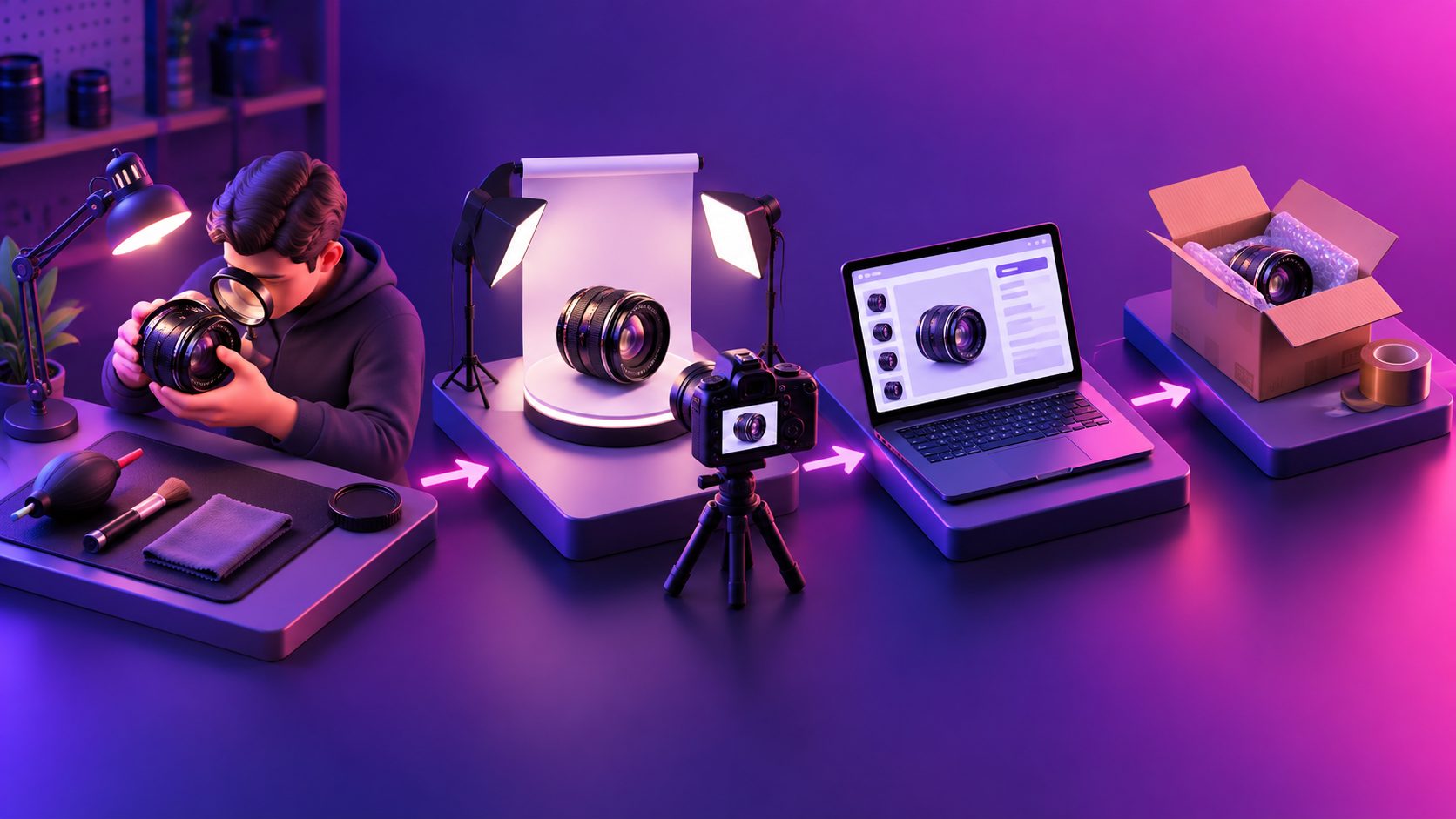
A practical 20-second proof sequence keeps the footage concise while covering the highest-risk details:
| Time | Shot | Buyer question answered |
|---|---|---|
| 0–3 sec | Full lens, front and side | Is this the exact item shown? |
| 3–7 sec | Front glass under angled light | Are there coating marks, scratches, or fungus? |
| 7–10 sec | Rear glass and mount | Is the rear element and mount clean? |
| 10–14 sec | Focus ring movement | Does the mechanism feel smooth and consistent? |
| 14–17 sec | Aperture ring and blades | Do the blades respond correctly? |
| 17–20 sec | Serial number, caps, and defects | What is included and what needs disclosure? |
This sequence is an original prioritization framework based on claim risk: show the details most likely to cause a return or “not as described” complaint before spending time on general beauty shots. For a rare or expensive lens, extend each proof segment and add a sample image made with the lens, if you can verify the camera body, adapter, settings, and shooting conditions.
For broader resale workflows, the pre-owned luxury condition video guide offers a useful way to structure condition proof around buyer questions rather than promotional language.
How should the written listing match the video?
The video and description should use the same condition vocabulary. If the video shows internal dust, do not write “clean glass.” If the focus ring has a tight patch, identify where it appears. If the lens was not tested on a camera body, say “operation not fully tested” instead of implying working status.
A clear condition section can follow this structure:
Optical condition:
Front and rear elements inspected under angled light. State whether you observed fungus, haze, scratches, coating wear, or internal dust.
Mechanical condition:
Describe focus-ring resistance, aperture-ring movement, aperture-blade response, and any looseness.
Cosmetic condition:
List dents, brassing, paint loss, scratches, engraving, filter-thread damage, and cap wear.
Compatibility and included items:
Name the lens mount and list caps, hood, case, adapter, or other accessories.
eBay advises sellers to use relevant specifications and explain what is included in the package. Its guidance also recommends concise, organized descriptions with headings and bullet points. (pages.ebay.com)
If you need multiple versions for different platforms, AdsTurbo can support related creative production workflows such as AI creative variations for controlled testing. For this product category, however, preserve the original inspection evidence in every version. Do not let localization or editing remove the defect disclosure.
Can AI improve a used-lens listing video?
AI can help with editing tasks, but it should not invent condition evidence. A responsible workflow is to record the real lens first, then use editing tools for trimming, subtitles, translation, aspect-ratio versions, or clearer sequencing.
AdsTurbo provides video subtitles that can generate synchronized captions and export either a captioned video or a separate subtitle file. Its video tools also include translation, upscaling, background replacement, and clip-by-clip editing. These functions can make a genuine inspection video easier to understand, especially when creating versions for different marketplaces or audiences.
For a technical item like a vintage lens, captions should label facts rather than add sales hype:
- “Internal dust visible under angled light”
- “Focus ring has slight resistance near infinity”
- “Aperture blades respond when lever is moved”
- “Rear cap included; front cap not included”
That keeps the video informative and aligned with the listing description.
Frequently asked questions
Should the lens be mounted on a camera?
Only if you have a compatible body or adapter and can test it safely. A mounted-camera demonstration can add useful evidence, but it should not replace close-ups of the optical glass, mount, focus ring, and aperture.
How do I show fungus versus dust?
Use angled light and slow rotation. Dust usually appears as isolated particles, while fungus may show branching, web-like, or clustered patterns. If you are not certain, describe the visible pattern without claiming a diagnosis.
Is a sample photo necessary?
It is helpful but not always required. A sample photo can demonstrate image output, but it does not prove the absence of internal defects. Pair it with a direct inspection video and disclose the camera, adapter, and shooting conditions.
What should I do if the lens is untested?
Say exactly that. Use “untested,” “partially tested,” or a specific limitation such as “focus movement checked; image output not tested.” Avoid calling an item “fully working” without a corresponding test.
Can one video serve TikTok, Instagram, and eBay?
One source recording can be edited into several aspect ratios, but the eBay version should keep the full condition sequence. Short social clips may attract attention; the marketplace listing needs evidence.