Claude
 Cursor
AI UGC Video Ad Examples for DTC Brands

Summarize with
Summary
Explore seven AI UGC video ad examples for DTC brands, with reusable hooks, scripts, proof patterns, and a practical testing framework. Build better creatives.
By adsturbo.ai | Published 2026-11-23 | Updated 2026-11-23
AI UGC video ad examples for DTC brands work best when they recreate the logic of creator content—not merely the appearance of a person speaking to camera. The strongest concepts usually combine a fast problem statement, visible product proof, one believable objection, and a clear next step.
This guide breaks down seven reusable formats for ecommerce brands. Each example includes the creative structure, the best product fit, and the main variable to test.
What makes an AI UGC ad useful for a DTC brand?
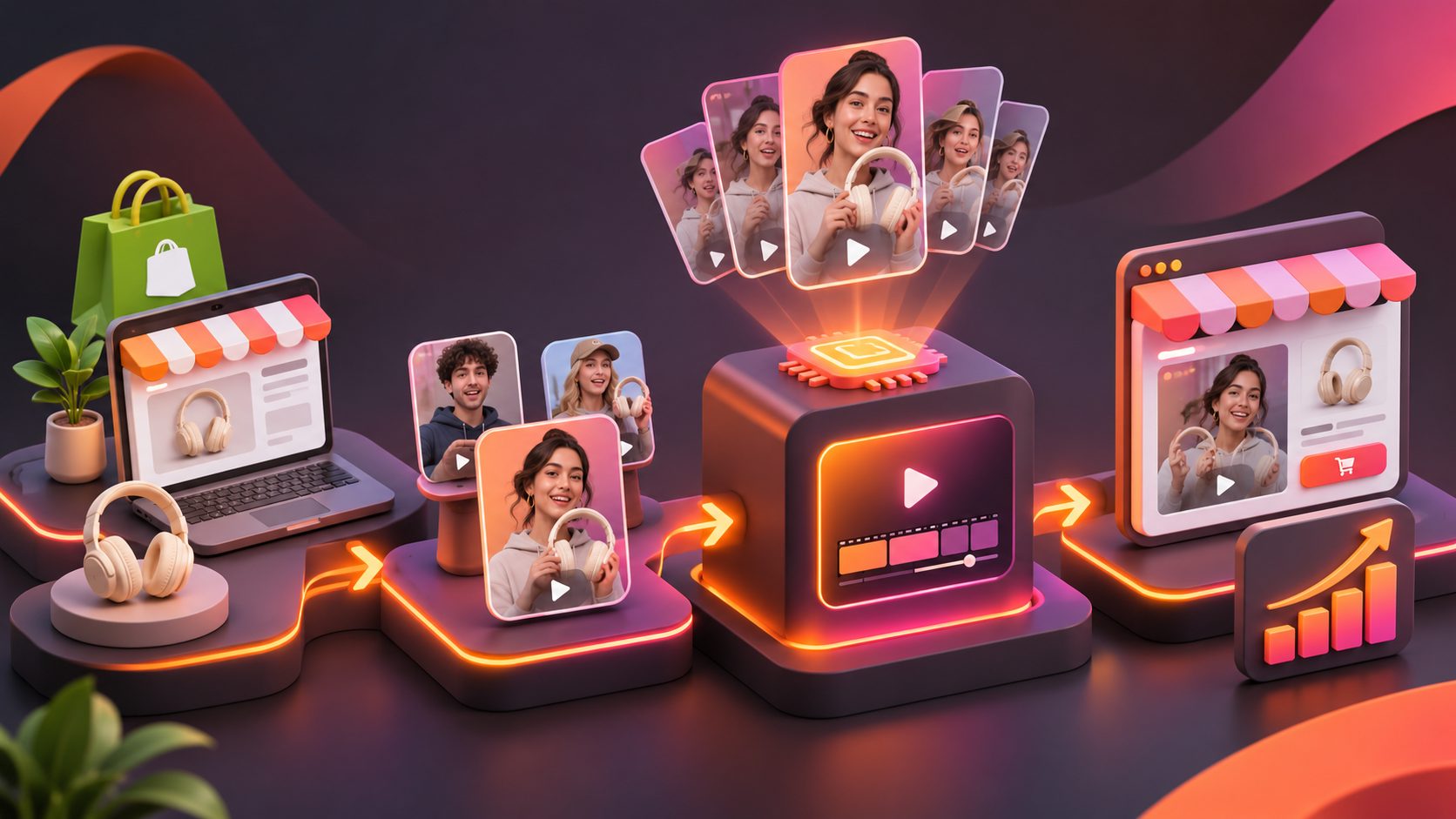
An AI UGC ad is a creator-style product advertisement produced with synthetic presenters, generated scenes, product visuals, voice, or editing workflows. Its value is not simply lower production effort. The bigger advantage is the ability to create more versions of the same marketing idea for different audiences, hooks, objections, and platforms.
Recent UGC ad libraries commonly group winning formats into talking-head testimonials, product demonstrations, and text-led POV videos. One dataset of 1,922 Meta ads reported that 42% used talking-head formats and 90% placed a person on camera, showing how strongly creator presence still shapes paid social creative. (ugcagent.app)
For DTC teams, the practical question is not “Which AI avatar looks most realistic?” It is:
Which customer belief must change before someone buys, and what is the shortest video structure that can change it?
That question leads to better creative decisions than choosing a template first.
1. The “I had the same problem” testimonial
Structure:
Hook with a familiar frustration → describe the failed alternatives → introduce the product → show the result → finish with a direct CTA.
Example script:
“I kept buying storage organizers that looked great online but collapsed after a week. This one is different because the panels actually lock into place. Here’s how it looks in my closet.”
This format is suitable for products that solve a recognizable daily inconvenience, such as home organization, accessories, beauty tools, or kitchen products.
The important detail is specificity. “This changed my life” is vague. “The panels lock into place” gives the viewer a concrete reason to believe the product may work.
Best variables to test:
- Frustration-based hook versus comparison-based hook
- Bedroom, kitchen, or travel setting
- Narrator focused on convenience versus durability
- Product result shown at second 3 versus second 7
AI-generated presenters can help test multiple audience identities, while real product images or footage should carry the proof whenever possible.
2. The rapid product demonstration
Structure:
Show the product immediately → demonstrate one action → explain the benefit → reveal a second use case → present the offer.
This is one of the clearest formats for products whose value is visual. Examples include cleaning tools, fitness accessories, beauty devices, apparel features, and household products.
Example storyboard:
- Product enters the frame in the first second.
- A close-up shows the key mechanism or texture.
- The presenter demonstrates the product in use.
- On-screen text explains the practical benefit.
- The final frame shows the product, price incentive, and CTA.
The creative principle is proof before persuasion. Instead of spending the opening on an introduction, let the viewer see the product doing something useful.
A product photo can be turned into a short product video workflow, then adapted into multiple aspect ratios for paid social and marketplace placements. For a broader process, see this guide to AI video ads for ecommerce product listings.
3. The “three reasons I kept it” review
Structure:
Open with a personal verdict → list three reasons → support each reason with a visual → close with who should buy.
Example script:
“Three reasons I kept using this travel bottle after the first week: it does not leak, it fits in my side pocket, and the cap stays clean.”
This format turns a general review into a structured buying argument. It works particularly well for products with several functional benefits, but the benefits should not be random. They should answer the buyer’s likely questions:
- Does it work?
- Is it convenient?
- Is it worth the price?
- Will it fit my routine?
A useful editing rule is to give each reason its own visual moment. If all three benefits are delivered over one talking-head shot, the ad may sound informative but feel unproven.
4. The objection-first ad
Structure:
State the buyer’s doubt → address it directly → demonstrate the answer → explain the trade-off → call to action.
Example script:
“I thought this jacket would look bulky in real life. It is actually lightweight, and here is how it fits under a coat.”
Objection-first ads are valuable because they enter the decision process later than generic awareness ads. They do not ask, “Have you heard of this product?” They ask, “What is stopping you from buying?”
Common objections include:
| Buyer objection | Creative proof to show |
|---|---|
| “It looks too small” | Product beside a familiar object |
| “It will not fit me” | Multiple angles, sizes, or use contexts |
| “It seems difficult to use” | One continuous demonstration |
| “It is probably low quality” | Material, stitching, texture, or close-up detail |
| “I can find something cheaper” | Feature comparison or bundle value |
This format should avoid exaggerated guarantees. A believable limitation can increase trust, such as explaining who the product is not designed for.
5. The before-and-after routine
Structure:
Show the starting situation → introduce the routine → demonstrate the product → reveal the improved state → explain the repeatable habit.
Before-and-after ads are common in beauty, organization, apparel, food, and home categories. However, the transformation should be observable and relevant to the product’s real use.
The strongest version is not simply “before” followed by a dramatic “after.” It shows the process between them. That middle section answers the viewer’s hidden question: What exactly did the product do?
For products with subtle results, use measurable or visible proxies:
- Time saved
- Fewer steps
- Cleaner surface
- Better organization
- Easier preparation
- Improved fit or presentation
Avoid unsupported performance claims. A product demonstration and a clear use case are more durable than an unrealistic promise.
6. The social-proof compilation
Structure:
Open with a pattern of customer reactions → show several short product moments → summarize the shared benefit → invite the viewer to try it.
This format resembles a collection of mini-reviews rather than one extended testimonial. It is useful when a DTC brand has several customer angles, such as comfort, appearance, convenience, and gifting.
AI can help create variations in voice, pacing, and presenter style, but the claims should remain grounded in approved product information and authentic customer feedback. Synthetic presenters should not be presented as real customers unless that representation is accurate and permitted.
A practical version uses three short sections:
- “What surprised me”
- “What I use it for”
- “Why I would buy it again”
The repetition creates a stronger pattern than one isolated claim.
7. The comparison and alternative ad
Structure:
Name the old way → show its weakness → introduce the new option → compare the experience → deliver a focused CTA.
Example script:
“I used to carry three separate chargers when traveling. This setup replaces them with one compact option.”
Comparison ads can be highly effective for products that simplify a process. The comparison does not need to attack a competitor. It can compare:
- Old routine versus new routine
- Multiple products versus one product
- Manual process versus easier process
- Generic result versus customized result
Keep the comparison fair and visually understandable. A side-by-side demonstration usually communicates faster than a long explanation.
A practical framework for turning one concept into 12 ads
The main information gap in many AI UGC examples is that they show finished videos but not the testing system behind them. A DTC team can turn one concept into a structured 12-creative matrix:
- Choose one customer problem.
- Write three different hooks.
- Pair each hook with two proof styles.
- Produce two presenter or setting variations.
That creates:
3 hooks × 2 proof styles × 2 executions = 12 ads
For example, a portable coffee product could use:
- Hook A: “I stopped buying coffee at the airport.”
- Hook B: “This takes less space than my headphones case.”
- Hook C: “The mistake I made with travel coffee gear.”
Each hook can then use a demonstration or a routine-based review, followed by two different creator styles.
This approach tests the message before over-investing in visual polish. AdsTurbo supports product video creation, ad cloning, subtitles, translation, motion control, and related creative workflows for producing and adapting ecommerce ad variations. Its video subtitle tool can also generate synchronized captions and export either a captioned video or a separate subtitle file.
For weak or compressed source assets, an AI video enhancer can improve the clarity of product footage before editing. Better resolution cannot fix a weak concept, but it can prevent avoidable quality loss in close-ups and demonstrations.
How to judge an AI UGC concept before scaling it
Use a five-part creative scorecard:
| Criterion | Pass question |
|---|---|
| Hook clarity | Can the viewer identify the problem in two seconds? |
| Product visibility | Is the product shown doing something specific? |
| Proof strength | Does the video support its main claim visually? |
| Objection handling | Does it answer one realistic buying concern? |
| CTA relevance | Does the next step match the viewer’s awareness level? |
A video that looks realistic but fails these checks is still a weak ad. Conversely, a simple creator-style video can work when the problem, proof, and offer are easy to understand.
Common questions about AI UGC video ads
Are AI UGC ads the same as traditional UGC?
No. Traditional UGC is created by real customers or creators. AI UGC uses synthetic production elements, but it can still follow the same storytelling conventions: personal context, product proof, natural pacing, and a clear recommendation.
What products work best with AI UGC ads?
Products with a visible use case, clear pain point, or easy-to-explain benefit are usually the simplest starting point. Demonstrable products often provide stronger creative proof than products whose value depends entirely on an abstract promise.
How many versions should a DTC brand create?
Start with a structured batch rather than one “perfect” ad. Twelve variations based on three hooks, two proof styles, and two executions provide a useful first testing set without changing the product message in every version.
Should every AI UGC ad use a talking head?
No. Talking heads are useful for testimonials and objections, but product demonstrations, POV text, unboxing sequences, and screen-led explainers may communicate better for some categories. The format should follow the buying question.
How can brands avoid AI UGC feeling unnatural?
Use shorter claims, specific product actions, natural pauses, visible proof, and consistent product details. Avoid making synthetic presenters deliver broad, overly enthusiastic claims that the visuals cannot support.