Claude
 Cursor
AI Video Ads for Ecommerce Facebook and Instagram: A Practical Creative Workflow


Summarize with
Summary
Learn how to build AI video ads for ecommerce Facebook and Instagram using product photos, hooks, captions, localization, and a repeatable testing workflow.
By adsturbo.ai | Published 2026-11-21 | Updated 2026-11-21
AI video ads for ecommerce Facebook and Instagram work best when they are treated as a creative testing system, not a one-click video generator. The strongest workflow starts with a real product asset, develops several customer-focused angles, adapts the edit for Feed and Reels, and then measures which hook, proof point, and call to action deserve more budget.
What makes a strong ecommerce video ad for Facebook and Instagram?
A strong ecommerce video ad explains the product quickly, shows why it matters, and gives the viewer a clear next step. The first seconds should establish the product or problem before adding secondary details such as features, reviews, discounts, or brand history.
For most product categories, a practical short-form structure is:
- Hook: State the problem, desire, or surprising benefit.
- Product reveal: Show the product clearly and early.
- Demonstration: Show how it works in a realistic context.
- Proof: Add a result, comparison, use case, or credibility cue.
- Offer and CTA: Tell the viewer what to do next.
This structure is more useful than asking AI to “make a viral ad.” It gives the generation system a controlled brief and makes the final creative easier to compare against other variants.
Facebook Feed and Instagram Reels require different creative decisions
Facebook Feed and Instagram Reels can use the same core idea, but the framing, pacing, and text treatment should not always be identical. Feed users may encounter the ad among posts, comments, and product content, while Reels viewers usually expect faster, more vertical, entertainment-led edits.
| Placement | Recommended creative direction | Common mistake |
|---|---|---|
| Facebook Feed | Product clarity, readable captions, benefit-led opening | Spending too long on brand introduction |
| Instagram Reels | Vertical composition, movement, fast hook, native-looking pacing | Reusing a horizontal edit with empty side space |
| Stories | One message per scene, strong contrast, direct CTA | Placing essential text too close to interface areas |
| Retargeting placements | Objection handling, comparison, offer, social proof | Showing the same prospecting message again |
A useful production rule is to create one concept with several placement edits, rather than creating unrelated ads for every placement. That preserves the creative idea while respecting how each surface is consumed.
How to create AI video ads from one product photo
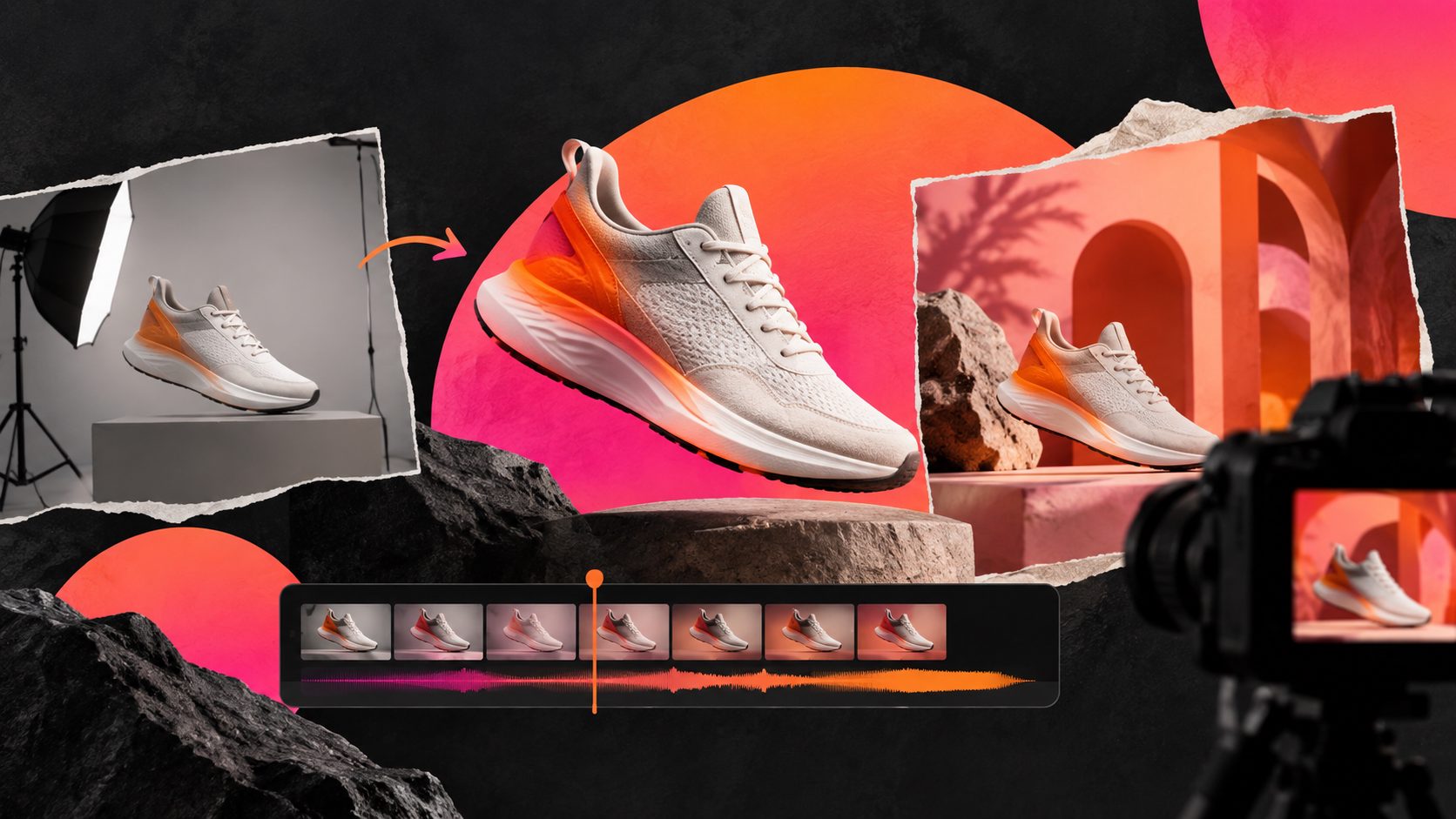
A clean product image can become the foundation for several ad directions. AdsTurbo Product Video supports JPG and PNG product images, and a clear product photo on a plain background generally gives the system a better visual starting point.
The workflow is:
- Prepare the source image. Use a sharp product photo with the complete item visible.
- Define one primary selling point. Examples include convenience, durability, portability, appearance, or time saved.
- Choose the audience situation. Describe who uses the product, where they use it, and what problem it solves.
- Select the video angle. Use a product demo, review-style explanation, unboxing, problem-solution story, or lifestyle scene.
- Add promotion details only when accurate. Include a discount, code, or deadline only if the offer is active and approved.
- Generate multiple variations. Change the hook, audience, proof point, or CTA—not every element at once.
For a deeper production path, see this guide to creating realistic AI UGC ads for ecommerce. The key principle is to keep the product visually consistent while varying the surrounding message.
A practical creative matrix for Meta ad testing
Many brands generate several videos but test them without a clear hypothesis. A better method is to build a small matrix with controlled changes.
The 3 × 3 × 2 framework
Create:
- 3 hooks: problem-led, benefit-led, and curiosity-led
- 3 selling angles: convenience, performance, and identity or lifestyle
- 2 CTAs: shop now and learn more
This produces 18 possible combinations. You do not need to generate all 18 immediately. Start with six to nine videos, keeping the product, offer, and landing page consistent. Then expand the combinations around the strongest early signals.
The important information is not only which video wins. It is why it wins:
- A stronger hook may improve thumb-stop behavior.
- A clearer demonstration may improve landing-page visits.
- Better captions may help viewers understand the offer without sound.
- A stronger CTA may improve the final conversion step.
This framework creates an information trail that can guide the next production cycle instead of producing disconnected creative batches.
Use captions, localization, and editing controls deliberately
Short-form ecommerce ads are often watched in environments where audio is unavailable or ignored. Captions should therefore reinforce the visual story rather than duplicate every spoken word in a crowded block of text.
AdsTurbo Video Subtitle can automatically transcribe speech, generate time-synced captions, and export either a video with embedded subtitles or a separate subtitle file. Caption styling can also be adapted for TikTok, Instagram Reels, and YouTube Shorts formats.
For international campaigns, translation should preserve the selling logic, not only the literal wording. A translated version may need a different hook, shorter sentence structure, or a locally familiar benefit. AdsTurbo supports video translation and multilingual subtitle workflows for this type of localization.
When an existing clip has the right idea but weak image quality, an AI video enhancer can improve the usable source before editing. This is especially helpful when the original video is compressed, old, or recorded in low resolution.
When should you use ad cloning?
Ad cloning is useful when you have identified a reference video with a clear structure but need a new version for a different product, market, or audience. The goal should not be to copy a competitor’s identity or assets. Instead, analyze the underlying creative pattern:
- How quickly does the video introduce the problem?
- When does the product first appear?
- How many scenes support the main claim?
- Where is the CTA placed?
- What changes between the opening and the payoff?
AdsTurbo Ad Clone can analyze a reference video of up to 12 seconds and use its structure to generate advertising variations. A responsible workflow keeps the product, claims, brand voice, and visual identity original while borrowing only a general storytelling pattern.
For more detail on this method, see how to reverse engineer winning ads with AI.
How to choose the right AI video ad workflow
The best workflow depends on the bottleneck in your current production process.
| Bottleneck | Useful approach |
|---|---|
| No usable footage | Start with a product image and generate a product-focused video |
| Too few creative angles | Build a hook-and-angle matrix before generating |
| Existing videos look blurry | Upscale selected source clips before editing |
| One ad works in one market | Translate the script, voice, and captions for each region |
| Strong idea but weak execution | Analyze the reference structure and rebuild it with original assets |
| Too many manual revisions | Use asynchronous task processing, status polling, or Webhooks in an API workflow |
For larger teams, AdsTurbo supports team workflows, API access, and custom workflow support on advanced plans. Its video generation API includes endpoints for shot analysis, lip sync, watermark removal, translation, upscaling, face swap, motion control, and subtitles.
Frequently asked questions
What is the best length for an ecommerce video ad?
There is no universal winning length. Start with a concise version that communicates the product, benefit, and CTA without unnecessary scenes. Then test a shorter hook-focused cut against a fuller demonstration cut.
Can one product photo create both Facebook and Instagram ads?
Yes. One product photo can provide the visual source for multiple concepts and aspect ratios. The message, framing, captions, and pacing should still be adjusted for Feed, Reels, and Stories.
Should AI-generated ads use captions?
Captions are usually valuable because they make the message understandable without relying on audio. Keep them short, high contrast, synchronized with the scene, and focused on the main point.
How many variations should an ecommerce brand create?
A practical starting batch is six to nine videos built from controlled changes in hooks, angles, and CTAs. Generate more only when the first batch reveals a clear direction worth expanding.
Can existing creator footage be reused for new audiences?
Yes, when you have the necessary rights and the source footage is suitable. You can also create audience or localization variants with tools such as character swap, provided the people, likenesses, and advertising use are properly authorized.
Final takeaway
AI video ads for ecommerce Facebook and Instagram perform better when production and testing are designed together. Start with a clean product asset, define a specific customer promise, create controlled variations, adapt the edit for each placement, and record what each version teaches you.
The highest-value output is not one polished video. It is a repeatable creative system that helps your store discover better hooks, clearer demonstrations, and more relevant localized messages.