

By adsturbo.ai | Published 2026-09-28 | Updated 2026-09-28
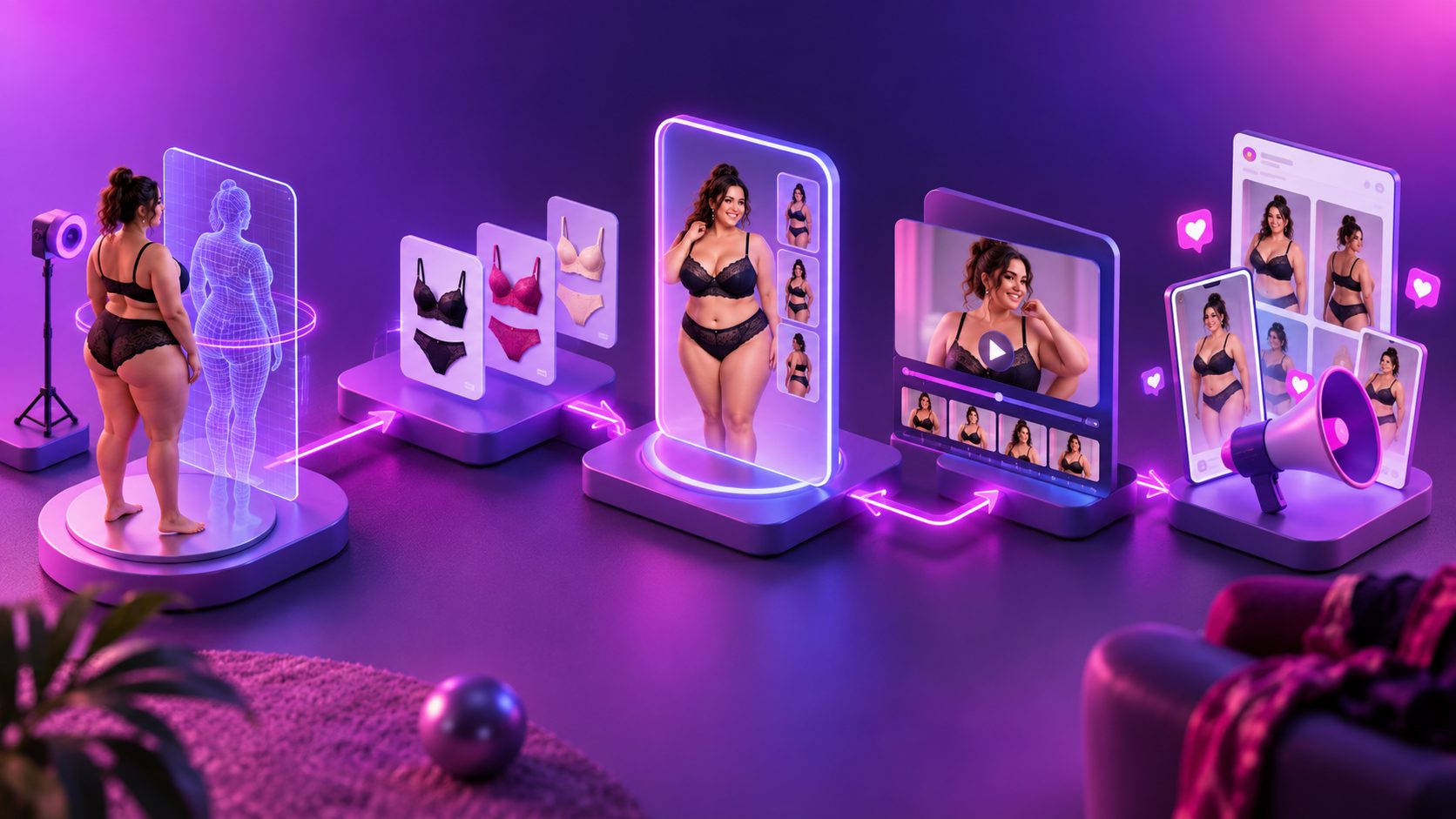
A plus size lingerie virtual try-on video ads generator helps DTC brands turn product images, fit-focused messaging, and selected model references into short-form creative without organizing a full photoshoot. The strongest workflow does not treat AI imagery as a replacement for fit evidence. Instead, it uses AI to show construction, support, coverage, movement, and styling in multiple ad variations.
For lingerie brands, that distinction matters. Customers need more than an attractive model: they want to understand how the band sits, where the straps fall, how the fabric stretches, and whether the product is designed for their body type.
What is a plus size lingerie virtual try-on video ad?
A virtual try-on video ad is a short product creative that presents lingerie on a selected body type or character while using motion, voice, captions, or scene changes to communicate product benefits. It can combine product imagery with AI-generated actors, character replacement, lip sync, translation, and editing controls.
The format is useful for three different jobs:
- Product education: Show straps, closures, stretch, lining, support zones, and coverage.
- Creative testing: Compare hooks such as “support without digging” against “smooth under everyday clothes.”
- Localization: Reuse the same product story with different languages, characters, captions, and aspect ratios.
Current virtual try-on tools commonly emphasize garment uploads, body diversity, AI fashion models, and on-model product visuals. However, research on virtual try-on also identifies persistent challenges around precise garment size, length, and body-shape control. (capcut.com)
That is why a responsible ad should describe visual presentation, not promise that an AI rendering proves exact fit.
Why plus-size lingerie needs a different video structure
Plus-size lingerie buyers often evaluate practical details before responding to aesthetic storytelling. A video that only shows a model posing may create attention, but it does not answer the questions that influence purchase confidence.
A better creative structure is the Fit Evidence Ladder:
- Silhouette: Show the overall shape and intended coverage.
- Construction: Highlight seams, underband, straps, panels, lace, mesh, or closures.
- Movement: Use a turn, walk, seated pose, or controlled close-up to show how the garment behaves.
- Use case: Connect the product to workwear, occasion dressing, lounging, layering, or everyday support.
- Proof boundary: State what the product does without making unsupported claims about comfort, sizing, or body transformation.
This framework is an original planning model for creative production. It helps brands avoid a common mistake: generating visually diverse models without generating visually useful information.
For example, a 15-second ad might open with a front view, cut to a side angle showing the band, display a close-up of the strap adjustment, and end with a size-guide prompt. The purpose is not to simulate an exact fitting-room result. It is to make the product’s design easier to understand.
How to create the video from one lingerie product image
A practical workflow starts with clean inputs rather than elaborate prompts.
1. Prepare the product image
Use a clear JPG or PNG product image with visible edges, accurate color, and minimal background distraction. AdsTurbo Product Image supports JPG and PNG uploads, and clear product photos on a plain background are best suited to analysis and generation.
Before uploading, check:
- The full garment is visible.
- Straps, hooks, trim, and texture are not cropped.
- The color matches the product page.
- The image does not contain misleading text or competing logos.
- The product is shown in a way that does not imply unsupported fit performance.
If the source image is soft or compressed, use an upscaling step before building the ad. AdsTurbo provides AI upscaling with before-and-after preview and 4K video export support for suitable source material.
2. Define the body and audience brief
Describe the audience in functional terms rather than relying only on a generic “plus-size model” prompt. Include the intended size range, body diversity, styling context, age direction, skin-tone diversity, and campaign market.
A useful brief might specify:
- Full-bust or fuller-hip representation
- Front, side, and three-quarter angles
- Neutral or confident expression
- Everyday bedroom, dressing-room, or wardrobe setting
- Product-first framing
- No exaggerated body reshaping
- Clear space for captions and CTA text
AdsTurbo offers more than 300 AI actors and supports character replacement, which can help create different audience-facing versions from a consistent creative concept. Character Swap requires a source video or image containing a person and a target character image; the workflow is best used for controlled variation, not for claiming that every generated body represents an exact customer fit.
3. Build the short-form script
Use a simple five-part script:
- Hook: “Support that works with your outfit, not against it.”
- Visual proof: Show the front and side silhouette.
- Feature: Identify a real construction detail.
- Use case: Explain when the customer might wear it.
- CTA: Direct viewers to the size guide, product page, or color options.
Avoid claims such as “guaranteed perfect fit” unless the brand can substantiate them. For intimate apparel, “designed for,” “features,” and “shown in” are safer and more accurate than universal promises.
AdsTurbo Product Video can use a JPG or PNG product image and optional selling points to generate product-focused short videos. For a broader testing workflow, combine this with a 12-variant creative testing matrix rather than producing one “hero” ad and assuming it will work for every audience.
A useful testing matrix for DTC lingerie ads
The most efficient test is not “model A versus model B.” It is a structured comparison of the customer problem, visual evidence, and message.
| Variable | Version A | Version B | Version C |
|---|---|---|---|
| Hook | Everyday support | Smooth layering | Confidence and coverage |
| Visual angle | Front and side | Close-up construction | Motion and styling |
| Voice | Direct product explanation | Customer-style narration | Caption-led silent ad |
| Scene | Bedroom mirror | Wardrobe styling | Clean product studio |
| CTA | View size guide | See available colors | Shop the collection |
This creates 12 possible combinations before changing the product, language, or character. Keep the product facts constant while testing one major creative variable at a time. That makes performance results easier to interpret.
AdsTurbo’s video tools support lip sync, motion control, character swap, video translation, subtitles, background replacement, and resolution enhancement. Its Video Subtitle tool can automatically transcribe speech, create synchronized captions, and export either a captioned video or a separate subtitle file. For cross-border campaigns, a multilingual ecommerce video workflow can help adapt the same product explanation for different markets.
How to keep the creative trustworthy
AI try-on imagery should support product understanding, not hide uncertainty. Use real product specifications for fiber content, size range, closure type, care instructions, and support construction. If the visual is an AI-generated presentation, avoid wording that implies the person shown is a real customer or that the garment has been physically tested by the displayed character.
For lingerie, also keep framing tasteful and platform-appropriate:
- Focus on product construction and styling.
- Avoid unnecessary intimate close-ups.
- Keep copy centered on support, coverage, fit guidance, and use case.
- Review hands, straps, lace edges, closures, and text for visual errors.
- Compare the generated garment against the source image before publishing.
A hybrid workflow is often safer: use AI for concept variations and short-form editing, then retain the original product image or verified detail shots for the most important proof moments.
Can the same video be localized and repurposed?
Yes. One approved concept can become multiple versions by changing the voice, captions, character, background, or aspect ratio while keeping the product story consistent. AdsTurbo supports video translation, AI subtitles, character replacement, lip sync, and output adaptation for social formats.
For example, a single creative can be adapted into:
- A 9:16 TikTok or Reels ad
- A square feed version
- A 16:9 product-page video
- English, Spanish, Japanese, or other localized caption versions
- A silent autoplay version with embedded subtitles
For product launch campaigns, combine the video with AI-generated product visuals for ecommerce listings so the same fit-focused message appears across ads, product pages, and email assets.
Frequently asked questions
Is this the same as a shopper-facing virtual fitting room?
No. A shopper-facing fitting room attempts to show an individual how an item may look on them. A video ad generator creates promotional content for marketing. It should not be presented as a precise size or fit prediction.
What input works best?
A clear JPG or PNG product image on a plain background works best for product-focused generation. Include accurate selling points and avoid relying on the AI to invent technical product details.
Can I create ads without a real lingerie model?
Yes. AI actors, character replacement, product video generation, motion control, and subtitles can support model-free production. The final creative should still be reviewed for garment accuracy and responsible representation.
How should plus-size lingerie ads discuss fit?
Lead with observable design features and practical use cases. Pair the video with a real size guide, measurements, and product specifications instead of promising universal comfort or an exact fit for every body.
Can one concept produce multiple ad variations?
Yes. Test different hooks, scenes, characters, languages, captions, and CTAs while keeping the core product facts unchanged. This produces more useful learning than making many visually different videos with no testing structure.
Conclusion
A plus size lingerie virtual try-on video ads generator is most valuable when it turns one accurate product image into a disciplined set of fit-focused creative tests. The winning workflow is not simply “put lingerie on an AI model.” It is to show what the garment is, how it is constructed, where it may be worn, and what customers should verify before purchasing.
With AdsTurbo, brands can combine product-image generation, AI actors, motion control, character replacement, lip sync, subtitles, translation, and upscaling into a repeatable DTC production process. Use the Fit Evidence Ladder, test a structured message matrix, and keep every claim grounded in the real product.