

By AdsTurbo | Published 2026-09-24 | Updated 2026-09-24
A skincare ingredient mechanism video ad explains what an ingredient is designed to do, how it interacts with the skin surface, and why that matters to the shopper. The strongest versions do not attempt to reproduce a medical lecture. They translate formulation logic into a short, visual story that is understandable, persuasive, and careful about cosmetic claims.
For independent beauty brands, this format bridges a common gap: a product photo shows what the product is, while a mechanism video explains why the formula is relevant. The challenge is turning scientific language into a consumer-friendly narrative without implying unsupported treatment, cure, or guaranteed biological results.
What is a skincare ingredient mechanism video?
A skincare ingredient mechanism video is a short educational or advertising video that visualizes the relationship between a cosmetic formula, an ingredient concept, and an intended appearance benefit.
A useful mechanism video usually contains four layers:
- The consumer concern — such as dull-looking skin, dryness, or uneven-looking tone.
- The ingredient or formula concept — such as humectants, exfoliating acids, antioxidants, peptides, or barrier-supporting ingredients.
- The visual mechanism — for example, water-binding, surface renewal, film formation, or delivery through a cosmetic formula.
- The cosmetic outcome — such as skin that looks smoother, more hydrated, or more radiant.
The key is to describe the mechanism at the level your evidence supports. The U.S. Food and Drug Administration explains that claims about treating disease or affecting the structure or function of the body can cause a product to be regulated as a drug rather than only as a cosmetic. (fda.gov)
Why mechanism visuals work for independent skincare brands
Ingredient-led advertising can make an unfamiliar formula easier to understand, especially when a product contains technical actives that shoppers recognize but cannot easily interpret. A visual explanation can also reduce the need to place every benefit in dense on-screen copy.
However, more scientific detail does not automatically create a better ad. The practical question is:
What is the smallest visual explanation that makes the product’s claimed benefit easier to believe and remember?
For a 15-second ad, a useful sequence is:
| Time | Story function | Example visual |
|---|---|---|
| 0–3 seconds | Identify the problem or question | “Why does skin feel tight after cleansing?” |
| 3–7 seconds | Introduce the ingredient mechanism | Animated water molecules, surface film, or gentle exfoliation |
| 7–11 seconds | Connect mechanism to appearance | Skin surface appears more even or supple |
| 11–15 seconds | Present the product and CTA | Product pack, usage direction, and “Shop the formula” |
This structure is an editorial framework, not a claim that every product produces the same result. The visual must match the formula, evidence, and intended use.
How to translate skin absorption into a responsible visual story
“Absorption” is one of the most attractive concepts in skincare advertising, but it is also easy to overstate. A glowing particle traveling deep into the skin may imply penetration, transformation, or repair that the product has not established.
A safer approach is to divide the visual into three evidence levels:
Level 1: Surface-level cosmetic story
Use this when the product claim focuses on appearance, feel, hydration, or cleansing. Show the product spreading across the skin surface, forming a smooth film, or helping the skin look more comfortable and hydrated.
Level 2: Formula-delivery story
Use this only when the brand has support for the relevant formulation concept. A visual may show encapsulation, dispersion, or gradual release as a simplified representation of the product system. Avoid presenting the animation as a literal microscopic recording unless it is genuinely based on appropriate research.
Level 3: Biological pathway story
This is the highest-risk level. Claims involving inflammation, pigment production, collagen synthesis, cellular repair, acne treatment, or disease prevention may move beyond ordinary cosmetic positioning. The FDA notes that intended use can be established through claims made in advertising, websites, and other promotional materials—not only on the package. (fda.gov)
For most DTC skincare ads, Level 1 plus carefully limited Level 2 is the most practical balance between clarity and compliance.
The claim-to-visual framework for short-form ads
Before creating scenes, build a claim map. This is the most important step that many mechanism animation briefs omit.
| Claim component | Question to answer | Creative treatment |
|---|---|---|
| Ingredient fact | What is actually present in the formula? | Show the ingredient name or a neutral molecular motif |
| Cosmetic function | What is the ingredient intended to contribute? | Use surface, texture, moisture, or light-based visuals |
| Consumer benefit | What may the user notice? | Use qualified appearance language |
| Evidence boundary | What should the ad not imply? | Remove medical verbs and exaggerated outcomes |
| Proof cue | What supports the message? | Use formulation facts, testing details, or approved substantiation |
For example, replace “repairs damaged skin cells” with a more supportable creative direction such as “helps skin look smoother and more refreshed,” if that accurately reflects the product’s substantiated cosmetic positioning.
The Federal Trade Commission evaluates the overall impression of an advertisement, including words, images, charts, and implied messages. Advertisers must have a reasonable basis for objective claims before publishing them, and health-related claims generally require competent and reliable scientific evidence. (ftc.gov)
A practical production workflow for ecommerce teams
A lean production process can turn one ingredient brief into several platform-ready concepts.
1. Start with the product evidence
Collect the ingredient list, approved claims, usage instructions, formulation notes, test summaries, and prohibited wording. Separate what the formula contains from what the product is proven to do.
2. Write a one-sentence mechanism
Use this structure:
“This formula uses [ingredient or system] to support [cosmetic function], helping skin look or feel [qualified appearance benefit].”
If the sentence sounds like a drug claim, simplify it before designing the animation.
3. Build three visual metaphors
Create one visual for the ingredient, one for the formula action, and one for the visible cosmetic result. Avoid switching between unrelated metaphors, such as cells, pipes, magnets, and light beams, in a 15-second video.
4. Produce multiple hooks
Possible hooks include:
- “What does this ingredient actually do?”
- “The formula story behind smoother-looking skin”
- “Why this serum feels lightweight but hydrating”
- “From ingredient label to daily skin routine”
Each hook can lead into the same verified mechanism sequence.
5. Localize the finished assets
Skincare education often depends on precise wording. Generate captioned versions for TikTok, Instagram Reels, and YouTube Shorts, then review translated claims separately rather than relying on word-for-word substitution. AdsTurbo’s ecommerce video translation workflow can support subtitle, dubbing, and localization production.
AdsTurbo Video Subtitle can automatically transcribe speech, generate time-synced captions, and export either a captioned video or a separate subtitle file. This is useful when the same mechanism explanation needs different language versions and platform formatting.
How AdsTurbo can fit the workflow
AdsTurbo supports several production steps relevant to ingredient-led ecommerce advertising:
- Product Video can use a JPG or PNG product image, with optional selling points and promotional information, to create short UGC-style product videos.
- Ad Clone can analyze a reference video of up to 12 seconds, then help reconstruct its pacing, shot logic, and CTA structure for new creative variations.
- Video Subtitle can create multilingual, time-synced subtitles suited to TikTok, Instagram Reels, and YouTube Shorts.
- AI Upscaling can improve low-resolution or highly compressed source footage before export.
- Background Replace and product image generation can help create cleaner product-led scenes when original studio assets are limited.
For teams testing multiple ingredient angles, the practical advantage is not simply generating more videos. It is separating variables: keep the mechanism and product proof constant while changing the hook, narrator, visual metaphor, or CTA.
Teams with advanced plans can also use team workflows, API access, and custom workflow support. All AdsTurbo generation tasks run asynchronously, with completion available through status polling or Webhook callbacks. For broader production automation, the in-house ecommerce video ad workflow offers a useful framework for organizing creative requests and iteration.
Common compliance mistakes to avoid
Showing a literal “deep penetration” result
A particle moving through multiple skin layers can imply a physiological effect. Use a simplified surface or formula visualization unless deeper claims are properly supported.
Combining a cosmetic claim with a medical visual
Words such as “heals,” “repairs tissue,” “eliminates acne,” or “rebuilds collagen” can change the overall meaning of an otherwise cosmetic ad. The visual may communicate the same implication even when the text is cautious.
Using a disclaimer to rescue an exaggerated claim
A small disclaimer does not necessarily correct a dominant visual or headline. FTC guidance focuses on the net impression consumers are likely to take from the complete advertisement. (ftc.gov)
Treating ingredient research as proof for the finished product
Evidence for an isolated ingredient may not prove the same result for a particular finished formula, concentration, delivery system, or use pattern. Match the claim to the actual product evidence.
Frequently asked questions
What length should a skincare mechanism ad be?
For TikTok, Reels, and Shorts, 15 seconds is a practical starting point because it forces one clear mechanism and one CTA. A longer version can explain formulation context, but it should not add scientific detail without a stronger narrative purpose.
Should the video show skin layers?
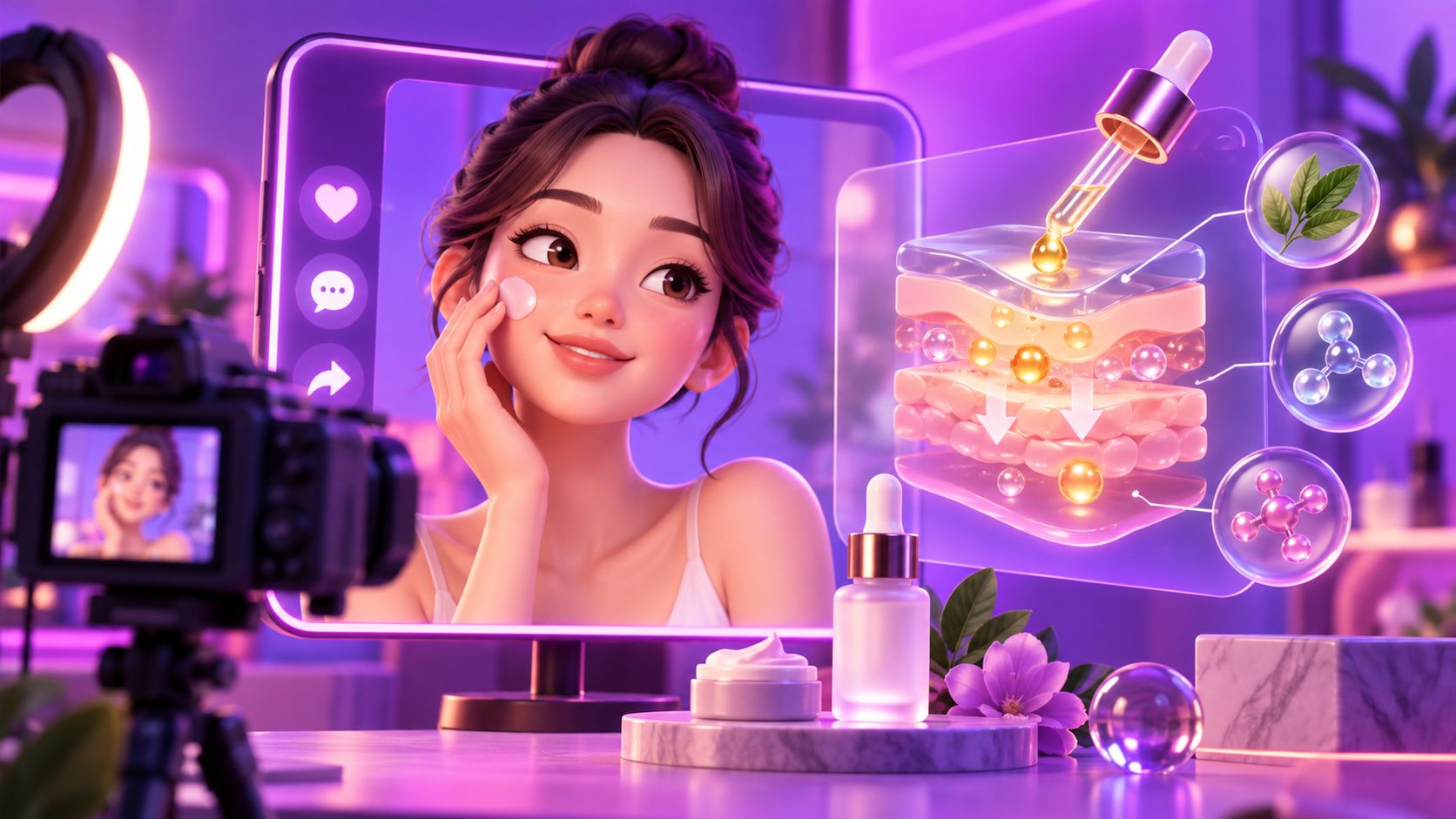
It can, but skin-layer visuals should be treated as explanatory graphics rather than proof of penetration or biological change. Keep the depth and language aligned with the product’s substantiation.
Can a cosmetic brand mention ingredient benefits?
Yes, provided the statements are truthful, not misleading, and appropriate for the product’s intended use. The FDA states that cosmetic claims are subject to limits, while advertising claims are also governed by the FTC. (fda.gov)
What is the best CTA for an ingredient-led ad?
Use a CTA that continues the educational promise: “Explore the formula,” “See the full ingredient story,” or “Shop the daily routine.” This is usually more credible than promising an immediate transformation.
Can one mechanism video be reused internationally?
Yes, but the script, subtitles, voiceover, product claims, and visual implications should be reviewed for each market. AdsTurbo can help create translated and captioned variants, while the brand remains responsible for claim approval.
A strong skincare mechanism video makes science easier to understand without pretending that animation is clinical proof. Start with the substantiated cosmetic message, convert it into one consistent visual metaphor, and produce controlled variations for testing. For ecommerce teams, this approach creates educational ads that are clearer, more reusable, and less likely to overpromise.