Claude
 Cursor
TikTok Spark Ads Safe Zone: A Practical Layout Guide

Summarize with
Summary
Learn the TikTok Spark Ads safe zone, how captions and UI overlays affect layouts, and how ecommerce sellers can protect hooks, prices, and CTAs.
By adsturbo.ai | Published 2026-11-27 | Updated 2026-11-27
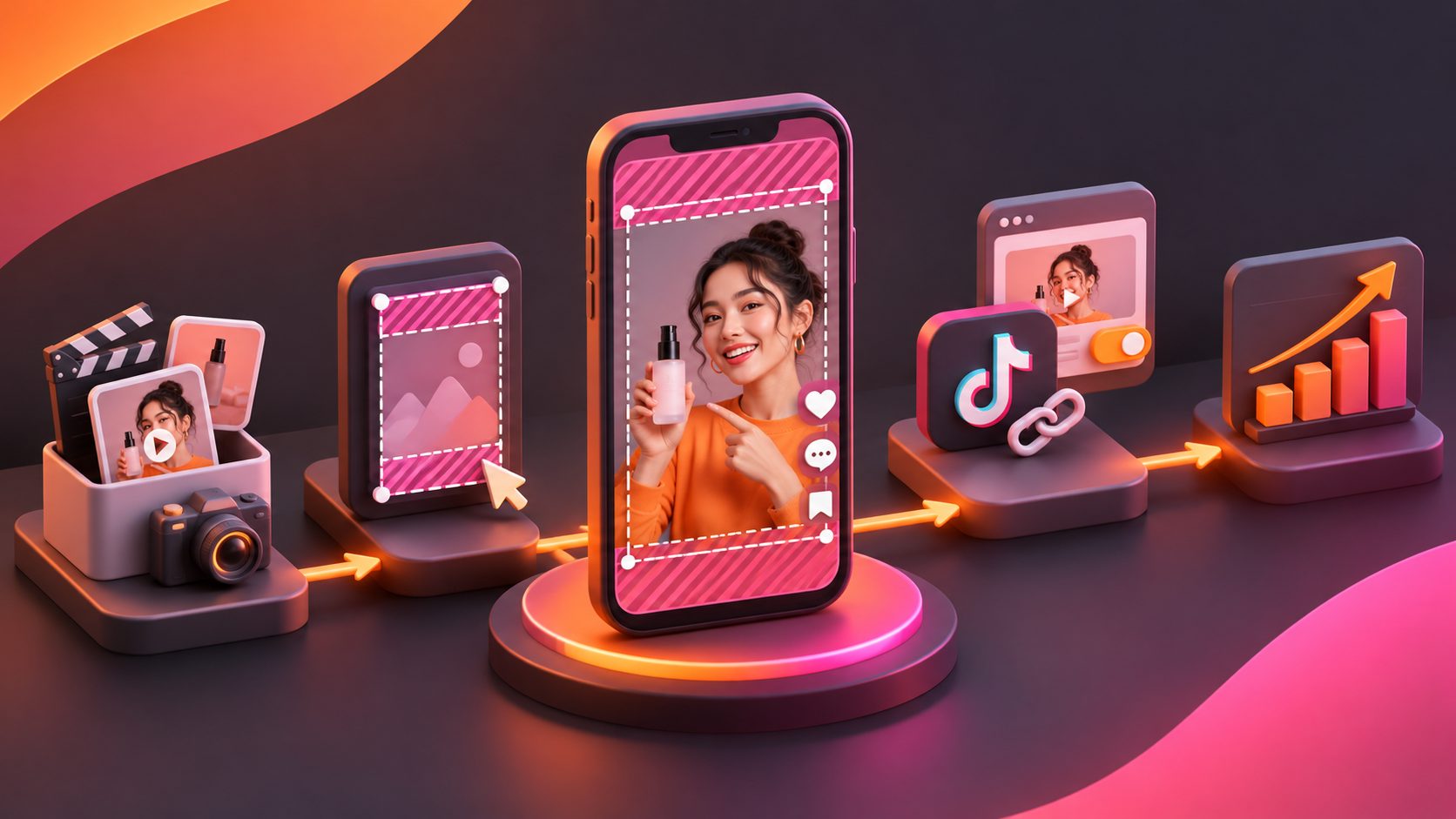
The TikTok Spark Ads safe zone is the part of a video where important text, prices, product claims, and calls to action are least likely to be covered by TikTok’s interface. It is not one fixed pixel box: the usable area changes with video orientation, caption length, and additional ad formats. (ads.tiktok.com)
For ecommerce sellers, this distinction matters. A video can pass upload requirements while still hiding the product benefit behind the caption, the right-side action rail, or the bottom call-to-action area.
What is the TikTok Spark Ads safe zone?
The TikTok Spark Ads safe zone is a layout boundary that keeps key creative elements away from interface overlays such as captions, engagement icons, profile information, and shopping prompts.
Spark Ads are different from ordinary uploaded in-feed ads because they promote an existing organic TikTok post. TikTok states that Spark Ads can use posts from a brand account or an authorized creator account, while engagement generated during promotion is attributed to the original organic post. (ads.tiktok.com)
This creates two practical constraints:
- The video itself must be safe to view beneath TikTok’s interface.
- The organic caption becomes part of the advertising layout.
TikTok’s current auction documentation says Spark Ad captions are extracted from the organic post and can display up to four lines, including emojis. The safe zone therefore becomes smaller as the caption takes up more vertical space. (ads.tiktok.com)
Does TikTok publish exact Spark Ads safe-zone pixels?
TikTok does not provide one universal safe-zone measurement for every Spark Ad placement. Its official guidance says the safe-zone size depends on the video dimension, caption length, and additional formats used. TikTok also provides placement-specific previews and overlay guidance rather than one permanent margin for every campaign. (ads.tiktok.com)
For production planning, many teams work from a 1080 × 1920 vertical canvas. A useful conservative reference is to keep essential text in the central area, away from the bottom interface and the right-side button rail. One independent 2026 layout analysis places the most restrictive Spark Ads exclusion area around the bottom 484 pixels and the right-side interaction rail, but these values should be treated as a production reference—not a TikTok guarantee. (capqa.app)
The safest rule is simple: use TikTok’s preview with the final caption and CTA before launch.
Which elements should stay inside the safe area?
Keep the following elements in the protected central region:
- The first-frame hook
- Product name and primary benefit
- Price, discount, or promo code
- Before-and-after labels
- Subtitles and spoken claims
- Brand logo
- Final call to action
- Important product demonstrations
Avoid placing essential information in these areas:
| Screen area | Common obstruction | What to avoid |
|---|---|---|
| Bottom section | Caption, CTA, Shop Now elements | Prices, promo codes, final CTA |
| Right side | Like, comment, share, and profile controls | Logos, product benefits, text labels |
| Upper section | Account or placement information | Small but essential disclaimers |
| Lower-right corner | Multiple controls may overlap | Product names and key visual details |
A decorative background can extend into these zones. A conversion-critical message should not.
How should ecommerce sellers design a Spark Ad layout?
1. Build the video before writing the caption
Because the organic caption affects the visible safe area, write the intended caption before finalizing the edit. A short caption gives the video more room than a long caption with several lines, emojis, hashtags, or promotional details.
For a product ad, separate information by job:
- On-screen hook: “A cleaner way to organize your desk”
- Product proof: Show the product solving the problem
- Offer: Keep the discount visible in the central area
- Caption: Add context, social proof, or searchable phrasing
- CTA: Use a short final line such as “See the full set”
This prevents the video from depending on the TikTok caption to communicate a message that may be hidden or truncated.
2. Treat the first three seconds as a protected conversion zone
The opening frame should communicate the product category and problem without relying on the bottom of the screen. This is especially important for Spark Ads because users may encounter the post in a paid context with more interface elements than the original creator expected.
A practical test is to pause the video at 0.5 seconds, 1.5 seconds, and 3 seconds. At each point, ask:
- Can a viewer identify the product?
- Is the main claim readable without opening the caption?
- Is any text blocked by interface controls?
- Does the product remain visually dominant?
If the answer is no, move the message upward or simplify it.
3. Keep subtitles above the lower interface
Subtitles are often placed too low because editors optimize for organic viewing rather than paid delivery. For Spark Ads, move subtitles upward enough to leave room for the caption and CTA layers.
Use short subtitle lines, high contrast, and a consistent position. Avoid placing every word at the bottom edge. When the spoken sentence is longer, split it into two or three brief lines in the middle-lower area.
AdsTurbo’s AI video enhancer can help improve clarity when subtitles, product labels, or small details become difficult to read after compression or resizing. The safe zone protects placement; it does not solve low-resolution source footage.
Spark Ads dimensions and file requirements
Spark Ads inherit the organic TikTok post rather than following exactly the same creative restrictions as a newly uploaded non-Spark ad. TikTok’s Spark Ads documentation states that organic videos can have no restrictions on ratio, resolution, file type, duration, bitrate, or file size, provided the post is successfully uploaded to TikTok. It also states that Spark Ads can promote videos up to 10 minutes in the relevant specification. (ads.tiktok.com)
For standard in-feed creative, TikTok lists 9:16 vertical as the recommended format, with minimum dimensions of 540 × 960 pixels for non-Spark ads. Horizontal and square formats are also supported for non-Spark placements, but their safe areas differ. (ads.tiktok.com)
For ecommerce testing, 9:16 remains the most practical starting canvas because it fills the mobile screen and gives the strongest control over product framing. However, do not assume that a 1080 × 1920 export automatically makes every text element safe.
A three-layer Spark Ads safe-zone test
A useful production framework is to check the creative in three layers:
Layer 1: Content safety
Can the viewer understand the product, offer, and action without reading the caption?
Layer 2: Interface safety
Does the final preview cover any important text with captions, buttons, profile information, or shopping elements?
Layer 3: Compression safety
After export, does the product remain sharp and does small text remain readable on a real phone?
This framework adds an important step that many safe-zone guides miss: a message can be geometrically safe but still fail after compression. In practice, product labels and discount text should be larger than the minimum readable size because TikTok delivery may introduce scaling and compression across devices.
For sellers creating several variations, keep the product and offer in the same central position while changing the hook, creator voice, proof point, or opening shot. This makes performance comparisons cleaner than changing both the message and the layout at once.
Common Spark Ads safe-zone mistakes
Putting the offer at the bottom
The discount may look balanced in an editing timeline but disappear beneath TikTok’s lower interface. Move the offer into the middle third or upper-middle area.
Copying an organic caption into the video
A long caption and burned-in subtitles can compete for the same space. Use the caption for supporting context and reserve the video for the one message that must be seen.
Designing only for the editor preview
The editing canvas does not show every paid interface layer. Always inspect the creative in TikTok Ads Manager with the final caption, objective, and add-on settings.
Using one safe-zone template for every placement
TikTok explains that safe-zone dimensions vary by orientation, caption length, and additional formats. A template that works for a short vertical Spark Ad may not work for square or horizontal delivery. (ads.tiktok.com)
Treating approval as proof of readability
Ad approval confirms that the asset meets platform requirements. It does not guarantee that a price, subtitle, or product benefit will be easy to see.
Frequently asked questions
What is the best size for a TikTok Spark Ad?
A vertical 9:16 video is the most practical starting format for mobile in-feed delivery. Spark Ads use organic posts, so TikTok’s Spark specification is more flexible than the standard non-Spark upload requirements. (ads.tiktok.com)
Can text be placed at the bottom of a Spark Ad?
It can, but important text should not be placed there. The bottom area may be covered by captions, shopping prompts, or call-to-action elements, especially when the organic caption is long.
Do Spark Ads use the organic post caption?
Yes. TikTok states that Spark Ad captions are extracted from the organic video captions. In auction specifications, up to four caption lines may be displayed, including emojis. (ads.tiktok.com)
Should subtitles be inside the safe zone?
Yes. Subtitles, product claims, and spoken offers should remain above the lower interface area. Keep them short and check their position in the final TikTok preview.
Is there one official pixel-safe area for every Spark Ad?
No. TikTok says the safe-zone size depends on dimension, caption length, and additional formats. Pixel overlays from third parties can help with production, but the final in-platform preview should be treated as the source of truth. (ads.tiktok.com)