Claude
 Cursor
AI UGC Ads for Ecommerce: A Practical Guide to Testing Product Videos

Summarize with
Summary
Learn how AI UGC ads for ecommerce work, when to use them, how to brief product benefits, and how to test review, demo, and intro variants.
By adsturbo.ai | Published 2026-11-16 | Updated 2026-11-16
AI UGC ads for ecommerce are short product advertisements designed to resemble creator-led content while using artificial intelligence for scripting, presentation, editing, voiceover, captions, or video generation. They help ecommerce teams turn one product image and a few clear benefits into multiple creative directions for paid social testing.
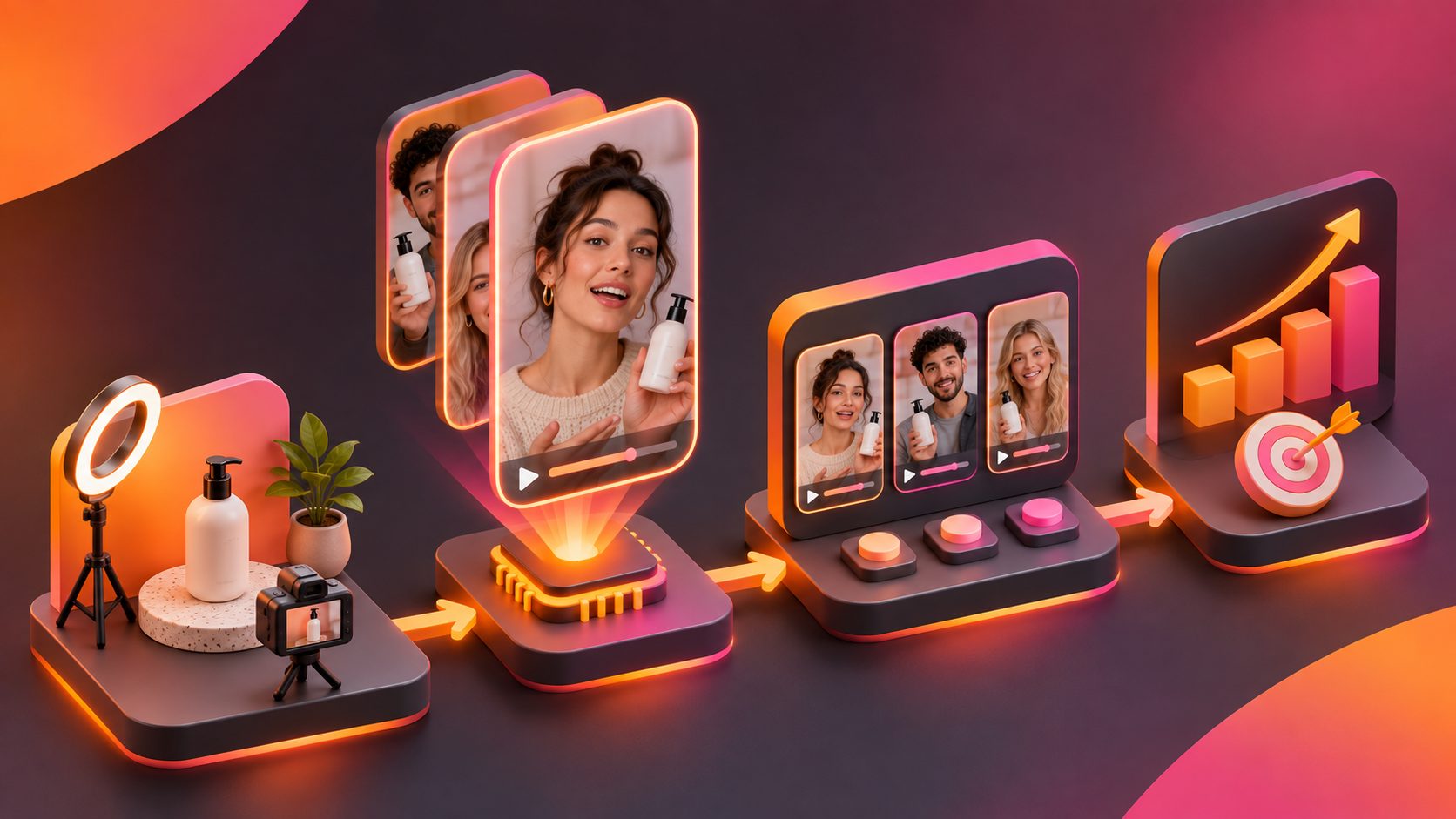
The key advantage is not simply making videos faster. It is creating a repeatable testing system: one product, several hooks, different selling points, and multiple ad formats that can be compared without organizing a new shoot for every idea.
What are AI UGC ads?
AI UGC ads are UGC-style advertisements produced with AI rather than filmed entirely by a human customer or creator. They may use a virtual presenter, generated voiceover, product animation, captions, lifestyle scenes, or a scripted review-style structure.
The format is useful because it combines the informal feel of creator content with a more controlled production process. However, “UGC-style” does not mean “real customer testimonial.” A generated presenter should not be presented as a customer who personally used a product unless that claim is accurate and properly supported.
Search results for AI UGC tools commonly emphasize product-image input, AI presenters, vertical formats, automated scripts, and rapid creative production. They are less consistent on the operational question that matters most to performance marketers: how should the resulting variants be planned and evaluated? That is where a testing framework becomes more valuable than a simple video generator.
When should ecommerce brands use AI UGC instead of hiring creators?
AI UGC is usually strongest when the immediate goal is creative exploration, not replacing every form of creator content.
| Situation | AI UGC may be a good fit | Real creator content may be better |
|---|---|---|
| Product launch | Generate several positioning angles quickly | Build deeper trust with authentic use |
| Early ad testing | Compare hooks and benefits efficiently | Capture genuine reactions |
| Many SKUs | Produce consistent product introductions | Film detailed demonstrations |
| Multiple markets | Adapt scripts, voiceovers, and captions | Add local cultural nuance |
| Social proof | Present product facts or scenarios | Show verified customer experience |
AI UGC video ads can outperform creator production on speed, consistency, and iteration volume. A creator brief can involve sourcing, shipping, scheduling, revisions, and usage-rights discussions. AI-assisted production reduces much of that coordination.
Creators still have an important role when the ad depends on genuine product experience, emotional credibility, specialized expertise, or visual proof that is difficult to synthesize. A practical hybrid approach is to use AI for early concept testing, then invest in real creator footage around the winning message.
How should you prepare a product for an AI UGC ad?
The quality of the input usually sets the ceiling for the output. Begin with a clear JPG or PNG product image. A sharp photo on a plain or solid-color background is easier to analyze and place into different scenes.
Then reduce the product brief to three selling points. Each point should answer one customer question:
-
What is it?
State the product category or primary use. -
Why should the shopper care?
Explain the practical benefit in plain language. -
Why act now?
Add a legitimate promotion, bundle, seasonal reason, or clear next step if one exists.
Avoid writing three versions of the same feature. “Lightweight,” “portable,” and “easy to carry” may be one benefit, not three separate angles. A stronger brief might combine “folds flat,” “fits in a small travel bag,” and “includes a carry case” if those claims are accurate.
AdsTurbo Product Video accepts a JPG or PNG product image up to 10 MB, up to three selling points, and optional promotional information such as original price, promotional price, and promotion details. It can produce review, introduction, or demonstration-style short-form ads. The workflow is designed for product-led iteration rather than a long creative brief, making it suitable for an AI UGC video generator workflow.
Which UGC ad formats should you generate?
A useful three-format starter set is review, introduction, and demonstration. Each format answers a different stage of the buyer’s decision process.
1. Review-style ads
Review-style creative focuses on a problem, discovery, and perceived benefit.
A safe structure is:
- Identify the customer problem.
- Introduce the product as a possible solution.
- Explain one concrete benefit.
- End with a clear product-focused action.
Do not invent a customer history, medical outcome, performance result, or personal experience. The video can use a conversational structure without claiming that a fictional presenter actually purchased or used the item.
2. Introduction-style ads
Introduction videos are useful for unfamiliar products or new brands. They should make the product understandable within seconds.
Use this sequence:
- Product category
- Main use case
- One differentiating feature
- Promotion or next step
This format is often easier to approve internally because it relies more on product information and less on implied personal testimony.
3. Demonstration-style ads
Demonstration ads show how the product works, how it looks in context, or how a shopper might use it. They are especially useful for products with a visible setup, transformation, interface, size, texture, or workflow.
Keep the demonstration honest. If the source image cannot prove a feature, add a real product asset, revise the claim, or remove the scene. A visually polished but inaccurate demonstration can create returns, complaints, and ad-review issues.
How can you build an AI UGC testing matrix?
The most efficient testing system changes one major variable at a time. This makes performance easier to interpret.
Start with a 3 × 3 matrix:
| Variable | Version A | Version B | Version C |
|---|---|---|---|
| Hook | Problem-led | Benefit-led | Promotion-led |
| Format | Review | Introduction | Demonstration |
| Proof | Feature | Use case | Offer |
This produces nine concepts, but you do not need to launch all nine at once. A practical sequence is:
- Create three hooks using the same format and selling point.
- Keep the strongest hook and test three formats.
- Keep the strongest format and test different proof points.
- Localize only after a message shows initial traction.
- Refresh the first three seconds before changing the entire ad.
This framework adds an important control: separate message testing from production testing. If one ad has a different hook, presenter, background, music, caption style, and offer, a winning result tells you very little. Keep most elements stable so the test answers a specific question.
For a working scorecard, track:
- Thumb-stop or first-second retention
- Three-second or early-view retention
- Click-through rate
- Landing-page view rate
- Add-to-cart rate
- Purchase conversion rate
- Cost per acquisition
- Return or complaint signals
The first metric identifies attention. The later metrics identify commercial value. An ad with a strong hook but weak product-page behavior may be entertaining without being persuasive.
For more planning guidance, this five-story matrix for ecommerce video ad variants can help organize creative angles before production.
How should you check AI UGC ads before publishing?
Use a four-part review before sending an ad to a platform.
Product accuracy
Check the product shape, color, packaging, proportions, and visible details. AI-generated scenes can subtly change a logo, feature, or component.
Claim accuracy
Every benefit, discount, comparison, and performance statement should be supported by the product page, packaging, or approved brand documentation. Avoid absolute claims such as “best,” “guaranteed,” or “works for everyone” unless they are substantiated.
Testimonial clarity
Do not imply that a generated presenter is a real customer. Avoid invented quotes, fabricated usage history, and unsupported before-and-after outcomes.
Format and accessibility
Review the opening frame, captions, text-safe areas, voiceover pronunciation, and final call to action. Captions should remain readable on mobile screens and should not hide the product or important offer details.
If an existing product video is blurry or heavily compressed, an AI video enhancer can improve legibility before repurposing it. Enhancement should clarify real footage, not create evidence for a claim that the original footage does not show.
Frequently asked questions
Are AI UGC ads the same as real UGC?
No. AI UGC ads imitate the style and structure of user-generated content, but they may not represent a real customer’s experience. Treat them as synthetic or AI-assisted advertising and review disclosure requirements for the platform and market where the ad will run.
What is an AI UGC video generator?
An AI UGC video generator turns product information or product imagery into short-form creator-style advertising. Depending on the workflow, it may generate scripts, voiceover, scenes, captions, presenters, or demonstrations.
Can an AI UGC ad use a product photo?
Yes. A clear JPG or PNG product photo can serve as the primary input for a product-led video workflow. Strong lighting, visible product details, and a clean background generally make the product easier to represent accurately.
How many variants should an ecommerce seller create?
Start with three to nine structured variants rather than generating dozens of random videos. Test hooks first, then formats, then proof points. This produces clearer learning and reduces creative waste.
Should AI UGC replace human creators?
Usually, no. AI UGC is valuable for speed, iteration, and message testing. Human creators remain valuable for authentic experiences, expert demonstrations, community trust, and original footage that depends on real-world use.